
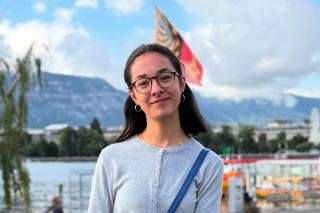
We spoke to undergraduate neuroscience major and physics minor Sonia Vader ’26 about her work in the Focused Ultrasound Lab at Brigham and Women’s Hospital’s (BWH) Radiology Department.
“The brain has always been something I’m interested in. It’s so complex, and yet we know so little,” says Sonia Vader ’26, who will complete her Bachelor of Science in neuroscience and minor in physics at the end of this semester. “Neuroscience sits at the intersection of physics, psychology, computation, and biology. It lets you answer big questions through different disciplines.”
Vader was drawn to study neuroscience at Simmons because of its size and location. “Simmons is near all the hospitals, and the small class sizes allowed me to get support from my professors. I’ve been able to network in Boston and have professional relationships that will get me where I want to go in my career.”
Student-Faculty Research
When she arrived at Simmons, Vader didn’t know about focused ultrasound or the work of Chemistry and Physics Professor Jason White, a trained physicist with over 20 years of research on focused ultrasound. However, she knew she wanted to be involved with faculty research.
“My first year at Simmons, I went to the fourth floor of Lefavour Hall and visited [Department of Chemistry and Physics] professors and asked about their research,” recalls Vader.
Though she wasn’t pursuing physics as a minor at the time, she found Professor White’s research fascinating. As a clinician, White uses MRI-guided focused ultrasound to treat patients with essential tremor [a neurological disorder that causes shaking in hands and feet] and Parkinson’s disease at Brigham and Women’s Hospital (BWH) Departments of Radiology and Neurosurgery. He also works with students in the Focused Ultrasound Lab, using ultrasound as a tool for neurosurgery, neurology, and neuroscience.
Vader worked in the BWH radiology department with Dr. Yoshio Okada, studying how focused ultrasound can use sound waves to safely stimulate the brain. The experiments include developing new ways of measuring and mapping brain signals using electroencephalogram (EEG) and ultrasound, potentially providing new ways of treating and monitoring patients with epilepsy and other neurological conditions.
“We’re using a rat model, targeting axons [cable-like structures in the brain that transmit electrical signals from neurons to other areas of the body] with focused ultrasound to activate neurons with almost no delay. It offers exciting possibilities for non-invasive modulation and treatment of neurological disorders with focused ultrasound.”
Vader’s day involves preparing the animal for the test, conducting the trial, and collecting data. She also assists in analyzing the data. “I look at which neurons are being excited or inhibited,” she says, “for a view of how the brain is responding.”
The Simmons Advantage
Professor White also encouraged Vader to pursue physics as part of her course of study. “I hadn’t taken physics in high school,” Vader recalls. “I ended up enjoying it. It doesn’t come easy for me, but I enjoy the challenge of it.”
The physics minor has afforded more opportunities, including her current position as a lab manager in Dr. White’s Biomedical Lab. “It gave me the opportunity to grow as a leader,” says Vader.
“I wasn’t that confident when I came to Simmons,” Vader reflects. “I was younger than a lot of my classmates. I felt unqualified at first at BWH, but my mentors at Simmons and beyond helped me feel confident and find ownership in these projects. My relationships with professors have helped me explore research, teaching opportunities, service, and interdisciplinary work, which has helped me become a more well-rounded scientist.”
Vader cites networking opportunities on campus that provided room for growth: a STEM networking night in her first year, inviting students to talk to alumnae/i about their career pathways. In her second year, a career fair helped her land an off-campus job. An early interest in pursuing a medical career provided Vader with pre-health advising, which helped her decide whether that was a path she wanted to pursue.
“You can get a lot of opportunities by being curious,” says Vader. “People are really interested in talking about their research. Talking to someone may lead you down the right path.”
Plus, Simmons has a prime location, especially for STEM students. “It’s a small campus in a big city, surrounded by lots of opportunities to connect and network. If you put yourself out there, your professors will help you.”
Future Research Plans
Currently, Vader is applying to labs abroad, hoping to build research skills before getting an advanced degree. Vader’s sister will be living in Geneva next year, and she hopes to join her there. “Zurich and Geneva are leaders in focused ultrasound,” she says.
In advance of a trip to visit family in the area last summer, Vader cold-emailed 50 labs in Switzerland.
“I was able to visit five or six labs and talk to people about their research: medical imaging, focused ultrasound, and the blood-brain barrier. There are a lot of exciting projects I hope to be a part of.”
She’s hoping to continue to conduct research at the intersection of neuroscience and physics, via bioengineering or medical technology.
“I want to research safer and more accessible therapeutic tools that can treat brain disorders,” says Vader. “This work is rewarding to me because it reminds me that science can be an act of service. If what we learn today can help someone move or live more freely, then that keeps me motivated to keep showing up in the lab, even with setbacks.”