
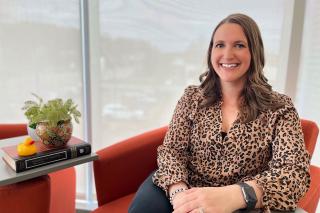
Interview is edited for length and clarity.
What inspired you to go into teaching?
It was a happy accident. I discovered the New England Center for Children (NECC) when they came to my undergraduate college, St. Lawrence University, to give a presentation on career opportunities through NECC. I was studying psychology with a minor in education at the time, so the presentation piqued my interest. I toured NECC and saw they had a partnership with Western New England College to study applied behavior analysis and a partnership with Simmons to study special education — I knew the latter was where I would fit best.
How did traveling abroad impact your higher education?
While I was at NECC and going through the Simmons master’s program, I spent three years doing practical teaching that counted toward my program credits. Later, in a separate experience, once I received my license as a special education teacher, I was a part of a residential team for girls. That was a wonderful experience because I was deeply involved in writing Individualized Education Programs (IEPs) and got to really know the students I was working with every day.
I was able to travel abroad for an opportunity to use what I learned from NECC in London. I was working with a private client there for four years before returning to the United States, where I am now. I found it to be an interesting comparison to my training in Massachusetts. Seeing how special education is taught in other cultures and other schools felt like an unbelievable opportunity.
In London, I actually met my husband. When he returned to the United States with me, he decided to go through the Simmons master’s program, too. His path differed from mine because he received a license in severe special education and is currently in a doctoral program studying kinesiology to support his role as an adaptive physical education teacher. He's been in this role since his last year of the Simmons program.
How did you create a work-life balance?
The Simmons master’s program is unique in that the hours a student spends in the classroom working hands-on with children count toward the needed hours for graduation. This was manageable because I enjoyed what I was doing. The work was hard, but even more rewarding because each day I was learning something new and adding elements to my repertoire, organizing, and connecting with students.
How did you become an adjunct? What do you teach?
It's a funny turn of events that my favorite class when I was a student is the class I teach now. Prior to that class, I knew students had access to the types of programs run at NECC, but I did not really understand why we were running programs with students or how they ended up at NECC, except for the students with challenging or severe behaviors.
That course broke down concepts I was not familiar with yet, like the Individuals with Disabilities Education Act, or what the least restrictive environment (LRE) or free and appropriate education meant in terms of special education.
Gaining that understanding made me a better teacher, and it just so happened that in my correspondence with the program chairperson, Chris Evans, I heard that the former professor who taught that class had retired and the position was open. At that point, I had earned my doctorate and felt like I could be a mentor to others in a class that was so profound in my education.
What is some advice you would give to a student just beginning the education master’s program at Simmons?
This may seem obvious, but follow your syllabus and do your readings. The work you do in a graduate-level program should feel different from high school and undergraduate experiences because, hopefully, you have a deeper interest or passion for the field you are studying.
Each course you take is like adding a tool to your toolbox that makes you more prepared for your career. The work won’t feel monotonous when you are passionate about learning it and about implementing your knowledge in a real-world setting.