
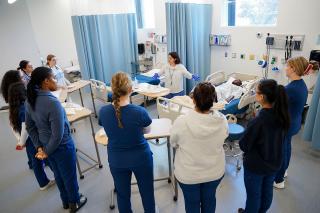
“My philosophy is that everybody has a gift. And one of the things college does is help you to define what your gift is,” says Beverly Byron ’75, who is currently the co-chair of the Montgomery County (Maryland) Department of Health and Human Services’ Child Fatality Review Team, and a longtime nurse educator and legal nurse consultant who double majored in nursing and sociology at Simmons. “Every year that you are in college, you want to learn more about whatever your gift is. And mine was pediatric neurology.”
Byron, who is from the Bronx, heard about Simmons from an aunt. After being offered a scholarship to Simmons, she decided to enroll.
Byron initially came to Simmons in 1970 to become a Spanish teacher, but soon discovered that nursing would provide a more stable livelihood.
Finding a Passion for Pediatric Neurology
The learning opportunities Byron experienced through Simmons’ School of Nursing (SON) introduced her to pediatric neurology, which became her passion.
“I wanted to learn how babies’ brains work,” Byron says. During her clinical experience, her pediatric nursing rotation instructor assigned her to care for a 4-year-old girl suffering from brainstem glioma. “She was dying, and I got to work with her until her transition. I got to work with her family and see what grieving felt like and looked like,” she recalls. “The experience opened my eyes to how the brain works and how it controls so many things. If your brain gets injured, your whole life changes.”
During her last year at Simmons, Byron took a part-time job at a local VA Medical Center, where she nursed Vietnam War veterans, many of whom were paraplegics and quadriplegics. “I got to learn about the brain from a different angle, from an adult angle,” she says.
Simmons’ SON gave Byron a strong foundation through coursework, clinical assignments, and nursing rotations.
Since the Simmons nursing program increased from four to five years while she was a student, Byron decided to take on a second major in sociology. “In my estimation, nursing and sociology are similar,” she explains. “They are two different paths that come together to help your clients and your patients achieve their health goals.”
Following her Simmons education, Byron received a full scholarship to Boston University, where she obtained a master’s degree in nursing, concentrating on neurology within a pediatric clinical specialist track.
Making an Impact in Nursing
After leaving the Boston area, Byron relocated to Baltimore at a world-renowned hospital, where she was offered and accepted a role as an RN pediatric clinical specialist in the Pediatric Emergency Room. This experience was revelatory from a pediatric neurology perspective, as she witnessed children with gunshot wounds to the head, seizure disorders, child abuse, and other traumatic brain injuries.
Byron saw an opportunity to educate the public on pediatric brain injury. From 1979 to 2000, she worked as a program coordinator for the Montgomery County’s Department of Health and Human Services. One of her most impactful accomplishments was creating the Shaken Baby (also known as abusive head trauma) and Family Violence Prevention Program, the first program of its kind. She also wrote about this intervention in an issue of the Nursing Spectrum magazine.
“I taught my program to a Community Health Nurse Leader in every county here in Maryland, and that’s how it spread … I was even on Oprah [Winfrey] one time,” she recalls. “Even today, I am an advocate for safely handling babies’ heads … You’ve got to make sure you [hold] them safely, because so easily a child’s life can change by being shaken.”
Utilizing her Spanish language skills, Byron created bilingual teaching materials on Shaken Baby Syndrome. She also maintained a Spanish-speaking maternity-pediatric caseload in Montgomery County.
“In this sense, Simmons helped me to continue pursuing my original passion for teaching Spanish,” Byron notes. These days, she practices her language skills through a weekly Spanish conversational class for senior citizens.
In addition to her pediatric work for the government, Byron took a position in the US Army Reserves Nurse Corps from 1981 to 2010, rising to the rank of Lieutenant Colonel.
“I was assigned to a field hospital, and we practiced nursing in a tent,” she says. “We were responsible for all those soldiers and all their medications and needs, and making sure that they were hooked up with the right resources to help them.”
Reflecting on the rewards of her profession, Byron says, “it gave me the opportunity to hear people, feel people, be a positive role model in their lives. I tell young women and young men that they can have what they want; they just have to work hard and believe in their gift. As I said, everybody has a gift … You will know what it is, because it will make you feel happy.”
The Simmons Sisterhood
As a young Black woman coming to Simmons in the 1970s, Byron faced unforeseen challenges. “There was a lot of social unrest [in Boston], and I wasn’t used to that. Coming from the Bronx, I did not have those issues with race, anger, and people not being nice to each other.”
Arriving at Simmons in the immediate aftermath of the Ten Demands (a 1969 document demanding racial equity on campus and in the curriculum that members of the Black Student Organization (BSO) presented to then-President William Park), Byron and her classmates exercised their right to free speech by peacefully protesting inequities and speaking with the University president.
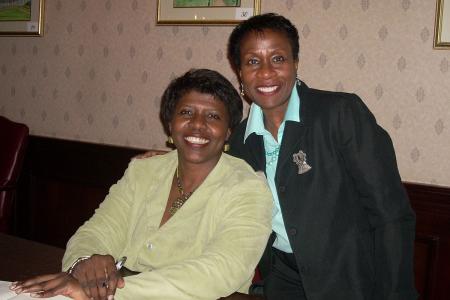
Throughout these challenging times, Byron formed special friendships with Simmons students from different class years. “We had big sisters and little sisters. And [the big sisters] were like mentors who showed us the ropes,” she says. Among this group, Byron befriended Gwen Ifill ’77, ’93HD, who was a “little sister” and a fellow New Yorker.
When Byron became a “big sister,” she took it upon herself to help acclimate new students to Simmons. “For two consecutive years, I found out who was coming to Simmons from the NYC area and invited them to a little get-together at my mother’s condo in the Bronx. I let them know who I was and told them that I was available for questions … I wanted them to know that there was somebody who cared about them and that everything would be ok,” she says.
In recent years, Byron had the opportunity to interact with current Simmons students through the Simmons Black Oral History Project. Spearheaded by Associate Professor of Race, Gender, and Sexuality Studies Professor Tatiana M.F. Cruz, this project enables current Simmons students to interview Black alumnae/i from previous generations. “It was great and a lot of fun,” says Byron on the experience of being interviewed by Sunei Clarke ’24. “I think this is something that will stay in the legacy of Simmons.”
In June 2025, Byron came to campus for her 50th Class of 1975 reunion. “I got to see people that I hadn’t seen in years … I felt that there was a lot of healing that took place,” she says.
Byron remains connected with Simmons by reaching out to local and regional alumnae/i in Maryland as well as Pennsylvania. “I love meeting people from the earlier years, because they have stories, too,” she says.
One of her dear friends is a graduate of Simmons’ School of Library and Information Science (SLIS), whose son and Byron’s son played together on the same baseball team in Columbia, Maryland. “You never know when and where you might bump into a Simmons alumna!” she says.
Words of Wisdom
Regarding advice to Simmons students, Byron suggests that they “create a vision board, when they come into the school as a freshman and update it every year. They also should consider creating an affirmation board that you can see every day you get up … because sometimes we just need that visual input: I am loved, I am appreciated, I am worthy, and I have a gift to share with the world,” she says. “Never give up on your gift.”