
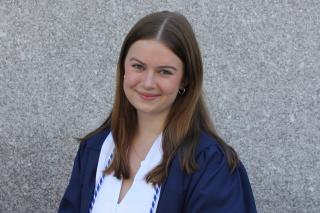
Emma Radlinski ’24 ’26DPT is pursuing the accelerated program in health and exercise science & physical therapy (3+3), which combines a bachelor of science in health and exercise science with a doctor of physical therapy (DPT). Now in the DPT portion of her studies, Radlinski shares what brought her to PT in the first place, and the accelerated degree.
“Anatomy was always a big passion for me,” says Emma Radlinski ’24 ’26DPT, who first linked her interest in the human body with physical therapy (PT) when her sibling visited a therapist. Her reasons for applying to Simmons are similarly close to home.
“My mom is a Simmons alum!” says Radlinski, who keeps a graduation day photo of her mother, Kirsten Anderson ’98MA, beside her laptop. “She suggested I apply, and when I saw the 3+3 program, that really sparked my interest.”
The 3+3 allows students to complete a bachelor of science in health and exercise science and a doctor of physical therapy (DPT) on an accelerated pathway. After applying, Radlinski was moved by the personal touch she received from Simmons.
“I felt like Simmons cared about me more than the bigger schools,” she recalls. “I received a handwritten note and a pair of socks! These are such small things, but they welcome you into a community. That drew me toward Simmons. I liked the small class sizes as well, and the close connections I could form with peers and professors.”
The Path from BS to DPT
Radlinski feels a connection among faculty and peers in her DPT cohort, and those connections began during the undergraduate portion of her studies.
“The exercise science labs are across from the DPT labs in the Lefavour building,” she says. “It offered great continuity; I would peek into the labs sometimes, as an undergraduate.” In addition, exercise science students were often invited to act as “patients” for DPT practical exams. “We could see what the program looked like,” she says.
In the first semester of the DPT program, “Professional Seminar I” (DPT 612) offered integrated clinical experiences. “That’s when you visit a place for four days, dipping your toe into different types of PT,” says Radlinski, who worked at a clinic that offered early intervention therapy for babies, and another at Beth Israel. “Those experiences helped guide my choices for the full-time clinicals.”
In addition, she notes that Simmons has connections with institutions such as Shriners Children’s Boston and Lexington Public Schools, that require students to spend an [integrated clinical experience] there if they want to pursue a future clinical on-site.
“The integrated experience offers you a pathway for your career, and those opportunities are built into the program.”
Radlinski’s interest in working with children was also satisfied by the curriculum, including guest lectures by pediatric physical therapists from Boston Children’s.
The Power of Dissection
One particularly pivotal experience for Radlinski was the hands-on cadaver anatomy training for Simmons DPT students at Harvard Medical School. Since taking “Human Anatomy” (DPT 621), she has gone on to work as a graduate assistant for the course, supporting students, hosting open labs, and creating practical exams for first-year students.
“It was life-changing; it’s hard to put into words,” she says. “These people donated the bodies that took them through their entire lives. We are lucky to have access to full human body dissection.” Radlinski has spoken to students at other institutions where DPT students have access only to prosected cadavers, which have already been dissected by medical students. “We do all the full dissection. Now, I can see in my mind where muscles are beneath the skin.”
She has high praise for Assistant Professor Steve Wechsler and Assistant Professor of Practice Rachel Verrill, the main lab instructors for the course. “They are so good at answering questions and helping us learn more, even if it doesn’t pertain to the curriculum. Rachel will discuss things that interest us, as individuals.”
In addition, she expresses respect for the individuals who donated their bodies for dissection. “At the end, we learn about our patient’s age and occupation, as well as how they died. It really signifies that this was a real person, and the sacrifice they made for our learning and our careers in the medical field.”
Top-Choice Clinical Rotations
Thanks to the in-depth learning opportunities, Radlinski felt “totally prepared” for her clinical rotations. Before rotations, students were required to do a full patient evaluation, usually with an undergraduate student or peer playing the role of the patient. “It was hard work, but valuable to experience that while surrounded by peers and a lot of support.”
Now in her final year of the DPT program, Radlinski is in her third clinical rotation: this one, at Brigham & Women’s Hospital, will end in March.
Thanks to the diligent work of Assistant Professor of Practice and Director of DPT Clinical Education Jillian Kulinski and Assistant Professor of Practice and Assistant Director of DPT Clinical Education Matthew O'Rourke, “everyone in my cohort got one of their top three choices [for terminal clinical rotations],” noted Radlinski. “That is incredible. Not everyone gets that opportunity, especially at bigger schools.”
Radlinski’s first two clinicals were special requests; places that didn’t have pre-established connections with Simmons. “Jillian reached out and made that connection,” she says, noting she was not the only student in her cohort to have a special request fulfilled.
In addition, the network of Simmons alumnae/i across the country creates further opportunities for students.
“A lot of Simmons alumnae/i [in the field] love to work with Simmons students!” notes Radlinski. “Professors know people who can provide students with the best possible clinical experience.”
A DPT student’s first full-time clinical experience takes place at an outpatient orthopedic facility. Radlinski received her requested placement at Cape Cod Orthopaedics, in Hyannis, Massachusetts, where she was able to live with a friend for the summer. “It was an amazing learning experience,” she says.
Her second clinical was at PEAK Pediatric Therapy in Braintree, Massachusetts, which offers weeklong opportunities for children in need of intensive, daily therapy using different modalities. This clinic is specifically pediatric: the youngest patient was 5 weeks old, the oldest around 11 years, depending on their diagnosis.
“I loved going to PEAK and being with the kids all day. It was great to see the change we were able to make in these kids’ lives, and to have participation from family members. We saw kids crawl for the first time!” Radlinski’s clinical instructor at PEAK, who specializes in dynamic movement intervention, was also a graduate of the 3+3 program at Simmons.
Faculty Mentorship in DPT Program
Professor Verrill offered invaluable support to Radlinski, since teaching the Anatomy course the first semester of the DPT program.
“Her passion for teaching us about the human body radiates off of her. I’ve been so fortunate to learn from that.” Radlinski was also Verrill’s graduate assistant.
“Simmons faculty have an expectation for us to be professional, but they want to work alongside us, like colleagues. They want to teach us and learn from us. That is really special. I can always go to their offices and ask questions about life, classes, anything.”
Associate Professor of Practice Jenna Stuebe Powers, who continues her practice as a clinical specialist in Brigham & Women’s Hospital’s Cardiovascular & Pulmonary PT Residency Program, was a great resource before Radlinski’s clinical experience.
“I talked with her endlessly about it! Simmons faculty are really invested in your learning and understanding,” says Radlinski. “Simmons is a place where you can lean on your peers and faculty when you feel unsure. There were many times when I doubted myself, and I was lifted up.”
Radlinski’s Advice for Prospective PT Students
- “Students shouldn’t be afraid to ask for help, or to make mistakes. Mistakes are how you learn, and they do not make you less of a clinician.”
- “Be curious and ask questions! Ask if things don’t make sense — that’s important, especially through such a long program.”
- “Self-care is so important. I tell people to set a boundary with their computer. In my dorm room, the computer never sat on my bed, and it was put to bed at 9 or 10pm. I could never do an all-nighter! The brain needs time to recuperate while we are sleeping if we want to learn. Especially the night before an exam, you need a good night’s sleep.”