
For Dix Scholar and biology major Ann Paim ’26, a health scare sparked a new career path.
“I had a career that I loved in product design, but then I was diagnosed with Parkinson’s Disease (PD) at 42 and retired. I hated being retired, and I thought that I could do something new. Researching my own health sparked and renewed my interest in science,” she says.
While being an adult learner poses some challenges, Paim has found friendship with classmates who are the same age as her children. “I feel that more people my age should go back to school,” she adds. “It’s so exciting to have something to look forward to and new challenges ahead. That’s the best part of it for me.”
Choosing Simmons
Initially, Paim was drawn to Simmons for practical reasons. She sought a school that would accept her 96 credits from community college and her earlier undergraduate studies. She also liked the fact that Simmons is located in the Longwood Medical Area, conveniently close to many research hospitals.
Simmons also made financial sense to Paim. As this is her second bachelor’s degree (she already received a bachelor of fine arts in product design from Rhode Island School of Design), she was not eligible for free college programs offered by the state of Massachusetts. Simmons Dix Scholars program, however, offers a different pricing structure and several scholarships.
Next, Paim researched Simmons faculty. “That is when I found Associate Professor of Biology Eric Luth and his lab, where he and his students work on Parkinson’s Disease and other neurological questions,” she says. “It’s not typical to find [a professor] working on Parkinson’s research in an undergraduate setting. It’s actually very special. At that moment, I felt the planets align. I reached out to Dr. Luth, and the rest is history.”
The summer before Paim officially started at Simmons, Luth invited her to join his research lab. “Professor Luth is an incredibly generous educator,” she says.
Finally, Paim felt drawn to the women-centered atmosphere at Simmons.
“Initially, I was a bit neutral at the idea of a women’s school,” she says. “But in my process of researching the mission and history of Simmons, and specifically how John Simmons envisioned a school where women could earn an independent livelihood … now I really do see the value of a nurturing, women-centered school.”
STEM Research at Simmons
In her studies in biology, Paim is excited about her year-long capstone project: “I want to be doing research,” she says. “Simmons’ biology program aligns well with what I want to do, plus I can work towards an honors thesis.”
The most significant research Paim has conducted at Simmons revolves around Parkinson’s Disease. As she explains, “an umbrella area of research focus in the Luth Lab is centered around spastin inhibition in PD models. According to prior work in the Luth and partner labs, spastin inhibition has been shown to reduce the toxic accumulation of alpha synuclein (S) and improve neuron survival in PD cell and animal models.”
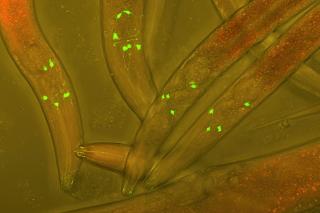
In Luth’s lab, Paim uses C. elegans, or microscopic worms, which can be mutated to develop PD-like pathology. “Spastin is a protein involved with lipid droplet logistics. In PD, these lipid droplets get tangled up with S, a protein normally involved with dopamine storage and release,” she says. “I put these worms through behavioral tests to see if the neurons are functional. So, if they behave the way a normal worm should, then it’s likely that the function of the cells has been restored,” she adds.
“My specific research question is to determine if these rescued neurons are functional and if spastin inhibition extends the therapeutic effect of standard-of-care L-dopa in advanced disease. My research question and my interest in PD research are more generally influenced by the fact that I have this disease,” Paim says. “This research has the potential to improve the lives of people who are living with PD, which is ideal.”
Paim appreciates the many opportunities for STEM research that Simmons offers. “I think it is incredible. I’ve seen first-year students included in lab meetings and invited to participate in research in labs,” she says, and also notes that Dr. Luth has a “buddy system” where more advanced students take newer students under their wing. “It’s kind of introducing the next group of people to the lab so that they get comfortable with procedures, and I think it’s a really good system.”
For Paim, studying STEM at Simmons is “wonderful. It’s a welcoming, encouraging, rigorous, and supportive environment.”
Faculty Support
Thus far, Paim’s favorite Simmons course is “Animal Physiology” (BIOL 222), taught by Luth.
“I never worked harder or gained more directly applicable knowledge towards my area of research interest,” she says. “In this course, you really learn how systems work across species and how they integrate at the mechanistic level.
“Professor Luth is a really great instructor,” she adds. “In his courses, he teaches these complicated concepts, but then right away he has you working with them with class activities … not only that, but he’s really there to help you succeed.”
Moreover, Luth is helping Paim to prepare for her life beyond Simmons. She hopes to work as a research assistant for a few years and, eventually, pursue a doctoral program in neuroscience. “Professor Luth has helped me look into some programs and other research opportunities,” she says. “Simmons is helping me prepare for my career.”
Finding Fulfillment in the Laboratory
Paim finds laboratory work enjoyable and gratifying. “Working in the lab requires attention to detail, careful record keeping, designing an experiment, and lots of patience and resilience because success is hard won,” she says. “I also see many parallels to what I used to do [in product design]. There is a lot of creativity involved in experimental design and the process is all about trouble-shooting and problem-solving.”
“For me, what I do in the lab could directly affect my life, so that’s also a big part of what makes my work fulfilling,” she says. “I love [scientific research], and I am proud of what I’ve done so far … I want to improve the lives of those diagnosed with PD, and Simmons is helping me get there.”