
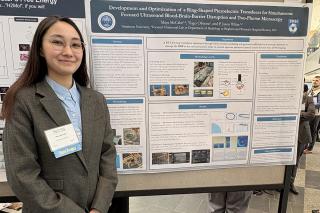
Maya McCabe ’27 is a biochemistry major and physics minor in the dual degree (3+2) engineering program. We spoke with McCabe about her research funded by the Focused Ultrasound Foundation and the hands-on STEM training she is receiving at Simmons.
“I am so fascinated that our brain — which is made out of water and fat and lipids — is capable of producing all of our scientific discovery and art,” says Maya McCabe ’27, a biochemistry major and physics minor in the dual degree (3+2) engineering program.
As a trained classical violinist, McCabe experienced how beneficial music is for the brain, but at the same time witnessed young musicians developing chronic nerve-related injuries from playing musical instruments. These observations sparked an interest in studying science and medicine.
McCabe is a recipient of the Dan and Lou Jordan Focused Ultrasound Internship Program, which is funded by the Focused Ultrasound Foundation. Through this opportunity, she receives a scholarship and a certification in focused ultrasound.
Currently, McCabe is a research assistant at the Biomedical Ultrasound Lab at Simmons and at the Focused Ultrasound Lab at Brigham and Women’s Hospital.
In every Focused Ultrasound Internship cohort, the Foundation's internal scientific review board selects three students with the most impressive research projects. McCabe was one of the 2025 awardees from 26 global interns across five countries: Canada, England, Italy, South Korea, and the USA.
McCabe has also been named a Clare Boothe Luce Scholar. Funded by the Henry Luce Foundation, these scholarships support the success and retention of women in STEM fields. Associate Teaching Professor of Chemistry Shreya Bhattacharyya holds the Clare Boothe Luce Professorship and mentors students in the program. “As a women-centered institution, Simmons is uniquely positioned to help students thrive and lead in a wide variety of STEMM [science, technology, engineering, math, and medicine] careers,” Bhattacharyya says.
Researching Ultrasound and the Blood-Brain Barrier
One of the reasons why McCabe is drawn to ultrasound technology is the effects it has on the blood-brain barrier (BBB). “This is an issue in the pharmaceutical industry and in health,” she says. “The blood-brain barrier is basically a semipermeable wall that protects your brain from harmful substances. However, this creates a problem in the drug industry, because if you want to administer a drug to a patient with a neurodegenerative disease or cancer, for example, the drug will not be able to reach the brain because of the blood-brain barrier.”
From her Foundation certification and studies in the Biomedical Ultrasound Lab led by Professor of Chemistry and Physics Jason White, McCabe has learned the benefits of ultrasound technology for people with serious health conditions.
“I watched videos and had the opportunity to see a real-life neurosurgery of a patient with severe Parkinson’s Disease having their tremors be temporarily dissipated from the focused ultrasound,” she says. “Many of the videos showed patients with severe tremors … but after a few months of focused ultrasound … they can actually eat and pick up a glass of water without spilling it.”
In her current research project funded by the Foundation, McCabe is building a focused ultrasound transducer that is capable of temporarily opening the BBB. “The fact that ultrasound can be used to address the blood-brain barrier is very exciting,” McCabe says. She is grateful to the Foundation and Simmons’ Department of Chemistry and Physics for their funding and resources.
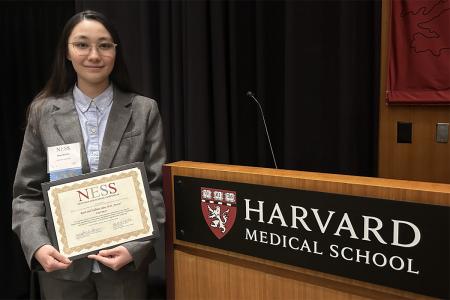
Beyond the lab, McCabe presented her research for the first time in the form of a poster presentation at the New England Science Symposium, which was held at Harvard Medical School in March. Her presentation was entitled “Development and Optimization of a Ring-Shaped Piezoelectric Transducer for Simultaneous Focused Ultrasound Blood-Brain-Barrier Disruption and Two-Photon Microscopy.”
McCabe was awarded the Ruth and William Silen M.D. Award, winning the first prize in the category of biostatistics, physics, chemistry, and engineering
An Accelerated STEM Pathway
Growing up in Massachusetts, McCabe was aware of Simmons. One of the reasons she decided to attend was the dual degree (3+2) engineering program. This program allows undergraduates to obtain an accelerated bachelor’s degree in a STEM discipline at Simmons, followed by a second accelerated bachelor’s degree in engineering at one of the partner institutions.
“I heard from many engineering majors that it’s difficult to satisfy the premed requisites. By majoring in biochemistry at Simmons, I will be able to complete my premed requirements while also being able to study engineering,” McCabe explains. “I am still not entirely sure if I will go to medical school, but this program has allowed me the time and the flexibility to make a proper decision.”
McCabe believes that the dual degree program will give her a solid foundation for a career in biomedical engineering.
“I discovered that if I have an engineering degree, and I decide to go to medical school, I can not only use this [biomedical] technology on patients, but I can also develop it at the same time,” she says. “I aspire to go into biomedical engineering because I would be able to directly impact the work I do on patients.”
Coursework and Mentorship
For McCabe, Simmons' coursework has provided her with the necessary context to perform her research.
Some of her favorite Simmons classes include “Differential Equations” (MATH 225), taught by faculty member Kyung Soo Yang, and “Multivariable Calculus” (MATH 220), taught by Professor Donna Beers.
“In my research, I have to do a lot of simulations and mathematical modeling,” says McCabe. “These courses gave me the context I needed. I couldn’t imagine doing this internship [in the lab] without having a strong mathematics background.”
Furthermore, McCabe appreciated “Introduction to Computer Science” (CS 112), taught by Professor Nanette Veilleux of the Department of Computer, Data, and Mathematical Sciences. “In this class, we used Python, which prepared me to graph and analyze data,” she says.
Beyond Simmons, McCabe took an 11-day “Introduction to Electrical Engineering” course at Washington University in St. Louis. “We learned about electrical circuits, which is so helpful because I am developing a device that requires a lot of circuit theory,” she says.
White has advised and mentored McCabe throughout her time at Simmons. “I am truly grateful for Professor White, and through him I was able to perform hands-on biomedical engineering research … This has opened so many doors for me in biomedical engineering,” she says.
Making a Vital Contribution
Reflecting on her career aspirations, McCabe would like to use her computational and building skills to develop medical devices and other new pathways in biology.
“Doing biomedical engineering research is rewarding because it gives people hope. Especially with what’s happening right now, with many institutions losing funding, this research is such a crucial contribution to humanity,” she says. “You are contributing information that will be used to directly impact patients’ lives.”
“The focused ultrasound systems I see being developed right now weren’t just made by one person — they were made by thousands of researchers who committed to years and decades [of work],” McCabe notes. “It is so gratifying to see a patient finally be able to live again, because of a device, program, or software that we developed.”