Ask Simmons

Why Study STEM at a Women's College?

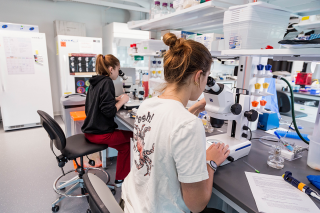
Two Simmons students using microscopes in the Biology lab

If you’re interested in STEM and want to study in a place where you feel acknowledged and supported, enrolling in a women’s college is a smart option. Research shows that women’s colleges are particularly well equipped to help you thrive in STEM fields and realize your leadership potential.

STEM stands for Science, Technology, Engineering, and Mathematics. STEM careers are often grouped into two areas: “applied” sciences, such as computer science and engineering, and “pure” sciences, such as biology, chemistry, and physics. Choosing STEM means entering fields that advance science and innovation and solve global problems — areas known for high-paying, in-demand jobs.


Women remain underrepresented in STEM

<28%

of the STEM workforce

US women make up less than 28% of the STEM workforce.

Read the NSF report

* reported in 2024 by the National Science Foundation

<20%

in leadership roles

For women in STEM, less than 20% are in leadership roles.

* reported in 2024 by the National Science Foundation

<15%

in life sciences executive positions

Less than 15% of women in STEM are in life sciences executive positions.

* reported in 2024 by the National Science Foundation

Why women aren’t pursuing STEM majors

One reason young women may drop STEM majors is a feeling of not belonging in classrooms and labs. They might face bias or the pressure to disprove assumptions about who is naturally suited for science and math. These experiences can affect confidence and persistence, even if they perform as well as, or even better than, their peers.

Grades alone don’t explain who completes their bachelor's or master's degree in a STEM field. Research examining 10 years of data from a large public university shows that women who left STEM often had higher grades than the men who stayed. This suggests that retention is more than purely an academic matter. 

Benefits of a STEM education at a women-centered college

To retain women in the sciences, technology, engineering, and math, recognition and support go a long way. Faculty, peers, mentorship programs, and institutional culture plays a powerful role in women’s success in STEM. 

Women’s colleges offer this support more consistently, especially in STEM programs. Because women aren’t competing for attention in male-dominated groups, they are more likely to:

  • Lead lab teams
  • Present findings from research projects
  • Participate in internships and fellowships.
  • Hold STEM leadership roles early in college.

Study STEM at Simmons University, a women-centered college in Boston

Simmons University in Boston, Massachusetts, is a leader in supporting women (inclusive of students who identify as women or nonbinary) in STEM. We offer 20+ bachelor's degrees and tracks in areas including biochemistry, biology, neuroscience, computer science, data science and AI, and pre-engineering — as well accelerated and advanced degrees to fast-track your career success.

At Simmons, your journey to prepare for a career as a scientist, researcher, or inventor begins immediately. From year one, you’ll learn with expert faculty and mentors who know your name and welcome you into the discovery process.

  • You’ll take STEM classes with no more than 16 students, giving you access to faculty mentors and chances to work with your peers.
  • You’ll conduct research in faculty-student groups, with opportunities in biomedical ultrasound, microscopy, spectroscopy, and advanced tissue culture labs.
  • You’ll belong to a community where women choose STEM majors more often than at many coed schools. This builds a strong network of peers and faculty. It also connects you with alumnae/i role models who can connect you with real-world experience.

The encouraging atmosphere helps you grow, and prepares you to join other women in STEM fields making a difference in science.

Learn more about STEM at Simmons

What Simmons Students Say


Reagan Cleversey ’26

Almost every semester I took research courses (CHEM 150 or 250), which can be done for credit or not for credit. It’s amazing to be able to work in a lab under the supervision of one of our STEM professors.

- Reagan Cleversey ’26, Biochemistry major

Meet Reagan
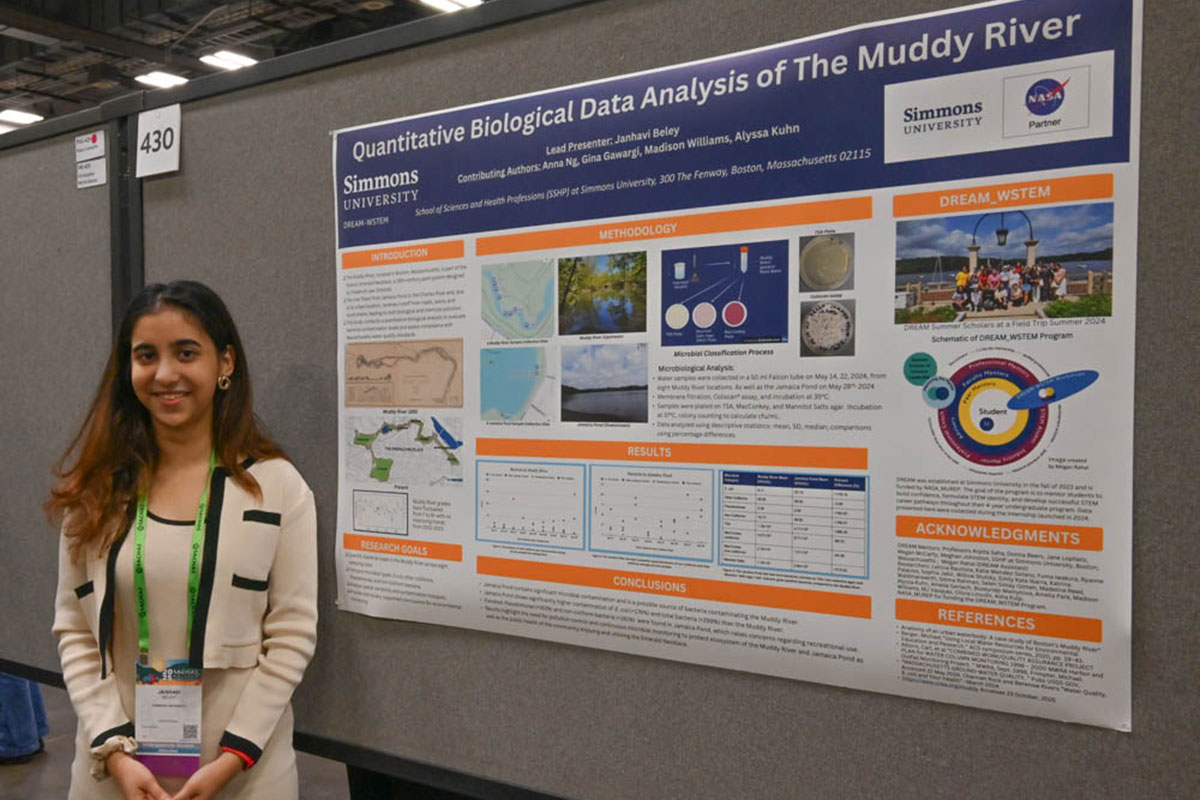
Janhavi Beley ’27 with her poster from the Society for Advancement of Chicanos/Hispanics & Native Americans in Science (SACNAS) National Diversity in STEM conference

Data Science is a very unique field. And it can pair well with other fields. It plays a pivotal role in solving complex questions … It can be used for public health, social aspects, and many other things. I am really excited about pursuing a career in the field of data science.

- Janhavi Beley ’27

Meet Janhavi
Ann Paim ’26

Studying STEM at Simmons is wonderful. It’s a welcoming, encouraging, rigorous, and supportive environment.

- Ann Paim ’26

Meet Ann
Jenn Leishman ’26

The most important thing that Simmons has done to prepare me for becoming a library professional is providing me with a computer science background and the technological skills that I would not have gained without the 3+1 program.

- Jenn Leishman ’26

Meet Jenn
Emma Radlinski

Simmons faculty have an expectation for us to be professional, but they want to work alongside us, like colleagues. They want to teach us and learn from us. That is really special. I can always go to their offices and ask questions about life, classes, anything.

- Emma Radlinski ’24 ’26DPT

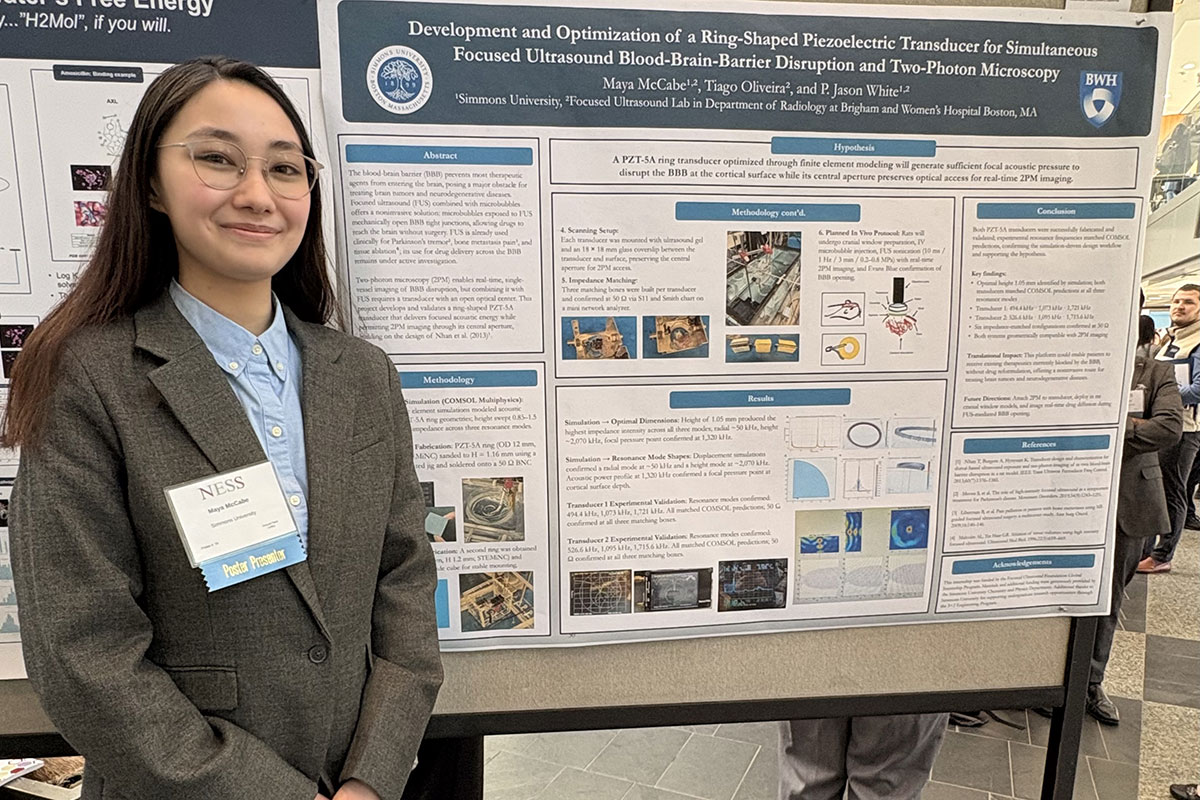
Maya McCabe '27 presents research at the New England Science Symposium, held at Harvard Medical School.

I heard from many engineering majors that it’s difficult to satisfy the premed requisites. By majoring in biochemistry at Simmons, I will be able to complete my premed requirements while also being able to study engineering.

- Maya McCabe ’27

Meet Maya
Annabelle Hannah ’25 seated by a waterfall

Simmons is a smaller institution and women-centered, while STEM fields are mostly male-dominated and offer fewer resources to women. At Simmons, we have those resources.

- Annabelle Hannah ’25, Chemistry and Physics double major

Meet Annabelle

Publish Date

Author

Laura Pedulli