
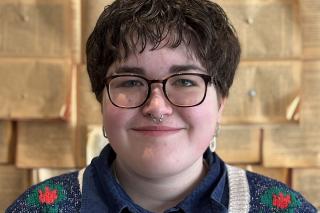
What are the most impactful things you have done over the last three years?
Spending these past three years in Boston has absolutely changed my life. At Simmons itself, the past two years working as a campus ambassador in the undergraduate admissions office have shaped my relationship with this school and our campus. By learning how to interact with future Simmons students, I have come to better understand my own love for this school. I am honored to chat with high schoolers about my own experience, because I want them to feel as comfortable somewhere as I do here at Simmons.
Off campus, I have found fulfillment in volunteer work with the Prison Book Program in Quincy, Massachusetts. Twice a month, I ride the red line to Quincy Center and spend an evening reading letters from incarcerated people around the country, choosing books for them, writing to them, and learning more about prison abolition. Forming local community in volunteer work and making a direct impact on people’s lives continue to be an important part of my routine.
What is your major(s) and why did you choose this field of study?
I am a computer science major in the computer science + library and information science 3+1 program. I always thought I wanted to major in history or classics, and I am able to fulfill that love through my history minor at Simmons. However, when I discovered library science and archives as a career path, I knew the multidisciplinary field was for me.
Computer science is a major that I never would have thought to pursue, but the unique accelerated program has prepared me for a field that relies on modern technology and a comprehensive understanding of systems. The accelerated program also has been of great financial benefit, and allowed me to already be in my second class toward my master’s degree before I even have my bachelor’s completed.
With my master’s degree, I plan to concentrate in archives management, and hope to apply my undergraduate education in digital preservation work. I feel most connected to myself through the history of others, and I want to preserve that history by working in archives.
Did your course of study entail any internships?
Yes! Last summer, I interned in the archives of the West End Museum in Boston. The West End is a neighborhood in Boston that was destroyed by 1950s urban renewal projects, and its history is preserved in this small museum. Under archivist and curator Bob Potenza, I completed an extensive photograph digitization project, scanning a collection donated by a long-time museum volunteer and previous resident of the West End neighborhood.
I loved interacting with a collection, handling materials, working with metadata, and learning organization and digitization processes. The most special part of this was discussing the photographs with the donor himself, learning about his family and his history.
I also read “memory letters” sent to the West Ender publication and chose specific letters to digitize and highlight for future exhibitions. This challenged me to think about what pieces would be of most interest and educational benefit to a wide audience, and I also learned more about the neighborhood’s geography, people, and history through this process.
What was your favorite Simmons course and why?
I think my answer to this question could change every time you ask me. One of my favorite courses is “Introduction to Public History” (HIST 253), taught by Associate Professor Steve Berry. This course focused on how history is displayed to the public, through museums, archives, digital assets, et cetera.
I had never deeply considered curation as a subfield I could be interested in, and this class opened my eyes to new areas of museum work. We also took several field trips that enhanced the coursework. One of my favorites was to two graveyards in downtown Boston: King’s Chapel Burying Ground and Granary Burying Ground. On this trip, we discussed what we can learn from iconography on gravestones, and I had a lot of fun considering aspects of historical evidence I had never thought of before.
How has Simmons prepared you for your career path or intended profession?
The most important thing that Simmons has done to prepare me for becoming a library professional is providing me with a computer science background and the technological skills that I would not have gained without the 3+1 program.
The Simmons curriculum has also allowed me to explore many areas of interest, giving me the freedom to double minor in history and data science, and take classes purely for my own knowledge. Every class I have taken during my time at Simmons has informed my worldview and my understanding of my field, including a poetry workshop, a political science class, and a machine learning class. When I am in these classes, I am thinking about how I can apply what I learn to my future, and that’s what I take away.
How has Simmons taught you to be a leader?
As part of the PLAN (Purpose Leadership ActioN) curriculum, I had to take a leadership class my freshman year. Along with many of my classmates, I was resistant to it: I had no desire to lead … But thanks to that class, I am now able to look back two years later at my first-year reflections of my leadership identity, and understand just how much growth I’ve undergone.
One major step to becoming more a leader in my everyday life is gaining self-worth that I have not always had. The activities and classes I’ve undertaken at Simmons have given me the confidence to trust myself and my instincts. One way I see my leadership in action is in my role as writing editor for Simmons Sidelines, our art and literary magazine. I am able to help lead editorial discussions and contribute to a creative team, which has been a tangible marker of my growth over my time at Simmons.
What is your favorite Simmons memory?
I worked in the Office of Undergraduate Admissions during summer 2025, and this entailed giving tours for Simmons alumnae/i during the June 2025 reunion. Many of the attendees had graduated in the 1960s and 1970s, and some stayed in dorms on our residential campus. While giving tours to groups of alums, I learned pieces of Simmons history that I had never before heard, such as a previous twin staircase in the Main College Building, “nap” rooms on campus where students would sleep between classes, certain days of the month were men were allowed in dorms, and stories about Simmons traditions that I participate in now, like May Day. One of my friends and I also attended an informal dance in Alumnae/i Hall, where Simmons alumnae/i from all generations danced to a 1950s cover band.
Working at events of this reunion was very emotional for me, knowing that neither my friends nor I will get to have a reunion on our residence campus, as it is getting leased out very soon. I’m so thankful for Simmons alumnae/i for sharing their stories with me, and that I get to attend a school with such a rich history. The alumnae/i I met, even those who graduated 50 years prior, had similar college experiences to my friends and me in many ways, and it was beautiful to learn that.
What advice do you have for current and incoming Simmons students?
Do you have an interest in starting a radio show? Sign up! Is there an art or writing class you want to take but are scared you won’t do well? Do it anyway! Is there a project idea you have but you aren’t sure how to pursue it? Reach out to a professor! Do you see somebody around campus that you think looks really cool? Start talking to them!
This is advice I wish I took way sooner during my time at Simmons. I’m so thankful for all of the people in my life who have helped me grow and encouraged me to take larger steps into doing what I love.