
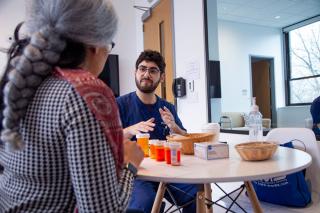
The Carlotta Simulation is an interprofessional simulation lab established by Simmons School of Nursing faculty. It has become an invaluable experience for students of nursing, physical therapy, and nutrition. This year, School of Social Work students have also been invited to participate. We spoke with faculty across Simmons who see the Carlotta Simulation as a prime example of Simmons’ commitment to interprofessional education (IPE).
Jenna Stuebe Powers is an associate professor of practice in the Department of Physical Therapy. For the past few years, she has also been in charge of coordinating the Carlotta Simulation, a unique on-site simulation lab that invites students and faculty from diverse disciplines — physical therapy, nursing, nutrition, and social work — to engage in a simulation and learn from each other’s work.
Students in “Health Care System: Interdisciplinary Perspectives” (IPE 450, RNBSN 250) meet (in-person and virtually, as needed) with a patient named Carlotta, in the home health suite in the Nursing Simulation Center.
Brenda Quach ’25MSN, a graduate of the direct entry Master of Science in Nursing and post-graduate certificate Family Nurse Practitioner (MSN/PGC FNP) program, found the simulation particularly impactful.
“A small group of students meets in the Simulation Lab with an actor named Carlotta, who has been newly diagnosed with diabetes,” Quach describes. “She has returned home after being hospitalized for a heart attack, and students from different programs practice their disciplines on Carlotta and learn from each other.”
While the Simulation Lab is often noted for its high-fidelity rooms, including an obstetrician/gynecologist office, pediatric office, surgical suite, Intensive Care Unit, and Emergency Room, the home health suite is unique: the lab looks like an apartment, with many of the comforts and potential hazards a real dwelling may entail.
The role of Carlotta is generally played by students who have previously participated in the simulation, and have received special training to prepare for up to 16 simulations over the course of the semester. Students are presented with Carlotta’s case in advance of their meeting on site.
“They receive discharge documents from the hospital,” says Powers, who notes that there are medical and social components of Carlotta’s care that students must navigate. “Her primary language is Spanish, she’s from Puerto Rico, and she lives by herself. There are cultural pieces, too, like the type of food she prefers. There are a lot of layers in this case.”
Learning How to Collaborate in a Healthcare Team
Each simulation invites up to three students and one faculty member from each discipline. After meeting with their faculty members to discuss their plan, each discipline visits the apartment for 15 minutes while the other groups observe.
“It’s an abbreviated assessment, compared to real life,” notes Powers, “but they are able to present their findings and red flags.”
One common takeaway that Powers hears students voice is that all the disciplines focus on similar things, but the approach is different. Exploring scopes of practice, including areas of overlap, is an integral part of the simulation.
“We have this power to reinforce each other, as long as we communicate,” Powers notes. “In home health care, a lot of things can fall through the cracks, so communication is especially important. Working together on one patient case offers a chance to problem-solve the patient’s needs and work together, with real-time discovery of who we need to go to to help this patient, and to understand the boundaries of their professions.”
For example, a physical therapy student may see that the patient has social challenges, and will need to contact a social worker to access resources, or else the patient is unlikely to reach their PT goals.
"Although the foundation of nursing is holistic in care, for the purpose of this simulation, nursing was focused on medication education, specifically teaching Carlotta how and when to take her insulin," noted Quach. “Nutrition students focused on her diet, and physical therapy students assessed her environment for fall risks. They were attentive to certain things that I wouldn’t have thought about, and all of it is important for a patient with a new chronic condition.”
Understanding what each discipline brings to the table is valuable for on-site clinical experiences. “It’s valuable to employers to see that a new graduate has training in this area and knows how to operate in interprofessional groups,” says Powers. “It’s particularly valuable in healthcare, where they constantly have to optimize patient outcomes by working with others.”
Studying Clinical Experiences through Observation
This year, students and faculty from the School of Social Work (SSW), including Assistant Professor Noelle Dimitri and MSW students in her Social Work Practice in Healthcare (SW478) course, participated in the simulation via Zoom.
These visits, says Associate Professor Kathrina Prelack (Department of Nutrition), “enlighten students to the role social work can play. Besides obtaining resources, students see how the social work students provide emotional and psychological support, often conversing with Carlotta about issues such as loneliness, feeling like a burden, and the loss of her husband. These all impact her ability to get well.”
After meeting with each group of students in turn, Carlotta joins the final meeting with faculty. “Incorporating the patient within the simulation allows students in each discipline to discuss her needs and challenges, while also helping her understand her plan of care,” says Powers. “At the end of the 2.5-hour session, there is a debrief to discuss what they learned, receive feedback from one another, faculty, as well as Carlotta herself.”
For Powers, taking learning out of the classroom is pivotal at this point in a student’s education. “It’s not a passive experience. It’s very active, and I think that’s why it’s so well remembered — these concepts are getting seeded in their brain as they interact with the patient and with other students.”
It’s excellent training in addition to clinical experiences.
“The academic stakes aren’t high,” says Powers. “We want you to be accurate, but you’re not being graded on how to teach Carlotta to do her insulin scale. This is your opportunity to show everyone else what you do and how you do it.”
This approach, she feels, allows students to enjoy the process and focus on the right things, instead of their grade.
“This is preparation for clinicals, where you will have team meetings and share your findings. That communication can be challenging for new professionals: to have the humility and confidence to share their findings takes practice. This early exposure rooted in the curriculum is really helpful to students.”
The High Value of Interprofessional Education
Associate Professor Patricia Rissmiller (School of Nursing) notes that “Students have commented that this has been one of their most valuable learning experiences during the nursing program.” Prelack and Powers see the Carlotta Simulation as the hidden gem of the Interprofessional Education (IPE) program at Simmons.
Powers notes that “this type of interprofessional programming has long been a part of Simmons history, and in the health profession.”
In the future, she hopes that School of Management students will be involved to offer perspectives on the healthcare industry, emergency preparedness, and managing larger teams and organizations.