
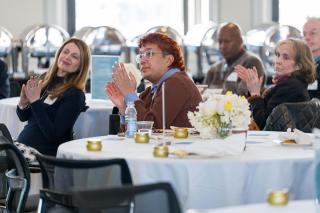
The Colleges of the Fenway (COF) recently celebrated the 28th Annual Martin Luther King Jr. Breakfast at Simmons University. City of Boston Chief of Economic Opportunity and Inclusion Segun Idowu served as this year’s keynote speaker.
Members of the community gathered in person and online on January 27 for the 28th Annual Martin Luther King Jr. Breakfast. Hosted by the Colleges of the Fenway (COF), this year’s breakfast took place on the Simmons University campus and featured musical performances, introductory remarks by local leaders, an award ceremony, and a keynote address by Chief of Economic Opportunity and Inclusion Segun Idowu.
Service as Justice
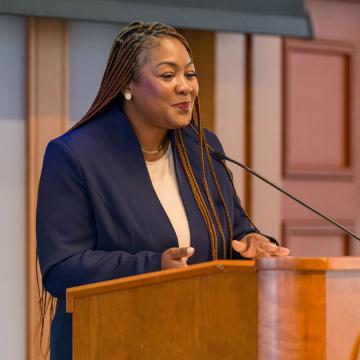
Following a filmed performance of the youth choir from the Hamilton-Garrett Center for Music and Arts, Dr. Rachel Deleveaux, assistant vice president of diversity, strategy, and engagement at Simmons, offered welcoming remarks on the theme of this year’s event, “Service as a Pathway to Justice.”
“This is a call to view community service not just as a one-time act of charity, but as a sustained tribute to the teachings and values of Reverend Dr. Martin Luther King Jr.,” she explained. “Service is the bridge between the world as it is, and the world as it should be.”
In the current sociopolitical moment, Deleveaux emphasized that “this is precisely the moment when service matters most.” Today, service demands vocal advocacy and willful disruption, and, she added, “justice isn’t just a dream, but a lived experience for everyone in our city.”
Education as Service
Simmons President Dr. Lynn Perry Wooten reflected on the relationship between higher education, civic engagement, leadership, and service.
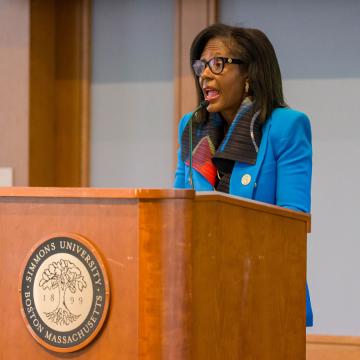
“Across the Colleges of the Fenway, service and learning are inseparable. Whether through learning communities, research, clinical placements, volunteering, or advocacy, our students are encouraged not only to ask what they can achieve, but how they can contribute to making the world a better place,” she said.
Wooten quoted a 1968 sermon by Dr. King entitled “The Drum Major Instinct,” in which King recognized the human desire to achieve greatness. “But Dr. King challenged us to define greatness not as the power over others, but as service to others,” Wooten noted.
Wooten also referenced Coretta Scott King’s 1972 Simmons commencement address, when she challenged Simmons students to think critically, question unjust systems, and resist complacency.
Emphasizing the importance of everyday leadership, or, in Wooten’s words, “the ability to use one’s strengths and passions to drive meaningful change,” she noted that “everyday leadership … often shows up through service, teaching, advocating, and the act of showing up for others.”
Challenging the Status Quo
In her remarks, Claire Ramsbottom, COF executive director, addressed the importance of gathering and togetherness in practicing service and achieving justice.
“We come together to reinforce the commitment to the ideals that Martin Luther King Jr. stood for and died for, to know that we are a community together, and to explore how we can effect change by working together,” she said.
Ramsbottom provided a personal anecdote of visiting the National Civil Rights Museum in Memphis, Tennessee (installed at the site of Dr. King’s assassination).
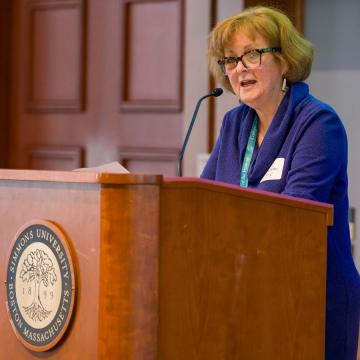
“Walking through that museum, which is a testament to the cost and power of protest [and] to the principle that civil rights are inalienable rights for all, I could not help but be moved by the conviction and risks that those people took in order to challenge [those in power],” she expressed.
Throughout her address, Ramsbottom quoted Dr. King on the necessity of continued protest, collective action, and service to others.
“That is the call to all of us,” she concluded, “to live a committed life, to do what we can to effect change through our service in whatever form it takes, to reject the narrative of rugged individualism, and to embrace the reality that we are all interconnected.”
Recognizing Inclusive Service
The COF Inclusive Service Award is given annually to a faculty or staff member who has demonstrated a commitment to the work and ideals of Dr. King through their contributions to their campus and the COF. The 2026 award recipient is Johnnie Hamilton-Mason, professor and associate dean for faculty development at Simmons’ School of Social Work (SSW).
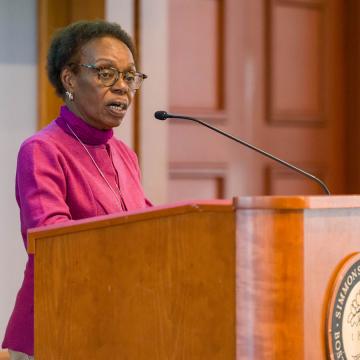
Bestowing the award, Ramsbottom remarked, “Hamilton-Mason’s career reflects an exceptional record of service, leadership, and advocacy. Her work has strengthened communities locally, nationally, and globally, and she exemplifies the values and spirit of the 2026 Inclusive Service Award.”
Hamilton-Mason’s diverse research includes African American women, HIV/AIDS in Africa and the US, and resilience in New Orleans after Hurricane Katrina. Accepting her award, Hamilton-Mason discussed a current project on the League of Women for Community Service, an organization created by and for Black women in the South End of Boston in the early twentieth century. (Coretta Scott King was among the members). Based on unprecedented access to the League’s archives, Hamilton-Mason’s research uncovers how these women defied racism and sexism while satisfying their intellectual appetites and serving their communities.
“What I found was not just history, it was living evidence of the resilience, the community care, and inclusive leadership. And that is why this award means so much to me,” Hamilton-Mason said. “It affirms that service, scholarship, and community engagement are not separate. They are deeply connected.”
Toward an Inclusive Boston
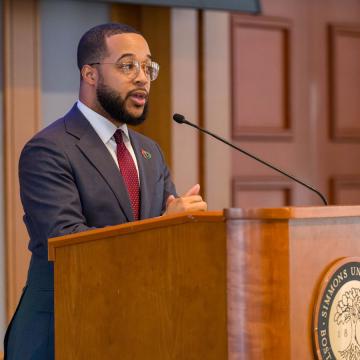
City of Boston Chief of Economic Opportunity and Inclusion Segun Idowu, who serves under Mayor Michelle Wu’s administration, delivered the keynote address.
Idowu began by reflecting on the maxim of his grandfather pastor: “We have to stop confusing motion with progress … and it was that age-old dictum … that has echoed through all of the work here in the city of Boston.”
In Idowu’s experience, the co-existence and collaboration of multiple communities coming together is necessary to realize inclusion and create real change. For him, this means investing in all of Boston’s neighborhoods, as well as supporting BIPOC- and women-owned and small businesses.
“What I have been proud of is to be part of the movement to make sure that we are helping to make the Boston that will be … a beloved community.” Indeed, Idowu’s 15 years in public service have been “focused on freedom for all.”
The event concluded with a filmed performance of the Hamilton-Garrett drumline.