
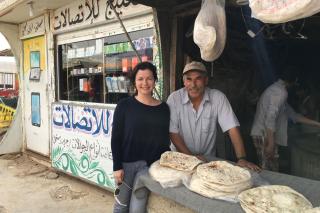
Dr. Karen E. Fisher, professor at the University of Washington Information School, visited Simmons as a recipient of the 2025 Allen Smith Visiting Scholars Fellowship, an annual award celebrating the life of Professor Allen Smith, who taught at the Simmons School of Library and Information Science (SLIS) for 31 years. Upon his passing in 2008, a fellowship was endowed to bring respected scholars working in the broad areas of reference, humanities, and oral history to SLIS to share their expertise.
Fisher spent a week at Simmons SLIS in October 2025 sharing her research on public libraries, trauma and resilience, and everyday-life information behavior. Her keynote presentation on October 20, “Countering Domicide: Preserving Indigenous Knowledge using Large-Scale Ethnography and Participatory Design,” focused on her work with Syrian refugees in the Za’atari Camp, and the creation of Zaatari: Culinary Traditions of the World’s Largest Syrian Refugee Camp (Goose Lane Editions, Canada, 2024).
Fisher first visited the Za’atari Camp — a closed, high-security and low resource camp on the Jordanian-Syrian border — in 2015, as an embedded field researcher with the United Nations Refugee Agency (UNHCR).
“There was no real handbook about how to conduct research in a conflict setting with displaced people,” noted Fisher. “We were guided by a simple principle: people first, data second.”
Refugees were brought to the Za’atari Camp in 2011 during the Syrian war, which displaced an estimated 14 million people. The war has been referred to as a “domicide,” the destruction of a built environment in an effort to destroy a way of life and identity. “This causes deep suffering, and the destruction of their [refugees] memories,” noted Fisher. “Creating resilience, agency, self-respect, and livelihoods are important for people surviving conflict.”
In addition to high security, low resources, and dense population in the camp, the refugees contended with limited reading materials, as well as weak internet and cellular service. Fisher conducted home visits and observed women cooking and cleaning in their caravans. “The cookers in camp were made of scrap metal,” Fisher noted. “There was nothing to regulate temperature, and no window to look through.”
In spite of this, the women of the camp made delicious food. “Syrians are known as the best cooks in the Arab world, especially in North Aleppo,” said Fisher, who was contemplating ideas for how to preserve Syrian culture in the midst of displacement. “I turned to the women and asked, ‘Would you like to make a cookbook?’ They said yes. Then they asked, ‘What is a cookbook?’ No one had seen a recipe. They learned to cook with their mother and grandmother.”
Recipes for Community Building
Thus started a six-year effort to create a cookbook, with contributions from the entire community. “It had to include poetry and art,” noted Fisher, as these are integral parts of the culture. Men, women, and children shared recipes, ways of cooking and healing, how to survive in a desert, and how to use herbs and food to keep the body healthy.
“The idea of the cookbook went viral across Za’atari,” says Fisher, who had held many workshops at the camp, usually attended by 10 to 15 people at a time. “This workshop [about the cookbook] had over 130 people.” Women, men, and children gathered at tables and were asked to write down recipes.
Fisher didn’t want to assemble a traditionally Western cookbook. “The first recipe in the book is for Arab coffee,” she noted. “Syrians start every event with welcome coffee. There are so many rituals around Arab coffee! It takes days to prepare.” Guests are expected to drink three cups of coffee, each one symbolizing safety, defense, and protection.
In addition to the challenge of finding a publisher for the manuscript, Fisher and her team faced the “massive information challenge” of finalizing the details of each recipe. “A dish could have different names, depending on where you are from,” said Fisher. She assembled an expert committee of cooks in the camp to go through each page of the manuscript and select which pages to include.
After a professional food photographer and food stylist visited the camp, the last stage was to gather consent for the use of each photo. For Fisher, the process was bittersweet. “Some [contributors] had returned to Syria or moved to another refugee camp. Others had passed away.”
It was also vital that the book remain apolitical, or else the lives of those pictured could have been at risk. In addition, the publication of the book was delayed to avoid celebrating its release during the height of the conflict in Gaza.
Cookbook Supports Refugees
In February 2025, a book launch party was held for embassy ambassadors. Women from the Za’atari camp came to prepare the food.
“We paid for the food, and everyone was paid for their time,” noted Fisher, who has observed that many researchers take advantage of people in refugee camps, taking their time without reimbursement. Royalties earned by the sale of the book will be returned to the people of Za’atari camp.
For Fisher, the cookbook is a valuable attempt to “preserve memories, and support different kinds of literacy,” she said, noting that some of her contributors “couldn’t read or write, but had so much knowledge to share.”
Fisher recalled the corporeal knowledge displayed in the creation of Kibbeh, a traditional Syrian dish. “They could tell by touch and smell if they were getting it right,” she said. “I couldn’t make my dough thin enough. They would laugh at [my attempt].” The instruction she was given — “cook until the golden color” — lacked specificity, but was clear to the Syrian women. “There was a tacit knowledge [of how to do this].”
While cooking, the women would recite the shahada, an Islamic declaration of faith. If you do this, they told Fisher, “the dish you are making will taste even more special.”