
“I love that science is concrete. And I love that you are able to ask a question, answer a question, and it always leads to another question,” says Senior Lab Manager and Assistant Tennis Coach Jyl Collins. “I consider myself a human biologist, and I find the human body fascinating.”
When she began her undergraduate studies, Collins wanted to become a physician. Although she loved biology, she eventually decided not to pursue medical school.
Collins’ first job out of college was at Simmons, where she worked in assisting laboratory preparation in the Department of Biology. She eventually went to graduate school, where she conducted scientific research and continued to teach at Simmons occasionally. Being married with children, she eventually decided to leave her doctoral program. When a chance opportunity arose for assisting in the lab at Simmons one summer, Collins found her calling. “I absolutely loved it,” she recalls, and soon landed a full-time opportunity at Simmons that includes teaching.
“The most fulfilling part of my days is when I am in the classroom,” Collins says. “That opportunity was presented to me through Simmons … If I hadn’t said yes [to the summer stint], I don’t think my path would have been the same.”
A Multipronged Role
The senior lab manager position comprises an eclectic role. Collins serves as a liaison between Biology, Chemistry, and Physics faculty and department chairs. She also schedules classes and labs for the STEM departments and is directly involved in staffing. In an academic lab coordinator capacity, she coordinates the lab courses that have multiple lab sessions.
Crucially, Collins plays a role in safety. She serves as the chairperson of Simmons’ institutional biosafety committee, which is tasked to ensure that any individual using biological agents does so safely and legally. She also serves on the Institutional Animal Care and Use Committee (IACUC), which follows animal care and animal safety regulations.
In addition to her lab-related operations, Collins teaches about two units per semester. “Over time, my position has morphed into not just being strictly managing, but also being more student-focused and student-centered,” she says.
Teaching STEM at Simmons
Collin’s favorite Simmons course to teach is “Anatomy and Physiology 2” (BIOL 232). “I love any biology, because the human body is so insanely awesome,” she says. “And I like A&P 2 because it covers topics that are already familiar to students, including the blood, the heart, the respiratory system, digestion, and reproduction … I feel that it keeps students engaged.”
In addition to the classroom, Collins instructs students in the lab. “I love the lab because it’s more intimate and more personal [than lecture], and you are able to connect with more students on a different level,” she says.
Collins has also contributed to the PLAN (Purpose Leadership ActioN) curriculum, teaching “Explore” (SIM 100) and “Extend” (SIM 200). The first course helps students transition into college, whereas the second course focuses on career planning. “Seeing the difference between first-year students and then the sophomore or juniors is staggering,” she observes. “It’s so fulfilling to see them grow.”
In Collins’ experience, “the students who come to Simmons are a really genuine group of students … They are very resourceful, hardworking, resilient, and grateful.” She also observes that Simmons students have a natural curiosity and a sense of independence. “And I see them getting progressively better at seeking help when they need it,” she says.
An Open Mentorship Style
When describing her mentorship style, “I try to be as approachable as possible. My door is open, figuratively and literally, all the time,” Collins says.
Collins gives students participation points for having an initial meeting with her. “It’s important to me to know people’s names … And to convey [to students] that I’m available to them.”
Moreover, Collins uses humor in her interactions with students. “I think humor helps to bring down some barriers initially,” she says.
Collins emphasizes encouraging students, especially nontraditional students. “We have a lot of students at Simmons who can’t prioritize academics, given full-time work and/or taking care of others at home,” she explains. “I try to help them build their confidence.”
Coaching Women’s Tennis
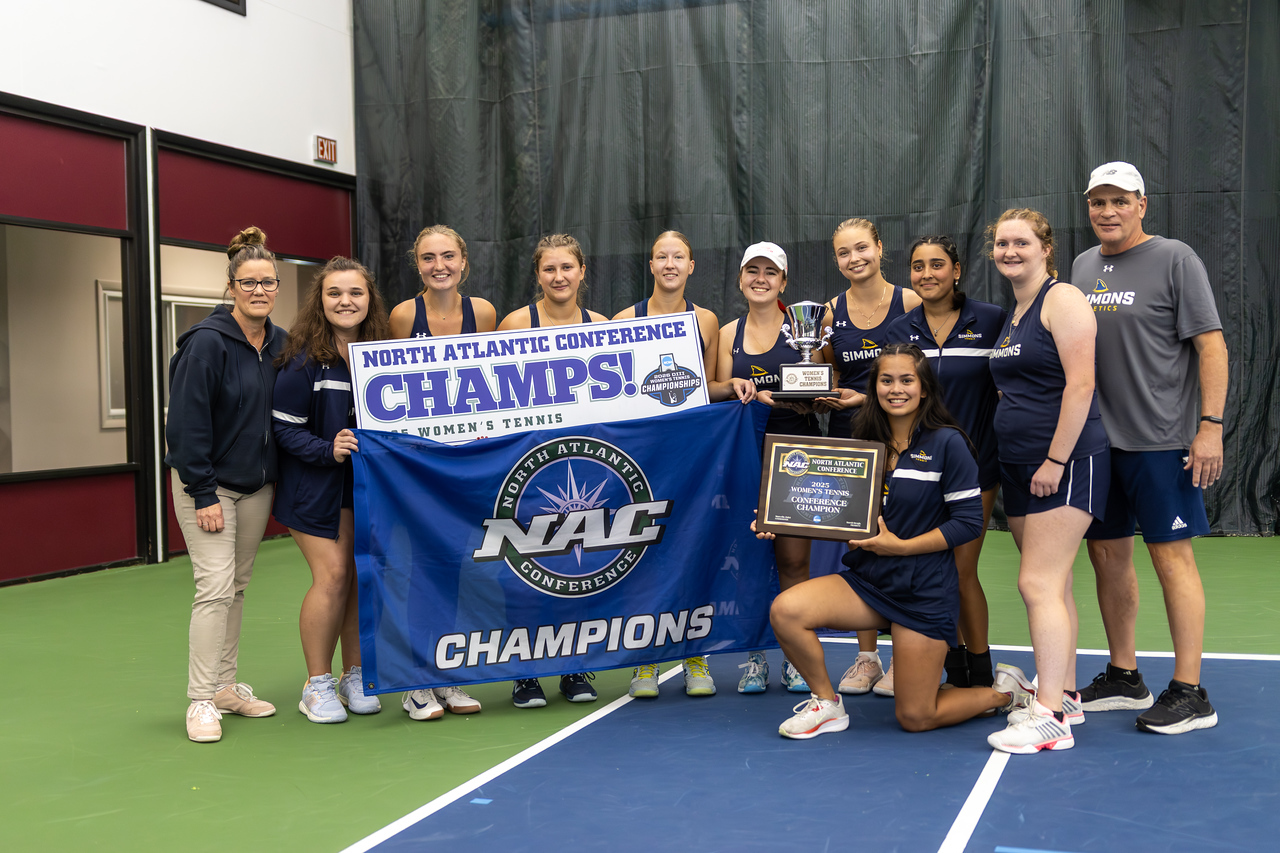
In 2024, Collins took on an additional role at Simmons by becoming the assistant tennis coach. She came into this position serendipitously during a PLAN curriculum meeting that the director of athletics attended.
Logistically, coaching is a good fit for Collins, given that she is already on campus most of the time. “And for a tennis player, the opportunity to be on the court every day is a dream,” she says. “The women [players] are just awesome. My head coach [Bob Rauseo] is so great, and the team made me feel welcome and included from the second I was there.”
In her coaching Collins emphasizes resilience and teamwork. “I like to remind our athletes that they are there for themselves and for each other as well,” she notes. “Being a coach is a lot like being a teacher. There is a lot of overlap with managing emotions, and dealing with success and failure in real time.”
Collins is especially proud of coaching at a women-centered institution. “I am happy to represent women coaches in athletics,” she says. “I think it is important to model that for other teams and for our players as well.”
Rewards of Mentorship
Over the years, Collins has appreciated staying connected with students long after they have left her classroom. She loves receiving updates and visits from former students, writing them letters of recommendations, attending their weddings, and meeting their children.
“You can’t know immediately if you are making an impact [on students’ lives],” she says. “So, it is most rewarding when students let you know that you have made an impact.”