
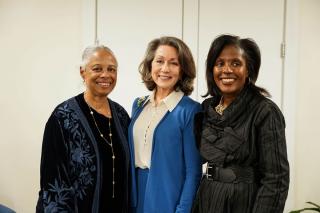
The seventh annual Ifill Forum, held on February 12, 2026, featured a keynote by Susan Goldberg, an award-winning journalist and President and CEO of GBH, the leading multiplatform creator for public media in America. In conversation with Ann Fudge ’73, ’98HD, Goldberg expressed her dedication to community-level journalism as integral to the strength of our democracy.
The 2026 Ifill Forum is Simmons University’s annual signature event in honor of Gwen Ifill ’77, ’93HD and her legacy as a groundbreaking Black woman journalist. “We have a responsibility to carry Gwen’s powerful legacy forward by educating our students to tell stories that matter,” said Dr. Ammina Kothari, Dean of The Gwen Ifill School of Media, Humanities, and Social Sciences, in her opening remarks at this year’s Ifill Forum on February 12, 2026.
Dean Kothari’s emphasis on the power of storytelling and local journalism was reflected in this year’s keynote speaker: Susan Goldberg, an award-winning journalist and President and CEO of GBH, the leading multiplatform creator for public media in America. She is the first woman to serve in this role since GBH was founded in 1951. The discussion was moderated by Ann M. Fudge ’73, ’98HD, who became the first woman to serve as President of Maxwell House Coffee Company in 1994 and currently serves on the Board of the American Academy of Arts and Sciences and is Senior Trustee at the Brookings Institution.
Dean Kothari shared a recorded message from Gwen Ifill’s older brother, Trustee Dr. Roberto “Bert” Ifill, who was unable to attend this year’s event. Ifill referenced his sister as an iconic figure in public broadcasting and emphasized the validity of her approach to share stories that “inform without inflaming.”
Gwen Ifill Emerging Journalist Award
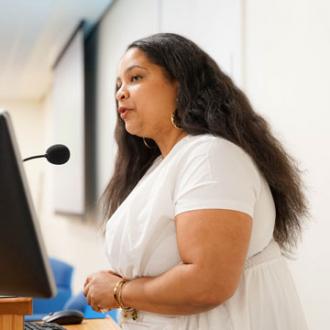
Before the keynote, the winner of the 2026 Gwen Ifill Emerging Journalist Award was presented to journalist Arielle Gray, an artist, writer, and Bostonian who has focused on arts and culture in Black and Brown communities for the past eight years. Gray’s journalistic work has been featured on NPR, BBC, The Boston Globe, Boston Art Review (among others), and she has been an artist-in-residence at the Isabella Stewart Gardner Museum and MASS MoCA.
Reflecting on her childhood in Mattapan, Gray said, “I saw so many things of beauty in my neighborhood that were not portrayed in the news.” Gray sees Black art and culture as “evidence of our humanity.” A consummate researcher, Gray searches for evidence of Black life in archives, while also bemoaning all that has gone undocumented.
“Journalism isn’t just reporting, it’s preservation,” said Gray. “Black women have always been memory keepers, and I am humbled to be a part of that sacred lineage.” Gray’s vision is to honor those who may be left out of the story, and to document the beauty that may not make the front page.
Susan Goldberg: Addressing the Current Moment
University President Lynn Perry Wooten introduced Susan Goldberg, a nationally recognized journalist and transformative leader. Wooten, herself a member of the GBH Board who has seen Goldberg in action, proclaimed her an “everyday leader,” a vital position given the current political climate.
“Telling stories can change the world,” Goldberg said, recalling when she joined GBH three years ago. “We reach so many people from every background … and our aim is to reach everyone.”
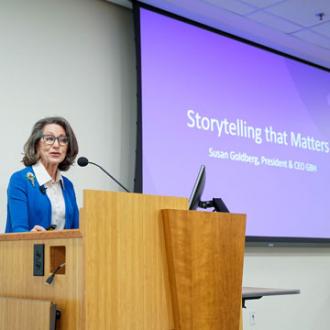
The current moment also includes attacks on free speech and the media. Goldberg cited the recent arrest of journalists — including former CNN anchor Don Lemon and independent Minnesota journalist Georgia Fort — in connection to an anti-ICE protest in Minnesota. “The work of journalists is protected by the First Amendment,” noted Goldberg, though the arrests show a direct attack on those rights.
In addition, the massive firing of 350 reporters from The Washington Post points to a further crisis in independent journalism. “When local reporting goes away, civic engagement falls, and polarization worsens,” noted Goldberg. This different media landscape is further impacted by the “TikTok-ification of our attention spans and the disappearance of agreed upon facts.”
Last July, the federal government pulled $1 billion in funding from public media. In response, GBH launched a “if you love it, fund it” campaign, which is millions of dollars ahead, with a surge in donations from Millennials. While Goldberg noted that many of these contributions may be momentary “rage giving” in response to the federal cuts, “it is inspiring, for everyone at GBH.” However, they can’t rely on philanthropy to bridge the funding gap. Consumer products are in development, including NOVA science kits that will debut at an upcoming toy show.
“Third-party platforms, like YouTube, will allow advertisers,” said Goldberg, who noted that this option will not be favored by many long-time listeners, but “we have to stay in business.” She is also willing to allow companies to sponsor content, as long as GBH maintains control of the editorial product. “We are storytellers. We can also help other nonprofits tell their stories.”
Principles of Storytelling
Goldberg clarified her point of view into three principles of storytelling.
“First, do the work that other people can’t do,” she said, sharing efforts made to create stories across the Commonwealth, visiting Gateway Cities and asking residents what stories they want to hear. (One such story, later recommended by an audience member, was a visit to Roxbury’s Nubian Square). “We ask, what are you concerned about, proud of? What do you want to hear?” said Goldberg, who noted that TikTok has been an important way to promote this content to a younger audience.
In addition, GBH has been creating free content for children for more than 50 years. “There is no business model for educational children’s programming, but we need to find a way to keep doing it,” noting that it is especially vital for children without access to pre-K education. Goldberg shared a clip from the animated show Work It Out Wombats!, in which a character learns that a chatbot isn’t really their friend.
The second principle: Be part of the conversation. To do so, journalists need to embrace technology they may otherwise avoid. “TikTok is exactly what we need to do to reach younger audiences.” And the effort is working: TikTok clips of ANTIQUES ROADSHOW now have a considerable following on the platform.
Third: Make a difference by telling stories that matter. The Oscar-winning 2023 documentary 20 Days in Mariupol documented the Russian invasion of Ukraine. In his acceptance speech, Director Mstyslav Chernov said that “cinema creates memories,” and emphasized the importance of telling these stories. His new documentary, 2000 Meters to Andriivka, uses bodycam footage from soldiers to bring renewed attention to the ongoing conflict in Ukraine.
“One of our jobs is to keep the focus on stories that are truly important,” said Goldberg. For these reasons, she counts herself lucky to be a journalist at GBH, “sharing stories that help change the world.”
Conversation with Ann Fudge
Dean Kothari introduced moderator Ann Fudge ’73, ’98HD, a trailblazer in global marketing and public service, who was appointed by President Obama to serve on the Simpson-Bowles Commission on Fiscal Responsibility and Reform.
Fudge, who lived in Minnesota for nine years, has found it difficult to watch the violence and upheaval caused by ICE raids. Her goddaughter, currently a reporter in the state, has shared the emotional toll of covering the news.
“Compartmentalization is necessary,” Goldberg noted, for a journalist’s self-preservation. “You also have to believe that it will make a positive difference to inform people. What is the bigger message, the perspective that people need?” She paraphrased an earlier quote from Gwen Ifill, emphasizing her commitment to balanced reporting: “Bringing light, not heat.”
While Goldberg applauded the efforts of “citizen journalists” using their phones to film the actions of ICE, she noted the downside of relying on this type of content. “These are not professional journalists. Where is the content coming from? Was it manipulated with AI? This is a problem for all consumers of information.”
On the subject of AI, Goldberg characterized herself as a “slow adopter,” though she can see benefits, especially given limited funding. “I’ve seen news organizations use it in creative ways. We used to sit in on obscure meetings [in local government]. Some stations are experimenting with recording those meetings and creating an AI-generated summary. If something interesting happened in the meeting, a reporter can follow up. They can also see patterns. AI can be used to help save a lot of time. You can request a list of the best experts on a subject and narrow it down by area. It’s a good starting point.”
However, she has many concerns about AI manipulation of images. “At National Geographic, we sent photographers all over the world,” said Goldberg. “When we chose the photo we wanted to use, we looked at every shutter click, before and after [that chosen photo], to make sure the image hadn’t been altered. It was the only way to be sure.”
Advice for the Next Generation of Journalists
“There are more ways to be a journalist now than there were when I started in the 1980s,” said Goldberg. “When I started at The State News with a manual typewriter, there were three modes of reporting: newspapers, radio, and television. Now there are so many ways to tell stories, using videos, photos, graphics, cartoons, and games. There are so many ways for creative people to get interested in journalism.”
Another technology used in reporting, Substack, allows writers to generate content and share it via subscriptions. Where brands once controlled journalism, now “people can become their own brand, but only a small number of people can be financially successful on this platform without being part of a bigger company.” That said, she lauds the platform as an opportunity to share transparency. “Show your work. What details were included? Was this story edited fairly? That [transparency] can help us bring back trust in journalism.” With the new technology available, it’s “an exciting time to be a journalist.”
Though the current political climate can make journalism a daunting career choice, Goldberg “can’t think of a more important way to give back. I started at 20 years old. I’ve been doing this for 46 years. I started writing obituaries, and learned that everybody has a story to tell, and that is a sacred trust. I’ve been so honored to have the privilege of telling other people’s stories.”
In closing the event, Dean Kothari called upon Gwen Ifill’s bravery and balanced viewpoint. “Journalism is not a luxury, but a public good worth investing in.” We must do exactly that to carry forward Gwen’s integrity and spirit.