
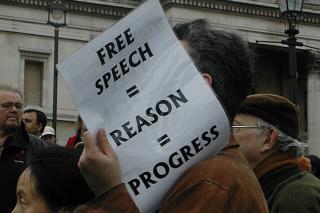
The Simmons Center for Information Literacy (SCIL) recently presented “Information is Power: The First Amendment, Public Records, and the Press,” a mini-conference designed to address how we can all exercise our First Amendment rights. Here are some quotes from one of the presenters, Justin Silverman, Attorney and Executive Director of the New England First Amendment Coalition.
Justin Silverman, Attorney and Executive Director of the New England First Amendment Coalition, offered an overview of the First Amendment — what it really protects and what issues arise, especially for journalists.
Silverman recounted his experience as a reporter in 2003, when the final game of the Syracuse University basketball championship was played in Louisiana. In Syracuse at the time, Silverman went to an area off-campus where students who were not at the game went to celebrate. He took his place among the other journalists behind a barricade, erected by riot police and intended to protect area businesses from the antics of over-excited (and possibly inebriated) college students.
However, a member of the riot police told him to leave. When Silverman assured him that he was a member of the press, he was told, “That doesn’t give you the right to do whatever the [expletive] you want.”
That begs the question: what does the First Amendment permit the press, and citizens, to do?
Silverman highlighted the main points: freedom of religion, freedom of speech, freedom of the press, the right to peaceably assemble, and the right to petition the Government. “The order matters,” said Silverman, noting that the freedom of religion could apply to any moral code important to an individual.
Constitutional Freedoms in Different Contexts
Restrictions on these freedoms can be dependent on different restrictions, with “time, place, and manner” as one category. “The government is tasked with being content neutral and is not permitted to police speech based on viewpoint or topic,” said Silverman. On that celebratory night in Syracuse, if there had been a restriction on access for everyone due to public safety concerns, that might have been considered content neutral. Singling him out, however, was unconstitutional.
If speech is restricted in a particular venue, “ample alternative channels” to communicate the information must be allowed. In another example, Silverman cited a Massachusetts statute that created a buffer zone around abortion clinics to decrease the incidents of violence. The US Supreme Court said this was unconstitutional in part because it didn’t allow the protestor, who wanted to speak directly to people entering the clinic, any alternative channels for their message. In addition, the sidewalk on which they approached people is considered a traditional public forum.
“In many states now, there are efforts to pass laws that you can’t be within 35 feet of any first responder, even in public,” said Silverman, noting that the so-called “halo act” proposed in Massachusetts essentially creates a buffer zone between first responders (including police officers or ICE officials) and the public or press.
However, as he noted, “There are already laws to prevent anyone from interfering with law enforcement or first responders. The purpose of the law is to create a buffer and keep journalists and photographers at arm’s length and limit their ability to report on what is happening.”
In the case of false, defamatory statements, a reporter might commit libel if such statements alleged a fact about a specific person, were communicated to a third party, and were offered without defense. If the plaintiff is a public official or public figure, however, additional requirements under the "actual malice" standard must be met.
“The First Amendment is a complicated body of law,” said Silverman. “There is a lot of legal analysis underpinning those laws.”
Relevant First Amendment Resources
- MuckRock: FOIA Requests
- The Reporters Committee for Freedom of the Press (RCFP) - Open Government Guide
- New England First Amendment Coalition (NEFAC) - Massachusetts FOI Resources
- Freedom of Information Act Electronic Reading Room | CIA FOIA (foia.cia.gov)
- Freedom of Information Act: The New FOIA Search Tool
- Murder the Truth by David Enrich (HarperCollins, 2025)