
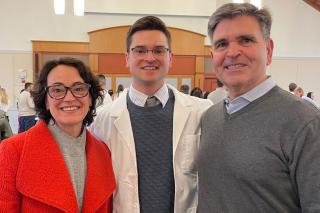
“The Doctor of Physical Therapy (DPT) Program opens up different avenues — acute care, neurological conditions, and pediatrics — that I wouldn’t have access to elsewhere,” says Louis Izzi ’26DPT, currently in his third year of the DPT at Simmons. “It’s a blend of what I’m interested in, and opens different opportunities.”
Before pursuing his advanced degree at Simmons, Izzi earned a bachelor’s degree in exercise science elsewhere and worked as a rehabilitation aide for hospital-based and private practice orthopedics.
“Simmons was recommended to me by different physical therapists I worked with before applying to a program,” says Izzi, noting that, in addition to the strong reputation, the University’s location and links to opportunities at local hospitals appealed to him.
Small Classes and Case-Based Learning
“I researched different programs in the city, and I loved the small class size at Simmons. During tours and visits with faculty, I could tell that it’s a tight knit community.
At Simmons, it’s about more than just a degree and passing board exams — while you’re here, you build relationships with professors and the members of your cohort. That is what I was really drawn to.”
To that end, case-based learning has also supported his growth and understanding of the field.
“Every program gives you the information you need to graduate and be a clinician, but the hardest thing is to take that information and relate it to the patient in front of you,” Izzi says. The case-based approach allows students the opportunity to apply the concepts they are learning to particular cases throughout the learning process.
“During clinical rotations, I’m less frazzled by patient presentation and patients in general,” Izzi reports. “I’m ready to use the knowledge I’ve learned, because we’ve practiced it so often in class.”
In Izzi’s experience, all of his professors were open and available to discuss their courses or an area of interest. Building strong connections with his professors, especially Assistant Professor of Practice Rachel Verrill and Assistant Professor of Practice and Assistant Director of DPT Clinical Education Matthew O'Rourke, has been invaluable.
“They are my go-to professors if I have questions, whether it’s about treating patients or navigating my career. They have helped guide me through these last three years, and I hope will help me navigate my career moving forward,” Izzi says.
Valuable Partnerships and Preparation
Given the location and reputation of the program, Simmons is able to collaborate with area institutions. One of Izzi’s favorite courses at Simmons was “Human Anatomy” (DPT 621), a hands-on cadaver anatomy training at Harvard Medical School.
“A lot of programs are moving away from [human cadaver dissection],” Izzi notes. “For Simmons to continue having that opportunity is invaluable. The Harvard labs are wonderful facilities, and that is where I learned the most about human anatomy — ligaments, tendons, nerves and artery coursings — by feeling them with my hands. Tracing the coursings myself helped deepen my understanding of the human body.”
For one course, the class received guest instruction from staff members from Boston Children’s Hospital.
“They were super knowledgeable about [pediatrics], an underrepresented portion of physical therapy.” For the lab section of the course, pediatric patients from Boston Children’s visited Simmons for a real-patient experience in the classroom.
In preparation for hospital and acute care clinical rotations, students visited the Nursing Simulation Center, where they would be presented with likely scenarios, often with classmates or actors in the role of patient.
“We would split into groups and work our way through all the IV lines and catheter bags, like working in a fully-functioning hospital room,” says Izzi. “It made going into a real hospital setting much less daunting. I had seen it before and had worked through all the awkward [issues].”
Clinical Rotations
Izzi has completed two years of coursework and, now in year three of the program, is nearly done with the first two separate 12-week clinical rotations. His first was an outpatient rotation, and his second was with patients in a hospital setting.
“Simmons does a really excellent job preparing you for your clinical experience,” says Izzi. “I felt very prepared to see that population, as we had practiced the technical skills I would need in that setting. I never felt like I was missing anything, thanks to the preparation at Simmons.”
For his current clinical experience, Izzi is visiting Tufts Medical Center patients undergoing radiation or chemotherapy treatment for cancer. “I help them manage pain or help with fatigue, and generally see them through their treatment,” says Izzi. “A lot of them are feeling pretty bad and don’t want to get up and out of bed — my job is to make sure that they do. If they’re moving, they are reducing the risk of muscle atrophy and skin breakdown from lying in bed for a long time.”
He notes that many of his patients have underlying co-morbidities, in addition to cancer diagnoses, which require a hospital stay. “[We want to] maintain as much function as they can while they’re in the hospital,” says Izzi. “The goal is that when they are medically cleared and discharged, they will have enough function to return home.”
For Izzi, the Simmons approach to clinical placements is also a strength of the program.
“They have 50–100 clinical sites you can choose from, ranking your top choices for placement,” Izzi reports. “If you have a particular interest in a site that Simmons doesn’t already have a relationship with, the clinical coordinators will reach out on your behalf to arrange a contract and get you that opportunity.”
This is exactly how Izzi’s second semester of clinical training was arranged, for which he will be living in Washington, DC, and working at an area sports performance clinic.
The Rewards of the Physical Therapy Field
As a physical therapist, Izzi values the time he can spend with his patients.
“Physical therapy has a very unique place in health care,” he observes. “We’re not providing medical care to patients, but we often have the most face-to-face time with patients. I get at least 30 minutes with my patients, and see them two to three times per week. It’s tough to describe how useful that is in a healthcare setting.”
While Izzi looks forward to working with athletes in post-surgery rehabilitation during his next clinical, he looks forward to working with all types of patients in his future career.
“The patients I have the most fun working with are older adults with chronic back or knee pain, who want to get back to kneeling in the garden or playing with their grandkids. Seeing their growth and ability to get back to things they want to do is incredibly rewarding.”
As for his future career, Izzi hopes that he can “treat anyone who walks into my clinic with anything they want to do, whether that’s a high-level sport or walking the dog.”