
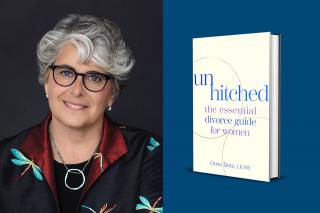
Oona Metz ’93MSW is a therapist who leads therapy groups and supports women in transition. We spoke with her about her new book on navigating divorce and the essential training she received at Simmons.
“I love seeing people change and grow. I get great satisfaction from seeing people make big or small changes,” says Oona Metz ’93MSW, a psychotherapist with private practice offices in Brookline and Arlington, Massachusetts. “It is gratifying for me to see the growth that women can make, especially when they go through a divorce. I see tremendous heartbreak in the beginning, as well as stress and fear, but over time, I really see the incredible amounts of growth, healing, transformation, and empowerment.”
Although Metz has experience in both individual and group therapy modalities, she finds the latter model particularly helpful for women in the midst of a divorce. “The group therapy model can offer people a sense of community and not being all alone. It is a chance to understand their feelings in a more nuanced way by listening to other people describe their feelings,” she says.
Metz’s insights into women and divorce have been featured in Time magazine and on the CBS Morning Show. In her new book, Unhitched: The Essential Divorce Guide for Women (Simon & Schuster, 2026), Metz addresses the emotional aspects of divorce and advises women on how to cope with them.
Addressing an Unmet Need
Metz has served as a therapist for the last 30 years; for the past 15 years, she has led weekly divorce support groups for women.
“The first group filled up immediately,” she recalls, noting that the response spurred her to start several other groups of its kind. “The divorce support groups were all so helpful to the women who were in them and it was so gratifying as a therapist to lead them.”
As time went on, Metz noticed a gap in the literature on divorce. “Women kept asking me for books about the emotional aspects of divorce. There were books out there about the financial or the legal aspects, but there wasn’t a book by a therapist about the emotional journey of divorce for women, which I found to be shocking,” she says.
After seeing hundreds of women through the process of divorce, Metz decided to write her own book. “I didn’t have any writing or publishing experience, but I hired a wonderful writing coach and I wrote the book. It took a few years of hard work, but now it’s out in the world. So, it was really about filling a need that I saw had not been met,” she says.
Navigating the Emotional Journey of Divorce
Unhitched is divided into three sections. The first contains accessible and practical information regarding the emotional journey of divorce. Here, Metz touches on how to initiate a conversation with a spouse about getting a divorce, how to tell children about their parents’ divorce, advice on the best custody schedule based on a child’s age, the five stages of divorce grief, as well as post-divorce dating tips.
The second section consists of vignettes that are “composites of the hundreds of women that I’ve seen through the process of divorce,” Metz says. “Privacy and HIPAA laws are my top priorities, so I never use a client’s direct story, but these composite stories help women feel less isolated as they go through a divorce … the book almost gives readers a feeling of being in a support group,” she explains.
The third section offers exercises for readers to reflect on their own experience, as well as learn and grow.
In terms of readership, Metz believes her book is a useful resource for people considering a divorce, people going through a divorce, and people who are already divorced but are still experiencing the emotional aftereffects. Furthermore, she thinks that therapists, attorneys, mediators, religious leaders, friends, and family can benefit from reading Unhitched as well.
Moreover, Metz hopes that Unhitched will lessen the lingering shame and stigma associated with divorce. “I think the way we reduce shame and the stigma is to keep talking about it, to keep writing about it, and to keep airing it out. We need to make those experiences public so that people don’t feel so isolated and alone,” she notes.
Career Preparation at Simmons
Simmons played a pivotal role in Metz’s preparation and professionalization. After graduating from college in 1989, Metz knew that she wanted a career in social work.
“The Simmons School of Social Work had, and still has, a wonderful reputation,” she says. “I looked at who the faculty were, and what the courses were, and I’m so glad that I made that choice.”
Metz credits Simmons for giving her a solid foundation for how to be a therapist. “I learned how to consider the interpersonal issues, the ethics behind being in practice, and the importance of supervision and continued learning throughout one’s career. Simmons established a solid base for me,” she says.
Following her Simmons graduation, Metz enrolled in a five-year advanced certificate program in group therapy. In addition to group therapy, she specializes in helping women in transition.
Making Connections
Reflecting on her profession, “I feel lucky to say that I love my work. I love being a therapist and I love being an author, and combining the two has been very rewarding,” Metz says. “I really love helping people and seeing the connections that get made between people.”
Metz finds working with women especially meaningful. “It’s something I’ve done for my whole career, and I really like the experience of seeing women connect with each other and support each other.”
On February 11, 2026, Oona Metz will be on a panel entitled “The Realities of Modern Marriage and Navigating Divorce” with Scaachi Koul, Nicole Graev Lipson, and Tiziana Dearing in Boston at WBUR CitySpace. Tickets can be purchased through WBUR.