
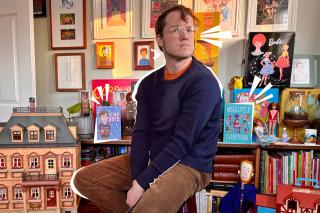
Damian Alexander ’18MFA grew up in the Boston area and had spent time visiting the Isabella Stewart Gardner Museum and the Museum of Fine Arts before applying to the MFA in Writing for Children at Simmons.
“I used to draw while sitting on a bench at the MFA,” Alexander recalls. “Or in a room at the Gardner.” The prime location, in addition to the chance to study children’s literature, inspired him to apply to Simmons.
“I was interested in children’s picturebooks and animated films when I was young,” says Alexander, recalling his fascination with Where the Wild Things Are by Maurice Sendak (Harper & Row, 1963); Chrysanthemum by Kevin Henkes (Greenwillow Books, 1991); Madeline by Ludwig Bemelmans (Viking Press, 1939); Eloise by author Kay Thompson and illustrator Hilary Knight (Simon & Schuster, 1955); the Arthur books by Marc Brown (Little, Brown, 1976); and the animated series based on Brown’s books, released on PBS Kids in 1996.
“I liked designing characters and backgrounds. I wanted to create an all-encompassing world with characters and stories and art,” says Alexander. “I liked the literary aspect of these stories, as well.”
Creative Evolution
Alexander had been drawing autobiographical comics for years, but started posting more consistently during his first year at Simmons. In 2017, one of his cartoons received the Locher Award from the American Association of Editorial Cartoonists.
Meanwhile, Alexander was writing, illustrating, and workshopping the raw material for his second book, the graphic novel Absolutely Everything (Lerner Publishing Group, 2025). While not a direct memoir, the book draws on his experience growing up with ADHD.
Initially, he approached the idea for Absolutely Everything as a picturebook, while taking “The Picturebook” (CHL 403) with then-adjunct Megan Dowd Lambert.
“For me, characters exist as imaginary friends,” he says. “I draw them and then write a story around them. A lot of my stories start with a character.” He created a picturebook script and watercolor paintings of his main character, Marcella, as early drafts of Absolutely Everything.
Later courses in “Writing for Children” (CHL 430) with Elaine Dimopoulos ’08MFA and Anna Staniszewski ’06MAMFA inspired him to write the story of Marcella as a traditional novel, though it eventually morphed into a graphic novel, thanks to his love of illustration. He recalls a particularly transformative critique from Dimopoulos on early drafts of the novel.
“She said I was good at creating characters that you really wanted to spend time with and talk to, but that I needed to work on the story around them,” he recalls. “She said, ‘You’re hanging out with these people and it’s fun, but it doesn’t go anywhere.’ Nobody had ever phrased it so well before. I started thinking more about how I could use the characters' dialogue to move the story forward. I also found that dialogue-driven storytelling works really well in graphic novels.”
The Simmons Advantage
When he began working with a literary agent, she asked if he would consider writing a graphic memoir. “I pitched her the concept and she signed me,” he recalls. “Some of the comics I'd been posting ended up being the basis for [my first] graphic memoir, Other Boys (First Second, 2021).”
During his time in the MFA program at Simmons, Alexander’s mentorship with an editor at First Second eventually led to working with that editor in a professional capacity.
“I had been working on another young adult project with that editor as part of the mentorship, while Other Boys was out on submission [to publishers].” That editor later snapped up the contract for Other Boys.
“That connection helped move things forward,” he says. “Simmons helped me feel much more immersed in the world of publishing and writing for children, which inspired me to keep going and pursuing this career after graduating.”
An ADHD Story
It wasn’t until after the release of his debut, Other Boys, that Alexander was diagnosed with ADHD. He realized that he shared the diagnosis with his character, Marcella, and that the diagnosis was integral to her story.
“She was a reflection of me as a child,” he says, recalling a feeling of connecting dots after his diagnosis. As a child, his struggles with attentiveness had been described as a result of his abundant creativity. “After the diagnosis, I revisited Marcella and the story fell into place.”
Alexander notes that popular depictions of ADHD in books and movies often strike him as silly, over-the-top caricatures. “I wanted to portray more of the anxiousness that comes with [ADHD]. Showing how someone with ADHD is feeling in the moment: feeling bad about being a bad listener, or forgetting things, and worrying that people are mad at me.”
The graphic novel format and Alexander’s deft illustrations offer a unique portrayal of Marcella’s experience: the disjointed words of friends and teachers (especially when voices overlap) and the enticing aspect of doing a non-stressful task (like sorting socks) while a deadline looms on another project.
Though Marcella’s experience was drawn from his own, the task of writing a graphic novel is distinctly different from a memoir.
“In a work of fiction, even though there are elements from my own experience, I can play with it more to tell a good story,” says Alexander. “With a memoir, the content is there, but putting it together is difficult. You have puzzle pieces and have to figure out how they fit. With fiction, you can create your own puzzle pieces.” His follow-up to Other Boys, the graphic memoir Hand Me Down, will be published by First Second in the summer of 2026.
Graphic Novels and Visual Literacy
Alexander has also published his short comics in publications such as The Nib and Kirkus. He has also lent his artistic flair to corporate collaborations: customizing Dr. Martens to benefit the Trevor Project, and winning a fan art contest to design a T-shirt in honor of Neil Gaiman’s Coraline (Bloomsbury and HarperCollins, 2002) sold by Hot Topic in 2019. In 2020, he illustrated The Trevor Project Guide to Being an Ally to Transgender & Nonbinary Youth.
For Alexander, comics and graphic novels assist readers in deciphering the language of visual media.
“It’s a different form of reading,” he says, noting that he has witnessed parents who perceive the format as less challenging or less important than a novel. “Getting kids to read in general is good. I don’t see graphic novels as a stepping stone to novels. If a kid is reading for fun, it’s a good thing.”