
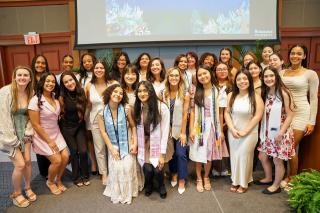
Simmons University held its first annual First-Generation Graduation Ceremony on May 11. The event was presented by the Multicultural Center and First to FINish, the university’s first-generation student support program.
Director of the Multicultural Center Rore Yanzon welcomed the attendees, describing the graduating students as the culmination of “dreams shaped by parents, grandparents, siblings, guardians, and communities who sacrificed, encouraged, and believed in the possibility of something greater.”
Yanzon also highlighted the impact of first-generation students at Simmons, noting the countries and states they represent. All graduating students received a pin to wear at Commencement on Friday, May 15, to commemorate their achievements. Since receiving the First-Generation Forward Designation in 2020, Simmons has hosted events, arranged mentorships, and collaborated across campus to support this community of students.
Reflections from a ‘First-Gen Professor’
After sharing a land and labor acknowledgment, Yanzon introduced the first speaker, Tatiana M.F. Cruz, associate professor and chair of the Department of Race, Gender, and Sexuality Studies, and interdisciplinary program director of Africana studies and women's, gender, and sexuality studies.
“I am the daughter of immigrants,” said Cruz, herself a first-gen student. Growing up in Costa Rica, her mother left school in the third grade to work and help support her family. She married at 17 and was pregnant a year later. Struggling to find work, her parents moved to Brookline, Massachusetts, to access a strong public school system. As Cruz says, “you don’t need a formal education to understand the value of one.”
Cruz began her first foray into higher education on a full scholarship at a rural school. Soon, she learned about the “hidden curriculum” — the details that other students gleaned from conversations with parents who had already experienced college.
The years were difficult, but Cruz managed to graduate with her bachelor’s degree six years later; by then, she had a 3-year-old son. Moving on to pursue her master’s degree, Cruz learned that the knowledge gaps she experienced in her undergraduate studies still persisted.
“That’s when I realized something important: you don’t stop being first gen after graduation.
You are first-gen in graduate school,” Cruz said. “You are first-gen in your first professional job. Every new academic or professional space comes with a new set of rules you often have to figure out on your own. I am a first-gen professor!”
Despite the challenges, Cruz highlighted the importance of these achievements.
“When you come from a family where people don’t have degrees, your degree belongs to everyone,” she said.
International Students Share First-Gen Experience
Student speaker Micah Joyce Guillermo ’26, a double major in political science and communications with a concentration in journalism, shared her perspective as a first-gen and international student from the Philippines. When she struggled to acclimate to college life, her parents, a public servant and farmer, continually told her “Agan-anus ka,” an Ilokano phrase meaning “be patient.” (They watched the ceremony via Zoom.)
When Guillermo realized the additional challenge the “Introduction to American Politics” (POLS 101) course posed for an international student with little understanding of US policies, her professor, Vice Provost Leanne Doherty, told her, “Trust yourself, Micah.”
She followed that advice, finding connection and community among her Simmons peers. She took advantage of her unique perspective and created guides for international students for the Admissions Office.
Guillermo admits that there were “moments when exhaustion felt heavier than hope.” In those moments, she thought of her grandfather, who had reminded her that she was lucky to be able to stay up late studying, because she didn’t need to wake up early to work in the rice fields. “My grandfather didn’t have the chance to sit in a classroom, but because of him, I do.”
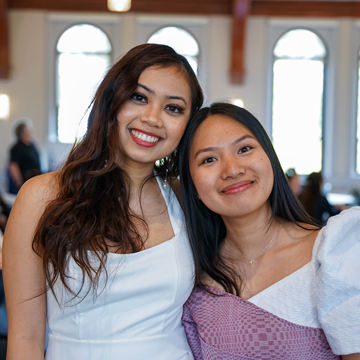
Reflecting on her family’s invocation of patience, Guillermo sees that “It is not just about patience. It is survival … My parents have lived these words their entire lives. Living in a country where education is often a privilege, not a right. In a system where hard work does not always guarantee fair pay, in a reality where opportunities, rights, and resources are often robbed, they worked under the sun, gave what they could, and endured what they had to, because patience was not a choice, but a necessity … I carry that patience with me, but I also carry something more: I carry trust … from the mentors and friends, who believed in me at Simmons.”
After pronouncing the names of each of the 2026 first-gen graduates, Yanzon welcomed the next student speaker, Justine Paragas ’26, a public health major. Paragas shared her experiences growing up in the Philippines and caring for her autistic younger brother.
“I knew that things were going to be different for our family. And for me, that meant carrying them with me in everything I do,” Paragas said.
She brought that mindset with her when she came to Simmons.
“Being first-generation is not just about struggle. It’s something to be proud of. It means being the first to navigate systems that weren’t built for us,” she said. “The first to ask questions no one taught us to ask. The first to build something — not just for ourselves, but for everyone who comes after us. We are not behind. We are pioneers.”
She praised the community she found at Simmons, noting that “friends carried me through some of my hardest moments,” advising peers to “lean into your community. Ask for help. Take up space. Because you belong here.”
Paragas ended with a common saying in her culture: “Malayo pa, pero malayo na. We still have a long way to go — but we have already come so far.”
‘A Master Class in Resilience’
Assistant Vice President for Diversity, Strategy and Engagement Rachel Deleveaux, herself a first-gen college student, delivered the closing address.
She told the graduates, “This isn't just a ceremony where you receive a piece of paper; it is a total disruption of the status quo. You are standing here today as a living, breathing defiance of every statistic that said you wouldn't make it to this room.”
Noting that one in five first-gen students leave higher education after their first year, Deleveaux acknowledged the challenges these students likely faced: from “financial gymnastics,” a lack of understanding of complex forms and systems, as well as the desire to assist a family likely still in need of support.
It is, as Deleveaux describes, “a master class in resilience.” The graduates assembled also exhibit the everyday leadership that Simmons so highly values. As Deleveaux said, “the quiet courage to keep showing up when it would have been easier to disappear.”
For Deleveaux, these challenges serve an important role.
“A diamond is just a piece of carbon that handles extreme stress exceptionally well,” she said. “It took intense heat and crushing pressure to create that brilliance. The pressure you felt over these last few years? That wasn't meant to break you. It was the universe refining you into something unbreakable … Class of 2026, the pressure was real, and the heat was intense, but look at you now. Look at how you shine.”