
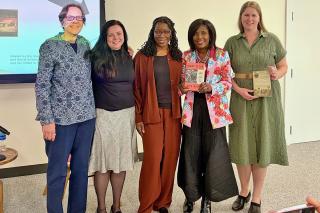
Simmons hosted the 2026 Robert M. Gay Memorial Lecture on April 10. This year’s distinguished speaker was Tiya Miles, the Michael Garvey Professor of History and Radcliffe Alumnae Professor at the Radcliffe Institute for Advanced Study at Harvard University. Miles spoke about spiritual and ecological approaches to reconstructing and understanding Harriet Tubman.
Established in 1964 by Simmons alumnae/i Eleanor Bates ’39, Miriam Gosian Madfis ’40, and Dorothy Gove Russell ’32, the annual Robert M. Gay Memorial Lecture brings distinguished guest scholars to Simmons for an inspiring lecture and conversation. Hosted by Simmons’ Department of Humanities and co-sponsored by the Gwen Ifill School of Media, Humanities, and Social Sciences and the Office of Research and Fellowships, this event honors the legacy of Professor Robert Malcolm Gay (1879–1961), a longtime Simmons faculty member who joined the English Department in 1918.
At the 2026 lecture on March 10, Professor and Chair of the Humanities Department Wanda Torres Gregory recounted Gay’s numerous teaching and leadership roles. He was an accomplished scholar who published numerous books, including Writing Through Reading: A Suggestive Method of Writing English, with Directions and Exercises (1920), Emerson: A Study of the Poet as Seer (1928), and a volume of essays entitled Another Look at Women’s Education (1955).
This year’s Robert M. Gay Memorial Lecture featured a talk by Harvard professor Tiya Miles. Entitled “‘Getting Fitted for the Work’: Harriet Tubman’s Preparation for a Lifetime of Courageous Action,” Miles’s lecture reconstructed the early life of abolitionist Harriet Tubman (1822–1913). She considered how religious faith, environmental knowledge, and social relationships prepared Tubman for a lifetime of bold activism and creative community building. Miles based her talk on her most recent book, Night Flyer: Harriet Tubman and the Faith Dreams of a Free People (Penguin Books, 2025).
Miles is the Michael Garvey Professor of History and Radcliffe Alumnae Professor at the Radcliffe Institute for Advanced Study at Harvard University. She is a public historian, academic historian, and creative writer. Her books have won numerous awards, including Yale University’s Frederick Douglass Prize and the National Book Award for Nonfiction.
Everyday Leadership
At the beginning of her welcome address, President Lynn Perry Wooten recounted fond memories of Miles when they both served on the faculty at the University of Michigan. “Even back then I knew she was a superstar,” Wooten said.
Wooten also reflected on the overlapping lifespans of Harriet Tubman and John Simmons (1796–1870). “Each of them thought a lot about freedom, education, and opportunity. So, both in their own ways, they expanded the boundaries of possibilities,” she said.
For Wooten, Tubman exemplified everyday leadership. “Everyday leadership is not about titles or recognition It is the choices she made daily. The choices to act with integrity. The choices to support others to challenge injustice. And the choices to be an influence When the stakes were high, she did the work of everyday leadership,” she said.
The Power of Public History
Assistant Professor Jamie Lee Andreson situated Miles’ oeuvre. She first encountered Miles’ scholarship as a doctoral student at the University of Michigan. “Over the last decade, her words have made an immense impact on public conversations of race, gender, and history,” Andreson said.
Andreson drew particular attention to Miles’ All That She Carried: The Journey of Ashley’s Sack, a Black Family Keepsake (Penguin Random House, 2021), a New York Times bestseller that won eleven literary prizes. Andreson has used this book in her undergraduate and graduate teaching at Simmons. “This text foregrounds the importance of narrative construction, the power of storytelling, and the public impact of historical research,” she said.
Moreover, All That She Carried employs creative methods to contend with the “archival silences” that haunt enslaved Black women’s lives. According to Andreson, Miles’ scholarship “shows that silence in the historical record is not an excuse for erasure,” and that fabulation and empathy can help tell “a fully human story.”
Commenting on Miles’ research on Tubman, Andreson noted that, at this critical moment when humanities disciplines are being underfunded and marginalized, and policies seek to ban African American history from schools, “authors like Tiya Miles are bringing fundamental American stories accessible to wider publics.”
Reconstructing a Life of Courage
Assuming the podium, Miles explained that the title of her talk originates from a phrase attributed to Tubman, as well as Tubman’s lifelong display of courage. Tubman “was actively engaged in interpreting her environment, her social relations around her, and what she could do about them,” Miles said. Night Flyer, for Miles, is “an attempt to position Harriet Tubman in relation to our times, and try to understand her in layered contexts by going as far as the sources allowed into her interiority.”
Throughout her lecture, Miles focused on two main themes: Tubman’s Christian faith and her ecological consciousness. As Miles found, Tubman’s belief was akin to “a higher purpose or a mission,” and “while she called the outcome of her thought processes God’s guidance, we can also call it brilliance.” Tubman developed environmental knowledge by observing the woods and waterways around her. “This would help make her into a liberator,” Miles said.
Born as Araminta Ross to enslaved parents in Maryland, Tubman grew up severely neglected, as her parents were often out laboring. As Miles recounted, some of Tubman’s earliest memories were the gum trees that populated the forests of Dorchester County. Tubman learned to survive alone in the wilderness for days at a time. Miles read a quote attributed to Tubman: “I grew up like a neglected weed. Ignorant of liberty, and having no experience of it.” This plant metaphor piqued Miles’s interest. “She saw her world primarily as analogous to natural things [and] she was tough [and resilient],” Miles said.
As a teenager, Tubman was subjected to hard labor, including logging. Reflecting on this period of her life, a quote attributed to Tubman relates: “I was getting fitted for the work the Lord was getting ready for me.” In Miles’s view, this work was an education for Tubman. With her father, woodsman Ben Ross, she was “learning how to read the woods,” Miles said.
After suffering a grave head injury, Tubman was plagued by painful headaches, seizures, visions, and vivid dreams. “She interpreted those visions and dreams as messages from God,” Miles said. Tubman “entrust[ed] herself to God,” which, Miles argued, was “the same logic she used for the Underground Railroad.” Despite suffering poverty in her later years, Tubman continued to help others.
At the conclusion of her lecture, Miles shared lessons she gleaned from Tubman’s story. Some of these lessons include: “have faith in a power larger than yourself,” “trust that adversity builds strength,” “know that disruptions to entrenched systems of power and abuse can come from the most unlikely of people,” and “like Tubman, know that we have to save ourselves.”
Discussing Swampy Archives and Ecowomanism
Assistant Teaching Professor Cait Parker joined Miles in a discussion. Parker first inquired about what Miles calls the “swamped sources” in the Tubman archive (i.e., sources muddied by others’ perspectives and biases). For Miles, the term came from “picturing Tubman in her natural environments” as well as the complex political and racial identities of Tubman’s contemporaries who wrote about her.
Miles supplemented these sources by creating her own archive, including photographs she took of Tubman’s natural environments. Miles’ research also drew on a late nineteenth-century quilt by formerly enslaved Harriet Powers (now part of the collection of the Museum of Fine Arts, Boston). The quilt depicts the Leonid Meteor Storm of 1833, which had a profound impact on Tubman. “It is really just about finding various materials that help tell the story I had to get a sense of Harriet Tubman,” Miles said.
Parker asked Miles to elaborate upon her concept of “ecowomanism.” Essentially, Miles combined author and activist Alice Walker’s notion of womanism, which is rooted in Black southern women’s experiences, with an ecological sensibility. “We could call it Black feminist environmentalism,” she said.
During the Q&A with attendees, Miles discussed issues of speculation, imagination, and community. One audience member, Professor of Practice of Social Work Gary Bailey, noted several Simmons/Boston connections to Tubman, including the Harriet Tubman Park and Tubman biographer Kate Larson ’80, ’95MA, a Simmons alumna who authored Bound for the Promised Land: Harriet Tubman, Portrait of an American Hero (Penguin Random House, 2003).
The event concluded with a book sale and signing.