
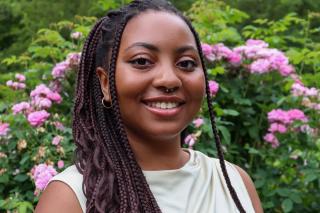
What are the most impactful things you have done during your graduate program at Simmons?
My favorite part about being a Simmons School of Library and Information Science (SLIS) student was how I was encouraged to bring my interests and passions to my coursework and create projects that I was genuinely excited to explore.
For example, I planned collection guidance for a Haitian and Caribbean literary collection aimed at public libraries, created instructions for implementing Mutual Aid, and generated guidelines for how the library can play a role in supporting independent community networks. In this way, the work I did for SLIS felt not only like one-off assignments, but works in progress that I can continue to improve upon throughout my future career.
I am also proud of the connections I made and people I met through SLIS, including the close friends that I met in one of my first SLIS classes, “Information Organization” (LIS 415).
Did you participate in any internships during graduate school?
During my first semester, I became a library services assistant for Fenway Library Organization, a Massachusetts-based consortium of academic and special libraries. Since then, I also worked as an archives assistant at Northeastern University and as a senior substitute librarian at the Somerville Public Library during my time at SLIS.
These experiences have given me great perspectives into what it is like to work in a variety of library spaces, from archives to academic libraries to public libraries, and have helped me narrow my focus and interests in terms of what I wanted to learn and get out of my SLIS experience. I learned about all of these opportunities through the SLIS Jobline, so be sure to use that resource as the institutions that post there are eager to work with SLIS students.
What was your favorite Simmons course and why?
I have enjoyed so many courses during my time at Simmons, and choosing the libraries and librarianship concentration let me explore my interest in a library career while exploring where my other interests lie. Some of my favorites have been “User Instruction and Information Literacy” (LIS 408), and two classes that I’m currently taking: “Literacy and Services to Underserved Populations: Issues and Responses” (LIS 422), and “Oral History” (LIS 433).
“User Instruction” was a supportive and collaborative classroom environment that helped me improve skills such as learning about your audience, lesson planning, and considering literacy and teaching from diverse perspectives. I use these skills not only within an instruction context, but also when I assist patrons at a reference desk, or when I’m planning presentations and events.
I appreciate “Services to Underserved Populations” and “Oral History” because they encourage us to engage with the larger Boston community in our work and learning. “Services to Underserved Populations” gives opportunities to learn from programming librarians and the valuable inclusive services they provide through investigative projects and field trips. The process of doing an oral history project has been very rewarding, and has led me to connect with the wonderful community organizations Queer History Boston and LGBTQ+ Elders of Color.
Who was your most influential Simmons professor/mentor and why?
There are so many great professors and faculty members within SLIS that I have had the pleasure of meeting and working with. Professor and SLIS Associate Dean Laura Saunders inspires me to continue combining information literacy advocacy and social justice activism in my professional and personal life.
I loved how in the class I took with her, “User Instruction,” she gave students the chance to learn by doing, for example, through running our own mini instruction and presentation sessions with our peers, which really helped to build up my confidence with teaching and presenting.
How has Simmons prepared you for your intended profession?
At Simmons, I often found that what I was learning in the classroom directly coincided with experiences I was having while working in libraries. My “Technology for Information Professionals” (LIS 488) and “Introduction to Programming” (LIS 485) classes help me evaluate the accessibility of online catalogs and web resources.
I took “Reader’s Advisory and Popular Culture Trends” (LIS 532R) as I was working at the Somerville Public Library reference desk and needed to help patrons with book suggestions. “User Instruction and Information Literacy” was great for informing the focus of the yearly Information Literacy Symposia I plan for Fenway Library Organization.
Simmons has truly helped me to become more knowledgeable and confident in my skills as a library professional, including learning technical skills like coding, gathering and analyzing data, and technical grant or report writing, and more interpersonal skills, such as being a better and more effective communicator, and viewing issues from multifaceted and diverse perspectives.
How did you find your community at Simmons?
In the fall, I started to attend meetings for Students of Color at SLIS (SoCS). Being a person of color in Boston can feel isolating at times, and it can be difficult to find community and places that feel safe, but they do exist! SoCS is a great student community here at SLIS, and also volunteering and getting involved in creative hobbies are good ways to connect with other people.
If you’re having trouble finding a group that you want to join, try making your own. If you talk enough about it and put the word out enough, people will come find you, as most people are also looking for that same sense of community and belonging.
In your experience, what was the best thing about attending graduate school in Boston?
This city has lots of opportunities for connection, exploration, and learning, especially with the number of libraries, archives, and museums. Most of the people I have met in Boston have been supportive, eager to share about their work, and willing to help and give people a chance.
Through current and past internships and just through talking to people, I’ve been able to establish new personal and professional connections and feel more rooted within the city.
What advice do you have for current and incoming Simmons students?
Take chances and try everything because anything can be an experience. Even if you don’t end up getting the result you initially wanted or expected, one action always leads to another and nothing is a waste. Don’t be afraid to reach out to people and ask questions, both inside of Simmons and within the larger Boston community.
It can be scary to go out on a limb and send an email to that organization or insert yourself into that conversation, but many of the connections that I made as a student came out of taking a chance and just telling people that I was interested in their work and wanted to learn more.
Take the time to volunteer, to attend community events, and to ask others about what they’re doing and interested in. Keep an open mind, and look out for newsletters and Instagram posts for events! Also, keep looking for opportunities to learn and grow, even after graduating. Once a student, always a student.