
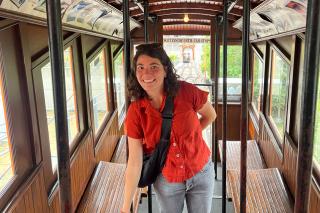
Joan Vera ’27MSN shares her experience in the direct entry Master of Science in nursing and post-graduate certificate family nurse practitioner (MSN/PGC FNP), an accelerated program for students who completed a bachelor’s degree in a field outside of nursing.
“My mom was a nurse, so I always had it in the back of my mind as a career I wanted to pursue,” says Joan Vera ’27MSN, currently in her second year of the accelerated direct entry Master of Science in nursing and post-graduate certificate family nurse practitioner (MSN/PGC FNP).
After completing an undergraduate degree in Vermont, she moved to Boston for a case management resource role in healthcare, working at two community health centers.
“I liked the community I was building in social services and healthcare, and the opportunities in Boston,” says Vera. “I started looking for nurse practitioner (NP) programs in the city, and Simmons worked out.”
Clinical Placements
As part of the program, students engage in clinical placements early, as required for pre-licensure as a nurse. In preparation, students spend time in the Nursing Simulation Center throughout the semester to practice basic nursing skills.
“Simulation days were helpful to get some jitters out,” says Vera. “It’s helpful to have an open learning environment where we can treat things as if they are real, but it’s actually low stakes, and we can debrief afterward.”
Now halfway through the program, Vera has already experienced a variety of clinical placements. She praises the clinical nursing instructors she encountered in all of her clinical rotations; these are nurses contracted through Simmons to supervise students and teach them skills on the floor.
“They give you a layout of what you can expect on the floor, and what you will do throughout the semester,” she says. “You’re learning content in the classroom to be tested on during clinicals. Preparation matters, but a strong instructor is going to provide the support you need and be a good coach.”
The last semester of the RN portion of the program includes a “Clinical Capstone Practicum” (NURS 419). “During the capstone, you are one-on-one with a clinical instructor. It’s a nice culmination to have that much time,” she says.
For her capstone experience last fall, Vera worked night shifts at Cambridge Health Alliance (CHA). “I was matched with an incredible nurse on the labor and delivery floor,” says Vera. “I watched 10 babies being born!”
A small hospital with a diverse patient population, CHA includes doulas (trained to provide continuous support throughout labor and delivery) and midwives on staff, and students in clinical rotations. “It was really cool to see a unique healthcare dynamic, all dedicated to providing the best possible care for patients during labor.”
The busy environment of a clinic or hospital has proved enlightening for Vera. “A lot of learning comes from being in the setting and being a sponge: absorbing as much as you can with the support of your nursing instructors,” she says.
Learning in the Classroom and on the Job
Vera’s coursework continues to make a huge impact on her nursing experience. She recommends “Community & Population Health” (NURS 436), taught by faculty member Colleen Wiggins.
“The class was really integrated with social and racial justice as a foundation to providing good nursing care,” says Vera. “That was really refreshing to hear in her nursing lectures; she’s wonderful.”
This spring, Vera took “Advanced Health Assessment Across the Lifespan” (NURS 530) with Associate Professor of Practice Kaylee Burke and “Advanced Pharmacology Across the Lifespan” (NURS 424) with faculty member Elaine Ferreira. “They gave wonderful lectures. I’m taking classes with them again this summer, and I’m so excited.”
Working in the Healthcare Field
Now a registered nurse (RN) and pursuing the second half of her degree (which will prepare her to pass the NP exam), Vera is a nurse at the St. Francis House clinic supported by Boston Health Care for the Homeless.
“I have only good things to say about this role and the organization,” says Vera, who works three days per week at the clinic and shelter. “I’ve been lucky with this job. I’ve learned so much about addiction medicine and homeless healthcare. I enjoy the patient population and my coworkers. Every day, there’s something new. And the work is aligned with the social justice frameworks that are part of my values.”
Working in the field since her licensure has informed her learning, Vera says. “I work in an outpatient setting with nurses who are really great teachers, and everything we do connects to what I learn in the classroom. My direct supervisor is an NP, and I also work with doctors, nurses, social workers, and volunteers. It’s a full spectrum of healthcare. I’m very grateful that I get to work as a nurse [while in the program]. The job I am in right now will prepare me for NP work.”
And her work at St. Francis may pave the way toward future roles. “I would love to stay involved in community health. It’s been very cool to feel supported and focused on homeless healthcare. It’s been very rewarding, and I’m enjoying my experience at the shelter and working with the patients.”