
“In my opinion, [children’s literature] is the most important literature that exists,” says Cassie Sheets-Kavanagh ’18MA. “You interact with it in your formative years, when you’re figuring out your place in the world, making initial meaning out of your experiences.”
For Sheets-Kavanagh, it’s vital for children’s literature to reflect different cultures and experiences. “The key is to expose kids to literature that diversifies their worldview, helps them see beyond a monocultural perspective, which is typical of K-12 schools, and makes the world a better place.”
Children’s books can broaden a child’s perspective. “Ideas about humanity are formed at 8 years old that can’t easily be undone in later years,” she says. “Storytelling is the most globally shared way of making meaning in our world.”
Broadening Cultural Perspectives
Before earning her master of arts in children’s literature at Simmons, Sheets-Kavanagh earned her bachelor’s degree in women’s studies and her first graduate degree in sociology. One Christmas Eve spent working at a homeless shelter made her reflect on the impact of children’s literature.
“I read a picturebook version of The Night Before Christmas [based on the original poem by Clement Clarke Moore]. I’ve never heard the cafeteria get that quiet — it was wild. The chaos became a whisper.”
A resident at the shelter was moved to tears, remembering his grandfather reading the story to him as a child. “[The book] didn’t fix the systemic issues of poverty, but it reminded us that there is hope. I realized that this is something children’s literature does for us: it brings us back to who we can be.”
Growing up in a suburb of Ohio, Sheets-Kavanagh reflects that she “didn’t get one piece of literature with an LGBTQ+ person in it.” As a bisexual woman, she feels that having access to such literature “would have changed my life, my confidence, my place in the world.”
While publishing has diversified in recent years, it still most often reflects a White, middle-class experience. “It’s bad for members of a hegemonic culture to see only themselves. You will think only your perspective matters.”
Opportunities at Simmons
Sheets-Kavanagh chose Simmons because the program took the study of children’s literature seriously. “It was a very rigorous study of craft, and the implications of that craft, and I wanted to be a part of that conversation.”
Thanks to connections she made at Simmons, she has “seen children’s literature from so many perspectives.” She was an intern, then a freelance editorial assistant, at Charlesbridge Publishing, which afforded a glimpse of “what publishing looks like on the inside.”
Later, she became the event manager of the Boston Globe–Horn Book Awards while in the program. “I got to work with amazing writers, illustrators, and poets. Celebrating them was an honor.” She also supported the Boston Book Festival, an opportunity to see what publishing and community can look like.
“I’m very grateful that Simmons gave me these opportunities to gain perspective on what children’s literature can do,” she says. “It launched my career, not just in networking and self-development, but in a richer understanding of what we are trying to do and how we are making an impact. That work has informed my career ever since.”
After graduating in 2018, Sheets-Kavanagh was hired by School Library Journal as a Cultural Literacy and Diversity Trainer. “I traveled the country and spoke to entire districts of teachers about how to diversify their libraries.” She helped librarians and teachers understand inequities of educational systems, and grappled alongside them about how to respond to local, cultural, and administrative barriers. All of these experiences have “led to a larger understanding of children’s literature, dissecting it in [Simmons] classrooms, and later in K-12 classrooms. I’ve had opportunities to be in community with different stakeholders. ”
Traveling from Seattle, Washington, to Fargo, North Dakota, the cultural differences were clear, but common issues still came to the fore. “There were some people who didn’t understand why the work mattered. They would say, ‘It’s just a kids’ book.’ But these are transformative tools for education,” she says.
Educating Future Teachers
Before enrolling in her current PhD in curriculum, instruction, and teacher education at Michigan State University, Sheets-Kavanagh was the director of a literacy nonprofit, Writing Coaches of Montana.
“I loved it,” she says. “We brought trained community members in to work with grades 4–12 in public schools, offering feedback on anything a child wrote. I watched transformation take place on an individual level. However, the K-12 curricular canon was still very White and heteronormative.”
Meanwhile, caring for two small children in an area with a steadily increasing cost of living, Sheets-Kavanagh and her husband opted to move closer to family in the Midwest. There, she began her PhD program, teaching education students the foundations of education, social justice, and intersectional anti-oppression.
One element of this work is guiding preservice teachers to select “read aloud” books for literacy instruction. While assessing phonics is often constructed as purely technical, the material used in assessment has broader, cultural implications.
“If a child can’t see themselves or culturally connect with the literature used to teach these concepts, it’s all moot,” says Sheets-Kavanagh. “A low-income child who just immigrated may not know what a vacation is; if you only ask comprehension questions about middle-class vacations, there is a lack of connection to lived experiences. We have to train teachers to critically evaluate their own positionalities, broaden their evaluation skills for literature, and offer students a variety of stories that motivate them to learn.”
She shows her students how to select content in a culturally relevant way, to support all of our kids equitably. “Teachers have to be educated about all of this before they can make strategic choices in the classroom,” she says.
“Without my background in children’s literature at Simmons, this would be so theoretical. I wouldn’t understand the power of all of this,” she says.
The Call for Moral Courage
The fields of publishing and education are staffed predominantly by White, straight, middle class, and cisgender women. As both a member and outlier of that group (as a bisexual woman), Sheets-Kavanagh is aware of her own privilege.
“Many people trying to ban books right now genuinely believe in what they are doing. It’s heartwrenching because it comes from a place of fear and hatred, on both individual and systemic levels,” she says, noting the moral challenge of offering books with LGBTQ+ characters in a school district where children may be taught at home that it’s not OK to be gay.
“That’s why I’m dedicating my life to educating the next generation of White, middle-class teachers. White people can’t expect marginalized populations to do it. We need to have moral courage. I look up to many of the people I’ve met through publishing who’ve made historical differences: Black authors who wrote about desegregating the South, artists who are immigrants and speak truth to power. If they can do that, White educators and publishers need to muster up the courage to do our part, too.”
To follow her passion to make an impact on the world, Sheets-Kavanagh says she has to believe in the work and adopt a growth mindset.
“I have learned from mentors that education is not painless, it is a transformation,” she says. “You will be torn apart and put back together again. You need to be willing to grow, and to accept that you don’t know everything and that you need to learn.”
Cassie’s Recommended Reading:
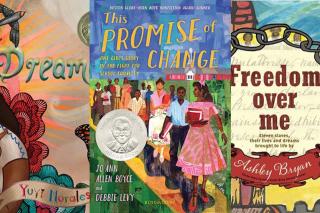
- This Promise of Change: One Girl’s Story in the Fight for School Equality by Debbie Levy and Jo Ann Allen Boyce (Bloomsbury Publishing USA, 2019)
- Dreamers by Yuyi Morales (Holiday House, 2018)
- Freedom Over Me: Eleven Slaves, Their Lives and Dreams Brought to Life by Ashley Brian (Atheneum/Caitlyn Dlouhy Books, 2016)