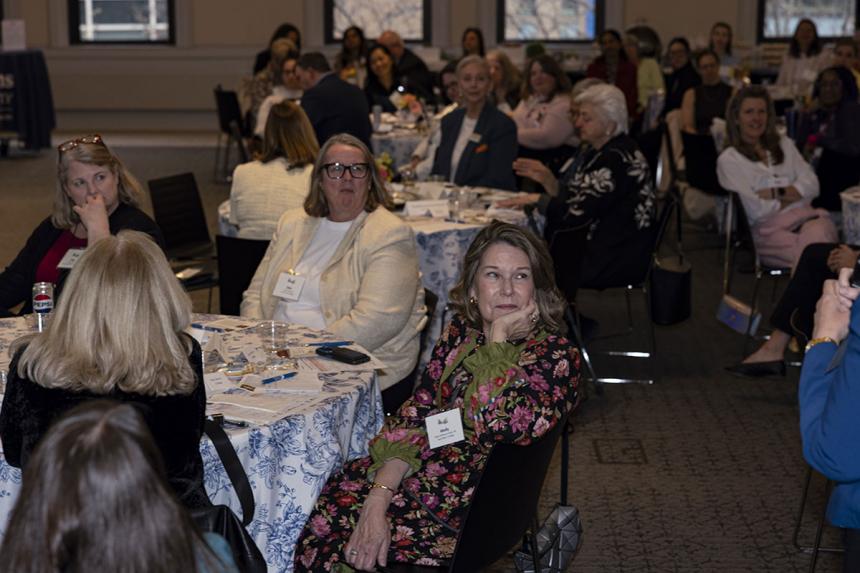
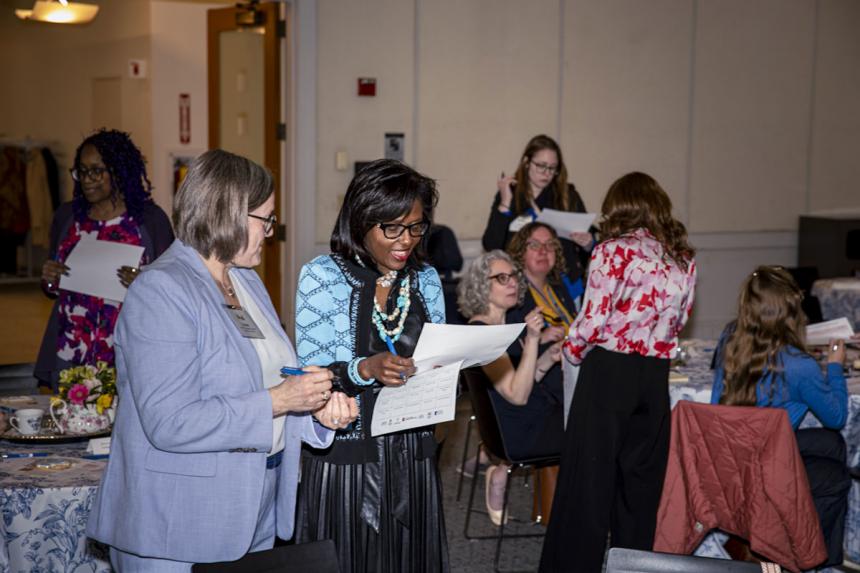
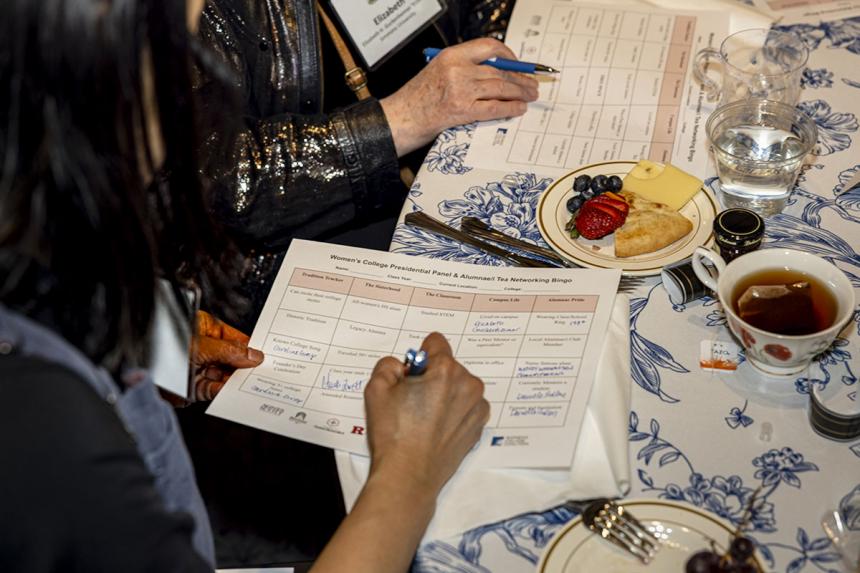
Simmons University hosted a Presidential Panel and Alumnae/i Tea in celebration of women’s college education on Sunday, April 12. Planned with the Women’s College Coalition, the event featured a panel with Saint Mary’s College President Katie Conboy, Mount Holyoke President Danielle R. Holley, and Barnard College President Laura Ann Rosenbury, moderated by Simmons President Lynn Perry Wooten. The event also brought together staff, leadership, and alumnae/i from Agnes Scott College, Brenau University, College of Saint Benedict, and Rutgers-New Brunswick Douglass Residential College.
President Lynn Perry Wooten welcomed the audience with a round of applause for all of the alumnae/i of women-centered institutions.
“This collective convening of alumnae/i shows your commitment to equity, social mobility, and gender parity,” said Wooten. However, the challenges are stark: in the 1950s, 250 women’s colleges were in operation. Now, only 30 remain. Wooten asked the panelists, “How do we create a future? How do we create a collective identity for women’s colleges?”
The Impact of Political Turmoil
The panelists agreed with Wooten that the last six years have brought unprecedented change in this country: politically, economically, and in the world of higher education. Both Wooten and Saint Mary’s President Katie Conboy — who served as Provost and Senior Vice President of Simmons University from 2013 to 2020 — began their presidencies in the midst of a global pandemic. Mount Holyoke President Danielle R. Holley and Barnard College President Laura Rosenbury began their presidencies in 2023, months before the October 7 terrorist attack against Israel.
“There was a lot of disruption [at Columbia] that affected our campus deeply,” said Rosenbury, noting the long-standing contractual relationship between Barnard College and Columbia University. She also noted that these protests were different from “traditional protests of students against the administration or students against the government,” in that there were divisions between students across the campuses.
“We’ve come through that by recognizing that, as an institution committed to learning, disagreement is core to learning,” she said. “We can’t learn in an echo chamber. We need to embrace diversity of backgrounds, experiences, and opinions, and do so boldly and bravely.”
Given these particularly intense challenges, Holley emphasized the power of her institution’s motto. “Mount Holyoke was ‘forged in dissent,’” she said. “In the face of so much turbulence, dissent is important. We must ask critical questions about how to make things better for women and girls and marginalized communities. Combining personal purpose with education is what powers us forward. That is the spirit in which Mount Holyoke was founded…and those ideas are more resonant today than they have been in 100 years.”
Committing to the Empowerment of Women
Reflecting on the bold vision of Simmons’ founder, John Simmons, who believed in educating women for independent livelihoods, Simmons University remains poised to prepare women to shatter glass ceilings. Given that there are still such ceilings to shatter, what makes women-centered colleges relevant in 2026?
“We have to make sure we’re not thinking about ourselves as a relic of the past, but as a strategy for the future,” said Conboy. “We are living in a paradoxical time. Women are getting degrees at higher rates than men, but are not retaining the positions of power at the same rate as men. Young women of college age are experiencing a crisis, [needing] a sense of belonging. Our colleges are an antidote for this moment … by intentionally designing our spaces to address these issues, so that the people who come to our colleges know that they are known and seen.”
Rosenbury noted that “it is incredibly special to be part of an organization committed to the empowerment of women…[culturally, in the US] We now have a resurgence of traditional gender role conceptions that seek to limit the opportunities available to women. That we are expanding possibilities is more vital than ever.”
She also noted the need for more women in the field of AI; creating, regulating, and deploying it equitably and fairly. “Women’s colleges sent more women to medical school in the 1950s and ’60s, they diversified Wall Street in the 1970s and ’80s. Now we need to diversify the tech industry at this crucial moment in our history.”
This highlights the need for updated research on student outcomes, noting that graduates of women’s colleges are more likely to pursue a PhD in a STEM field.
“Women’s colleges are still outperforming their coed counterparts, also in terms of law school, business school, and medical school,” Rosenbury said. “We know the outcomes are extraordinary, but the current [data] is outdated, not talking about the last 20 or 30 years.”
Balancing Tradition and Innovation
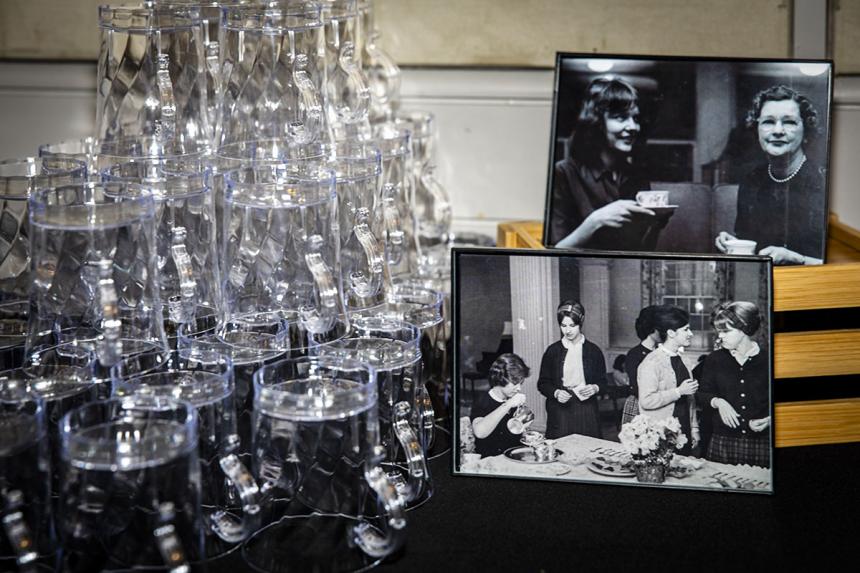
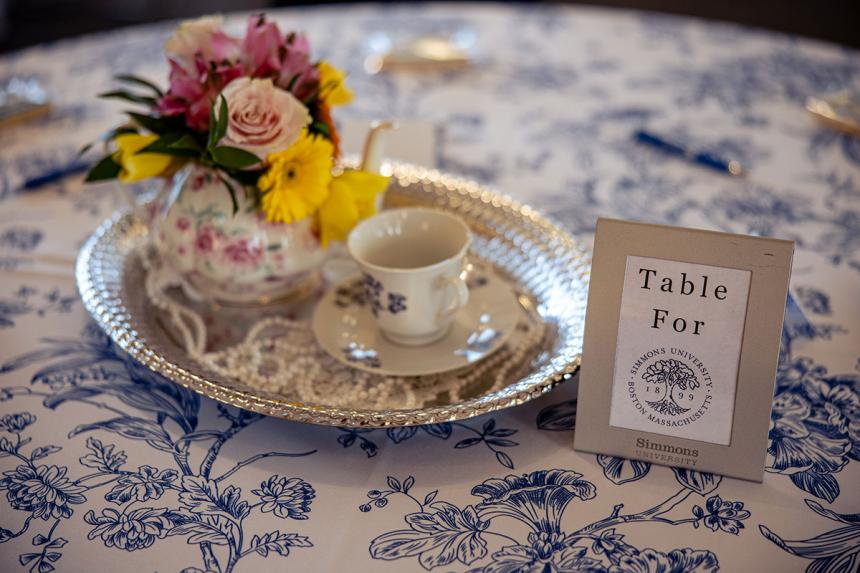
The panelists acknowledge that many traditions have ebbed and flowed over time, regarding May Day and tea time, as well as the curriculum.
“Fifty percent of our students are majoring in STEM,” noted Rosenbury. “[We choose to] double down on our liberal arts tradition while acknowledging that our students want to major in STEM.”
Conboy addressed traditions across all sectors of her institution. “I asked everyone: when you think about Saint Mary’s, what do you revere and what would you revise?” The broad range of responses informed strategic planning and empowered students to reclaim epithets once intended as derogatory. “We are always thinking about what the world needs right now,” said Conboy, noting the founder’s motto to “read the signs of the times and respond.”
For Holley, gender and identity are central to tradition. “We are a gender diverse women’s college, with nonbinary and trans students,” said Holley. “It was very important that we revise our traditions to reflect our current student body.” Mount Holyoke changed their admissions policy inclusive of genders assigned at birth or personal pronouns. Despite this inclusivity, Mount Holyoke retains the identity of a women’s college.
“Our identity hasn’t changed, it has just become more inclusive,” said Holley. “Gender is not stagnant, it’s on a spectrum. We have students who will come to Mount Holyoke as women and may graduate with a new identity.”
Rosenbury noted an additional challenge in perceptions, the notion that women’s colleges that went coed “broadened their mission” by doing so, “implying that our missions are narrow, which I think is deeply problematic,” she noted. “By remaining devoted to women and gender diverse individuals, we are expanding our mission and our reach.”
What is a Women’s College?
Historical Black Colleges and Universities (HBCUs) are federally designated by the US Department of Education. “We don’t have that for women’s colleges, which creates a challenge for our sector,” said Holley, noting that large donors typically do not invest in women’s colleges. To attract big investors, Holley feels that research is key.
“If you want to invest in improvements to women’s health and democracy around the world, why not invest in women’s colleges?” she said. “What can we do to move forward with research on menopause, breast cancer, and food shortages? Those are the questions that will help us get these 30 colleges into the next century.”
Conboy noted that in 2022, women’s colleges received recognition from Congress for their work supporting women and other marginalized groups. Given the current political climate, further federal recognition is currently on pause. “I’m hoping for further federal recognition before we lose more [women’s institutions] as that could ensure federal funds and attract big donors.”
Developing Leaders in Women’s Colleges
“An important role of women’s colleges is developing leaders,” said Wooten, noting that Simmons University was selected by the Carnegie Foundation for the Inaugural Leadership for Public Purpose Classification. “At Simmons, leadership is taught inside and outside of the classroom, for your career, your community, and your personal life. Leadership is embedded in our DNA.”
For Rosenbury, “every student who comes to Barnard is already a leader. Our job is to expose them to a much broader conception of leadership.” Conboy echoes this approach, noting that “leadership is not positional, we can define and model leadership in different ways. I can lead from where I am right now, in my profession, in my community.”
Holley notes that Mount Holyoke prepares students for “lives of purposeful leadership.” In addition, she wants young women to pursue their ambitions without inhibition.
“There is nothing wrong with wanting to earn money,” Holley said. “Do I want to see a woman as the chair of JP Morgan? Yes! We have to be willing to tell our students that leadership can come in all varieties, but we can’t fail to aspire to things that women haven’t done before. We should never exclude ourselves from any opportunities. Our students have experienced challenges [since COVID-19], and difficult times can be an opportunity for breaking barriers in positive ways.”
How Can Women’s Colleges Survive?
Wooten noted that women’s colleges receive less philanthropic support than other institutions, and often lack the endowments of larger universities. Wooten said to alumnae/i, “We need your treasure, time, talent, and testimony. Women should be leading the conversation about philanthropic plans in their households.”
Building an endowment is key to ensuring the future of any institution. In addition, the panelists encouraged alumnae/i to tap into the network. “Connect with other graduates, mentor students, help find an internship for a student,” Conboy suggested.
After a lively question and answer session with the audience, President Wooten thanked the panelists for their willingness to “remain relevant, resilient, and to reinvent. I truly believe that when you educate a woman, you educate the world.”