
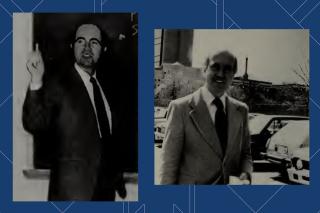
Professor Emeritus Donald W. Thomas, who served as a professor in the Department of Psychology at Simmons from 1966 to 1999, passed away in Santa Fe, New Mexico, on March 12, 2026. He was 90 years old.
Born on July 12, 1935, in Glendale, California, Professor Thomas enjoyed an enchanting childhood in a Craftsman-style cottage home. As he recollected, Southern California at the time was like a “Garden of Eden.” Though his sister was fifteen years his senior, she became his confidante.
Professor Thomas attended the University of California, Los Angeles, for his undergraduate studies as a first-generation student. He was initially an engineering major and then switched to psychology, obtaining his bachelor’s degree in 1958. While in Los Angeles, Professor Thomas was employed at Panavision, a motion-picture lens and camera company, and completed a stint in the US Air Force. For a period, Professor Thomas also worked at Thompson Ramo Wooldridge (TRW Inc.), which, according to him, was “one of the premier think tanks” of the time. For this position, Professor Thomas obtained top-secret clearance to work on the first photo reconnaissance satellite system.
In 1964, Professor Thomas received a master’s degree from the University of California, Santa Barbara. At UCSB, he wrote a master’s thesis on visual space perception (i.e., how to judge size at a distance). He also became fascinated with biological psychology. Thereafter, Professor Thomas went to Tufts University to focus on engineering psychology and human visual information processing. He obtained his PhD in 1966 and then completed a postdoctoral fellowship at Harvard University’s Department of Nutrition, where he conducted research on obesity.
Professor Thomas’s specialization in psychology encompassed eating disorders, obesity, and the regulation of food intake. In particular, he studied how psychological and environmental factors influenced the development of eating disorders. The Simmons student newspaper, formerly known as Janus and now The Simmons Voice, covered guest lectures by Professor Thomas on the subjects of obesity and eating disorders in 1975 and 1989, respectively.
While still a postdoc, Professor Thomas began teaching for Simmons as a part-time faculty member in 1966 and assumed a full-time appointment in 1968. At Simmons, he taught “Biological Psychology,” “Physiological Psychology,” “Research Applications in Biopsychology,” “Perception,” “Appetite, Obesity, and Anorexia,” and “Seminar in Psychobiology.”
During his tenure at Simmons, new labs were integrated into the (former) Park Science Center. Accordingly, Professor Thomas introduced laboratory components into some of the courses that had once been exclusively lectures. Over the course of his career, he published several papers in his field and took a sabbatical at Oxford in 1975. Professor Thomas retained active memberships in the American Psychological Association and the American Association for the Advancement of Science.
Professor Thomas was compelled to become an educator. As he expressed in a 2006 University interview: “I felt that was my calling … I always knew that I wanted to be a teacher.” Speaking about Simmons students, he added: “The [Simmons] students were super, … they were really outstanding. I had a number of students going to get their PhDs from those classes. Students were always super. I mean, that was the great thing about teaching here.”
From 1986 to 1991, Professor Thomas served as the Department of Psychology chair (then called Chairman). In 1994, he became the coordinator for the Psychobiology program — now the neuroscience major — which he co-designed with Professor of Biology Lewis Irwin. Moreover, Thomas served on numerous committees, including those that discussed the (former) H-P-F (Honors/Pass/Fail) grading system, faculty voting rights, and diversity. For 25 years, Professor Thomas chaired the Institutional Review Board, the panel that assures compliance with all federal regulations regarding the use of human subjects.
Professor Thomas’ Simmons colleagues have fond memories of working with him. “Don was a great partner and support in the education of our nursing students and a wonderful colleague … with a great sense of humor, wisdom, humility, and balance,” says Dean Emerita of the School of Nursing Judy Beal.
“Don Thomas was a treasured colleague. He showed a quiet, intellectual passion for his work and his students. Don didn’t seem to get caught up with politics. His kind, confident demeanor was appreciated by faculty colleagues and our students,” says former Registrar and Assistant Vice President Donna Dolan ’84, ’86MS.
For Professor Emeritus of French and Dean Emeritus of Humanities Charles Mackey, “Don was a devoted teacher, a wonderful colleague, and a great friend for many years. We were surprised to learn that we had both grown up in the greater Los Angeles area, not far from one another. We remained in close touch during [our] retirement years.”
After Professor Thomas retired in Santa Fe, he met his third wife, Diane. In the Southwest, he became very interested in Indigenous culture. He worked as a docent at the Indian Arts Research Center at the School for Advanced Research and at the Wheelwright Museum of the American Indian, where he gave guided tours and associated with curators.
Reflecting on his career at Simmons, Professor Thomas said: “I feel just really lucky to have had the experience of living here all those years, and I feel so lucky to have been at Simmons all those years. It was the perfect place for me, I just couldn’t imagine a better fit.” He also commented on his experience in a women-centered environment: “I always thought it was wonderful having just female students because there was this thing about empowerment … I really loved it when they could tell their parents how they did this and that and the other thing, and see them grow in confidence. That was the most beautiful thing about the whole business.”
Made possible by gifts from friends and colleagues, Simmons established the Donald W. Thomas Award in Professor Thomas’s honor. Income from this fund is awarded to a senior whose work demonstrates a high and sustained level of excellence in psychobiology, psychology, or biology.
“In Boston, Don loved his academic life: students, colleagues, and research, as well as sailing. In Santa Fe, we enjoyed our Western heritage, joined by our dogs,” Diane Thomas reflects.
Professor Thomas is survived by his wife, Diane, and her family; and his daughter, Elizabeth, and her family.