
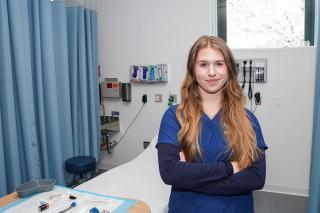
Jenni Costa ’27MSN is a student in the direct entry Master of Science in nursing and post-graduate Certificate family nurse practitioner (MSN/PGC FNP), an accelerated program for students who completed a bachelor’s degree in a field outside of nursing. She shares what led her to Simmons, and her experience in her first year of study and clinical rotations.
“I was a pre-med student in undergrad,” says Jenni Costa ’27MSN. “I knew I wanted to be a clinician.”
Costa earned her bachelor's and master’s degrees in public health from UMass Amherst. While studying for the MCAT (Medical College Admission Test), she worked at Mass General and Brigham and Women’s alongside nurses and nurse practitioners (NPs). “I shadowed some of the Nurse Practitioners, and they all went to Simmons.”
Meeting those Nurse Practitioners made her consider other options to meet her goals.
“I thought that if I didn’t have a bachelor’s in nursing, I couldn’t take that path,” she says. “When I learned about the direct entry graduate programs at Simmons, I realized that it was an option for me.”
While she considered other programs, she kept coming back to Simmons.
“I did the tour, and everyone was super open and communicative. It was a one-on-one tour, and I could hear the experiences of current students,” she says. “The admissions team was really good with communication, and I felt I was appreciated as an applicant.”
The Road to Medicine
Costa’s path to the medical field started around the age of 6. Her mother, a labor and delivery nurse, was diagnosed with ovarian cancer when Costa was a baby and passed away when she was 10 years old.
“Her NP was the point person for us, and [my mother’s] biggest advocate,” she recalls. “Spending time in hospitals and seeing the way they took care of my mom…I knew that I wanted to be a clinician.”
As a child, she didn’t know about the role of advanced practice nurse practitioners who can provide primary, specialty, and diagnostic care.
“While studying public health, I started to appreciate a holistic approach to patient care, which includes connecting patients with resources and enabling them to advocate for themselves, as well as thinking about what happens when a patient goes home from the hospital,” she says. “I felt like nursing aligned with those views — a mixture of my passion for holistic healthcare and treating physiological processes.”
In addition, Costa’s stepmother, herself a licensed doctor, acknowledged her dreams, and the reasons behind them, early on. “She has mentored me and helped me get to this point in my life. She supported me through making the change from medical to nursing school.”
Costa was pleased that her stepmother embraced the career shift. “She said that she saw something in me — she knew that I would be a good NP.”
Direct Entry Clinical Placements
Now finishing her first year of the program, Costa has already done three clinical placements. It’s all part of the design of the accelerated program, which confers a master’s degree in five semesters, after which students are ready to sit the NCLEX (National Council Licensure Examination).
“You hit the ground running with this program,” says Costa. “They need to prepare you in those five semesters to be a nurse. That’s why we start clinicals early.”
However, the first semester clinical rotation focuses on the foundations of nursing practice. Students visit an in-home nursing facility once every two weeks and engage in assistive care, helping feed, bathe, and ambulate patients.
“Students without any clinical exposure are eased into [the experience],” says Costa. “And [by your second semester] you will be prepared for medical and surgical rotations.”
Costa did her medical rotation this semester at Brigham and Women’s. “I was there twice a week in different units with different clinical instructors.” Her instructor floated between the different intensive care units (ICUs) and was part of the code team (a mobile emergency response team), but was primarily in a cardiac step-down unit, for patients in need of close monitoring but stable enough to leave the ICU.
“During that time, I got to give medication to patients, did wound care, and watched surgical procedures,” says Costa. “I also observed in the ICU and ER, and went with the code team on rapid response emergency care. It was super fascinating to me.”
It was also her first opportunity to participate in patient care and experience, firsthand, the “gory” side of nursing. “The nurses were so supportive,” she says. “They’ve all been there, their first time in this setting. The clinical instructors were amazing and inspiring, and really care about their patients.”
Costa has also done a psychiatric clinical rotation at Tufts Medical Center, where she was impressed by the rapport between staff and patients.
“I expected [the patients] to be more acute with their mental health illnesses,” says Costa. “They would have exacerbations while they were there, but the nurses and the security team had such a good rapport with the patients. They really cared about getting to the root of the problem and stabilizing patients, and learning how to prevent exacerbations from happening again. It was amazing to see such loving relationships between caregivers and patients.”
The experience was more positive than Costa had anticipated. “Social media can stigmatize these mental illnesses. Even the words that people use — that someone is crazy or bipolar or antisocial — when they aren’t describing the actual experience of someone who has these real diagnoses. Once you meet someone with the diagnosis, you understand it a lot more.”
That interaction with patients has made a difference in Costa’s appreciation of the work, as did the care the team offered.
“I talked to people about the experience of being restrained, and they were more reflective than I had imagined they would be. They were understanding, in retrospect, of why they had to be restrained, for their health and safety,” she says. “I believe that’s because of the care they are receiving … The nurses are explaining the processes and taking that extra step to debrief with them after an event or crisis, and taking that time has led to some great insights from these patients.”
Supportive Faculty at Simmons
Costa offers tours of the School of Nursing (SON) facilities at Simmons to prospective students and their families. She particularly enjoys sharing the Nursing Simulation Center, where she has found some of her most influential faculty members.
Simulation Center Technician Mark Cameron, she says, “has been so great at setting up simulations for all of our cohorts,” says Costa. “When I give a tour, he invites us into the Sim lab and explains everything; he’s always so welcoming.”
She’s had similarly positive interactions on tours with Associate Professor of Practice Michelle Isacson; though Costa hasn’t had her as a Simulation Instructor, those who have “rave about her.”
Costa’s personal raves go to her Simulation Instructor, Assistant Professor of Practice Allison Reid. “She walks you through the simulation you’ll be doing and helps with skills practice prior to the simulation.”
Beyond preparation, Reid’s encouragement has made an impression on Costa. “She’s a young nurse but very experienced, and she makes all of the students feel that we are enough for nursing. She understands that it’s a hard field to go into, and encourages us.”
Those experiences in the Simulation lab have also contributed to Costa’s readiness for clinical rotations.
“We take a health assessment lab that focuses on a full head-to-toe assessment of the patient,” says Costa. “In the fundamentals of the nursing lab, you practice skills like injections, inserting a urinary catheter, and wound care.” Practicing these skills on medical manikins has also helped prepare her for medical and surgical rotations. For another simulation, an actor portrays a person experiencing a mental health crisis.
“It’s an accelerated program, so there is a lot to learn,” says Costa. “The instructors are aware that for us to be safe, confident nurses, we need to retain key details. They emphasize the most vital details to remember when going into clinicals, the most important things to look out for with a patient.”
Learning from professors of practice is also a key strength of the program. “The faculty are experienced and in the field, they can share personal anecdotes to demonstrate what we need to remember in a clinical setting.”
Check out Jenni’s tour of the Simmons Simulation Center!