
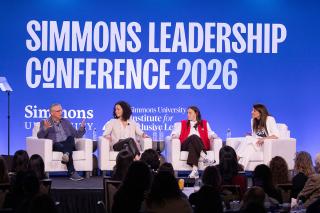
Sports industry leaders gathered for a discussion on the thriving business of women’s sports at Simmons University’s Institute for Inclusive Leadership’s 47th Annual Leadership Conference. Media executive and Professor of Practice Justine Pouravelis served as the moderator.
“The women’s sports era is here,” said Emmy Award-winning media executive and Professor of Practice Justine Pouravelis, as she began the panel session, “Game Changers: What the Rise of Women’s Sports Teaches Us About Leadership and Business,” at the Institute for Inclusive Leadership’s 47th Annual Leadership Conference on Tuesday, March 17.
Referencing the rise in valuation, sponsorship, engagement, and media attention around women’s sports in recent years, Pouravelis added, “What makes this moment especially powerful is that it’s not just a sports story, it is a leadership story.”
Pouravelis moderated a discussion with three industry leaders: Chief Revenue Officer of Boston Legacy Football Club, Amina Bulman; Vice President of Women’s Sports Programming and espnW and soon-to-be Guest Lecturer for Simmons’ School of Management, Susie Piotrkowski; and Senior Director of Systems Engineering at Cisco, Walter Jones.
Investing in Women Athletes
While espnW used to be one of the few media champions of women’s sports, coverage is now more expansive. Moreover, as Pouravelis noted, women’s sports is expected to accrue billions of dollars in revenue.
Addressing the new attention on women’s sports, Bulman said, “So much of the narrative around women’s sports today is that it popped out of nowhere … but female athletes have always been exceptional.” A significant change Bulman observed is that there is now a “more strategic commitment with investments.” For her, this kind of support “contributes to a wonderful fan experience,” one which “the athletes deserved all along.”
Speaking about media networks supporting women’s sports, Piotrkowski said, “We are continuing to prioritize accessibility and revenue generation … What you’ll see is just an exceptional product … and we are responding to what fans demand.”
Addressing Cisco’s sponsorship of women’s sports, Jones stated that investing in women’s sports helps “empower an inclusive future for everyone.”
The speakers approached the more specific topic of brands investing in women’s sports. “When brands invest in women’s sports, that really moves the needle for decision makers [and fans/customers],” Piotrkowski said. “You really get to be a part of long-term and sustainable growth.”
As Bulman remarked, “You can build a deeply emotional brand by supporting women’s sports.”
Piotrkowski, who is part of espnW’s launch of Women’s Sports Sundays (scheduled for the summer of 2026), noted, “The business opportunity is enormous … We are building a franchise around our women’s sports programming … Fans and the marketplace demand it.”
Bringing Joy Through Women’s Sports
Commenting on the Boston Legacy Football Club’s home opener game on March 14 at Gillette Stadium, Pouravelis observed that “the word of the day was ‘connection.’” Focusing on the special quality of women’s sports, she asked the panelists why people feel compelled to view and support them.
“I have a phrase for this,” Bulman responded, “it is our mantra this year, and it is: community joy … This is what brings people to women’s sports, that sense of joy and belonging.” Bulman specified that her role is to create “a new space” for fans who felt that they did not belong in a men’s sports space. “And I think that is what makes women’s sports so special.”
Speaking to the recentering of women’s sports in the public sphere, Piotrkowski said, “Women’s sports is inherently intersectional … We are often representing marginalized athletes [including queer athletes and athletes of color] … and we are elevating women at our core.” She added that the industry is “for good and for profit. And I think we can do both.”
Building Diversity, Shaping Leadership
During the “lightning round,” Pouravelis asked the panelists what qualities make the best women’s sports teams. For Jones, it is about “build[ing] diverse teams.” For Bulman, it is creating “a community where anybody can belong.” Piotrkowski responded, “How you treat anyone is how you treat everyone.” The panelists emphasized the need for authenticity and integrity in leading the women’s sports space, both on the field and behind the scenes.
In a Q&A with the audience, participants discussed supporting women athletes of color, the transferability of sports skills into the business/leadership realm, the importance of attending/spectating women’s sports events, and the revolutionary educational model of Simmons’ new MS in management: business and leadership in women’s sports concentration.
“Come to a game. It’s so fun, you’ll fall in love with it,” Bulman said in her closing remarks. “You don’t have to be an expert to be a part of the movement.”