
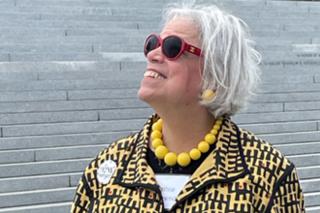
In November 2025, art history major Cathie Behrend ’70 received a Legacy Award from the 92nd Street Y in New York City. We spoke with her about receiving this honor, her love of art and public service, and her Simmons experience.
“I came to the 92nd Street Y [a cultural and community center in New York City] to take a swim and to learn to dance, and I stayed 50 years,” began Cathie Behrend ’70 as she accepted a Legacy Award, part of the Extraordinary Women Awards, at the 92nd Street Y in November 2025.
In the Y’s 150+ years of existence — it was founded in 1874 as the Young Men’s Hebrew Association — Behrend is the first board member to receive this honor. The organization also made a special film about Behrend’s signature contributions. In the film and her acceptance speech, she acknowledged the Y’s pivotal role in nurturing human creativity, upholding Jewish values, and bringing people together.
“They got a good return on their investment of 50 years … I have a lot of admiration for the board who [after eight interviews] had the wisdom to take a risk by hiring a very young woman with a career in public service from Philadelphia,” Behrend reflects.
A special highlight of the ceremony occurred when Behrend’s former student and mentee, Jonathan Miron, a Juilliard-trained violin student and co-founder of ARKAI Music, performed a musical piece with cellist Philip Sheegog that they co-composed. The following day, Miron and Sheegog were nominated (and ultimately won) a Grammy.
“This is what you live for as a teacher,” Behrend says.
Over her five decades as a Y board member, Behrend supported public art and mentored emerging artists. She has also served on the faculty at New York University (NYU) and the Fashion Institute of Technology (FIT), has worked for six New York City mayors in different capacities, and now volunteers as a docent for the Brooklyn Museum.
Early Exposure to the Arts
Behrend’s earliest memories of art include making collages at the Museum of Modern Art (MoMA) in New York starting at age 5. Once a month, her mother traveled with her from Philadelphia to NYC to participate in programming hosted by MoMA’s Education Department, then led by Victor D’Amico. (MoMA was the first museum to establish a division of arts education). Back then, MoMA staff gathered material/fabric remnants from Canal Street, which, Behrend recalls, “were fabulous materials to make collages with.”
Behrend’s formal schooling solidified further her love of the arts. For 14 years, she attended Germantown Friends, a Quaker school in Philadelphia, where she was exposed to the visual arts, music, community service, and political awareness. “I would say that community service and the arts were in my DNA,” she says.
Lessons in Leading at Simmons
A brother’s friend told Behrend about Simmons. “She told me that it would be a program where you would have a career,” Behrend recalls. Moreover, she felt inspired by the mission of founder John Simmons.
“Something about the idea that I could be an independent woman … attracted me [to Simmons],” she says.
Both her mother and grandmother attended Smith College, another historically women’s college. (Behrend’s grandmother graduated in 1906 as a classics major, and her mother, after graduating in 1935, ventured off to the UK to study English literature at the University of London).
As an art history major, with minors in sociology and education, Behrend wrote her undergraduate thesis on the artist Fernand Léger (1881–1955) as a surrealist. She was attracted to his “unity of technology and human form.”
Alongside her studies in art history and immersion in Boston’s museums, Behrend became very involved in Simmons’ Student Government Association (SGA). For four years, she was part of the Student Committee on Programmed Events (SCOPE), which was instrumental in bringing guest speakers and artists — including Alan Ginsberg, Duke Ellington, Lawrence Ferlinghetti, Anne Sexton, Ossie Davis, and Ruby Dee — to campus.
“It was really about bringing cultural events to the College, and I loved every minute of it,” Behrend says. “I took my extracurriculars and ultimately made them into my profession in a lot of ways … I learned a lot at Simmons from being involved in student government [SGA].”
Through SGA, Behrend helped implement a pass/fail grading system for select courses. She also served as a fire captain in her dormitory.
As an alumna, she continued her involvement with the University by helping lead the Simmons Leadership Council, in which members, including select board members, were regularly informed about new policies through biannual gatherings. The Council also developed and funded personalized mentoring experiences for students.
Behrend credits Paula Sneed ’69, who founded Simmons’ Black Student Organization (BSO), as an example of how to lead. “They [BSO members] were an effective force on campus,” she says.
Beyond campus, Behrend attained valuable student-teaching experience at the Newton and Brookline school systems. “I had an opportunity to design curriculum materials on looking at architecture for the Newton school system, which was wonderful.”
Behrend’s time at Simmons (1966–1970) coincided with major demonstrations, which heightened her political awareness.
“The people I demonstrated with … did this because they loved their country,” she said.
Behrend also recalls changes that occurred on campus during those years. For example, students were eventually allowed to wear pants in cold weather, and the hours students were permitted to have a man in their dorm room increased significantly.
“My four years at Simmons … were very dynamic academically, culturally, and politically,” she notes.
From Public Art to Public Service
Thanks to her Quaker education, Behrend cultivated a deep interest in community service. She also derived inspiration from Christo (1935–2020), a Bulgarian artist known for public art projects. (She first met Christo when she was a 20-year-old intern at the Philadelphia Museum of Art). “I wanted to do festivals in parks, especially Central Park. Who owns the parks? … You’ve got to work for the government,” she explains.
In the 1970s, during Mayor John Lindsay’s administration, Behrend managed 42 mobile recreation units, including art mobiles, puppet mobiles, a zoo mobile, music mobiles, and swim mobiles. These vans brought recreational activities to New Yorkers and their streets.
Later, Mayor Ed Koch invited Behrend to work for him at City Hall, specifically on a project on decentralizing city government. (Ten years later, this experience would inform her MBA thesis at NYU.)
Behrend’s government roles also encompassed devising economic development strategies to retain and attract corporate and financial jobs, serving on a Commission on New Media and the Arts (i.e., how NYC arts can enhance media/tech), and running the Mayor’s Science and Technology Awards. (NYC was not generally considered a science and technology hub. These awards recognized the city’s assets in this arena.)
In her capacity as a Y board member, Behrend, along with former Simmons Professor of Art Joyce Cohen, established the Simmons Arts Administration New York Institute. In operation from 2001 to 2015, the Institute invited Simmons arts administration majors, as well as select students in its first year from Smith, Scripps, and Wellesley Colleges, to spend a summer in NYC, housed at the 92 St. Y Residence. Each morning, there were academic classes. Each afternoon, there were visits with arts professionals at various arts institutions. “We used the Y as a laboratory,” Behrend says.
In 1995, Behrend became the deputy director of Percent for Art. (Since 1982, NYC has required that one percent of the budget for eligible city-funded construction projects be spent on public artwork.) She commissioned more than 100 artists. The Totally Kid Carousel by artist Milo Mottola (located over a water treatment plant at Riverbank State Park) is Behrend’s favorite Percent for Art project.
In 2007, Behrend founded VenturesinVision, through which she gives public art and artist studio tours throughout NYC’s five boroughs. Recent tours include Roosevelt Island/Cornell Tech, Dumbo (Brooklyn), the Noguchi Museum and nearby Socrates Sculpture Park (Queens), the Grand Concourse (the Bronx), and WPA (Works Progress Administration) murals and the Chinese Scholar’s Garden on Staten Island.
One of Behrend’s favorite public art tours is exploring the northern part of Central Park and the nearby artworks: the Duke Ellington, Frederick Douglass, and Harriet Tubman memorials.
Beholding Beauty
Behrend advises Simmons students to get involved at the University, secure internships, utilize the city of Boston, study abroad, and get to know their professors.
She also reminds the Simmons community of the transformative power of art. “As we are going through challenging times, the power and various manifestations of beauty are just so extraordinary to me, and so universal. I enjoyed it and grew up with it, and I also wanted other people to be able to have that experience of beauty.”