
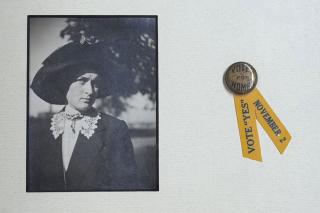
“When people think of university archives, they often imagine old yearbooks or photographs,” said University Archivist Kelsey M. Kolbet ’21MS/MA. “This is certainly a major component of our collection, but Simmons holds objects that stretch back thousands of years.”
Kolbet, a graduate of the dual degree program in archives management and history and an adjunct professor for Simmons University’s School of Library and Information Science (SLIS), shared some of those unique items in a virtual presentation this month, “Beyond the Glass: Simmons Women, Their Stories, and the Archives.”
Ancient Artifacts: Receipt and Notes for a Journey
Kolbet noted that the oldest items in the archive were purchased in the early 1920s by June Richardson Donnelly, the second dean of SLIS. “It was common practice at the time for artifacts and antiquities to be sold from sites of ancient civilizations,” noted Kolbet. The items were intended for preservation and instructional use.
“These are not just rare and beautiful artifacts,” noted Kolbet. “They represent some of the earliest ways human beings recorded and organized knowledge.”
The Sumerian Clay tablets, authenticated in 1996 as circa 2351 BCE, were found in Jokha, which had been the ancient Sumerian city of Umma. One tablet represents a “receipt” for the purchase of four lambs, most likely used in a ritual sacrifice. The other tablet, circa 2350 BCE, is a list of provisions brought on a journey. In addition, the Kampar Palm-Leaf Book, from the ninth century, was recently the subject of further research by Malika Brown ’27MS, a student with a background in Southeast Asian studies.
In the early twentieth century, not only was Simmons training women to become professional librarians, but they were also using the same materials as major research libraries and museums.
“These materials were used in the classroom,” said Kolbet. “Students handled them, studied their formats, and learned how different cultures across time had preserved information — from pressed palm leaves to hand-set type to baked clay.”
A leaf from a Nuremberg Chronicle, an illustrated world history published in 1493, is an example of the earliest form of printing in the Western world, with images illuminated by hand. Kolbet pointed out how a section of the document was once repaired with tape, evident by the residue left behind. “This is used to teach students the importance of preservation and conservation,” she said.
Historic Clothing for the ‘New’ Woman
“The University Archives’ historic clothing collection is another demonstration of Simmons’ successful mission to prepare women for an independent livelihood,” said Kolbet, referring to the mission of the University’s founder, John Simmons. “Indeed, our collection demonstrates the expanding roles of women from nineteenth to twentieth-century America and tells the story of women moving from private life to public, paid, and professional work.”
While the mid-nineteenth century dresses of Ann Small Simmons and Mary Ann Simmons may represent the feminine ideal of that time period, the nursing uniform and “gym bloomers” from the 1920s embody a shift in opportunities for women.
“These items show that Simmons women were not only gaining an education, but also physical and professional autonomy.” The so-called “New Woman” of the 1920s pursued higher education to earn an independent livelihood and take a vital role in public life.
In addition, the gym bloomers represent physical freedom. “Nineteenth-century clothing for women was very restrictive, with long skirts, corsets, and heavy layers,” said Kolbet, who noted that physical education was considered a part of a woman’s education at Simmons. “The gym bloomers are shorter, loose, and more practical. They allowed women to actually run, stretch, and compete in ways that earlier generations could not.”
In addition to a 1950s nursing uniform, Kolbet shared photographs of Commencement robes and hoods worn by Gwen Ifill ’77 ’93HD, noting that the archives houses a collection of 39 hoods that Ifill earned over her career.
“[The hoods] are both symbolic of one Simmons graduate who went on to make a local, national, and international impact as an independent, professional woman. They pay testament to Ifill’s accomplishments and success and to how far women can go if they are able to earn an independent livelihood.”
Preservation of Ticket Stubs and Photographs
The preservation of student scrapbooks, Kolbet said, allows alumnae/i to “insert their voices into the historical record and preserve and share with students of the present.”
Kolbet shared spreads of scrapbooks from two students. Class of 1923 student Pearl Simon Kaye filled her pages with flyers and tickets from the Tremont Theater and Shubert-Wilbur Theater, as well as an article about the Simmons May Day celebration. Ruth Tallmadge, from the Class of 1933, included photographs of friends, leaves, tickets, and ID cards.
What’s New in the Archives at Simmons?
Archivist staff and SLIS students continue to digitize materials to enable greater access to the collections. Kolbet highlighted a few collections processed over the last year, available for review in person, in the Archives. All three of these collections are currently being digitized by the students in Assistant Professor of Practice Mollie Metevier’s “Digitization Project Planning and Management” (LIS 462) course.
- Wilda Claire Strong Peck was a prominent American suffragist, a 1912 Simmons graduate, and a member of the Library Science faculty from 1914–1925. “From Pecks’ papers, we see a woman who was creative, political, and engaged in extending John Simmons’ mission of helping women attain an independent livelihood,” said Kolbet.
- The Boston Area Women in Libraries collection highlights the Somerville-based organization formed in the mid-1970s to “provide feminist resources, publications, and programs for women working in the library field,” said Kolbet. “Many members were graduates of both the undergraduate and graduate programs in Library Science at Simmons, demonstrating how the professional and political held a close relationship for these graduates.”
- The Massachusetts Black Librarians Network (MBLN) collection features the work of Simmons alumnae/i who were members of the MBLN. “The activism, community building, and justice-based organizing demonstrate how the Simmons education not only diversified the library professions, but also laid a foundation for graduates to organize against racism and exclusion within that profession,” said Kolbet. “Indeed, Black activism at Simmons extended beyond campus and into the communities of its graduates.”
The use of these materials in Metevier’s course is an example of how faculty use the collection to teach best practices of digitization, while providing practical hands-on education and experience, as Simmons has done since its inception.