Nursing (BSN)

Undergraduate

BSN

Build your future in patient care

Prepare to care for others and save lives through a rewarding career as a nurse.

Simmons University’s Bachelor of Science in Nursing (BSN) combines hands-on clinical experiences with a strong academic foundation to help you grow into a skilled, confident nurse. You’ll learn in labs and classrooms and gain experience at world-renowned teaching hospitals and research facilities in Boston.

With your degree, you’ll be prepared to take the registered nurse licensure (NCLEX) exam, pursue graduate study, and serve in entry-level roles in offices, homes, hospitals, and schools. You can work anywhere in the country or around the world. No matter where you go, no two days will be the same. The changes and challenges of healthcare will be demanding but also incredibly rewarding.

Why choose Nursing at Simmons?

As one of the nation’s first university-based nursing programs, Simmons is recognized for its clinical excellence and for building compassionate, evidence-based healthcare leaders. You’ll learn from expert faculty, train in top Boston hospitals, and become part of a close-knit community that supports your growth.

Choose from degrees matches your experience and goals:

Unsure of which Nursing program you should follow? Compare them all and discover which program is right for you

What will you learn in our BSN Nursing Program?

As a BSN student, you’ll:

  • Learn from Active Practitioner-Mentors: Engage in classes with professors who balance active practice with a commitment to mentorship.
  • Train in State-of-the-Art Facilities: Master skillful, compassionate care in our 11,000-square-foot Nursing Simulation Center
  • Access Elite Clinical Rotations: Gain experience at institutions, including Massachusetts General Hospital, Boston Children’s Hospital, and Brigham and Women’s Hospital.
  • Connect with Industry Leaders: Build your professional network through research opportunities, expert-led talks, and employment at research facilities.

Dotson Bridge and Mentoring Program

Simmons offers many programs and leadership opportunities, including the Dotson Bridge and Mentoring Program. The program serves students from diverse backgrounds through mentorship, tutoring, leadership training, volunteerism, and career counseling. 

What can you do with a BSN degree?

You will always be in high demand as a nurse. According to the Bureau of Labor Statistics, employment of registered nurses (RNs) is projected to grow 5 percent from 2024 to 2034, faster than average for most occupations. 

As a Simmons graduate, you’ll be known for your clinical skill, compassion, and ability to provide personalized, patient-centered care, and health promotion. You’ll be prepared for graduate study to become a nurse practitioner or pursue other graduate nursing roles. You may serve in roles in hospitals, community health centers, private practices, schools, and home care.

Career paths include:

  • Hospital Nurse
  • Public Health Nurse
  • Clinical Research Nurse
  • Case Management Nurse
  • Nurse Manager
  • School Nurse


BSN for Transfer Students

Transfer students can complete the BSN through a two-year sequence, depending on space availability. Programs begin in the fall, with the option to start in spring or summer to complete prerequisites. See deadlines and learn more about the nursing program for transfer students

You are considered a transfer student if: 

  • You have earned more than 17 college credits after graduating from high school.
  • You do not already have a bachelor's degree in another field.
  • You will be under 24 years old when you start at Simmons.

Apply to Simmons as a Transfer Student

If you have 17 or fewer credits and are under 24, you should apply as a first-year student. If you are over 24 and pursuing a BSN, apply as a Dorothea Lynde Dix Scholar.


The student who has been accepted into the major of nursing must fulfill the all-University requirements. A student accepted into the nursing major must achieve an acceptable level of academic performance, including a minimum grade of C+ in all science course prerequisites, prior to beginning the nursing course sequence, as well as maintain an acceptable level of clinical and academic performance to progress to the next nursing course. Progression is also affected by professional behavior. Those students achieving outstanding academic records may be initiated into the Academy and/or the Simmons chapter of Sigma Theta Tau, Theta -at-Large, the International Nursing Honor Society. Criteria regarding academic performance, professional behavior, and health requirements are available upon entrance into the nursing major. Nursing students are required to show documentation of appropriate immunization and health clearance for clinical coursework. Please see the Nursing Student Handbook for specific requirements. All students will undergo a criminal record check each year (CORI) required for nursing practice in state and private agencies and by the Massachusetts Board of Registration in Nursing.

Traditional BSN Course Sequence

This sequence will be followed by students admitted to Simmons in Fall 2025. Students admitted prior to Fall 2025 should refer to the 2024-2025 Academic Catalog or consult with Advising. Students in the Honors Program should consult with Advising.

Fall Year 1

WRI101 Writing Boston 4
SIM100 Explore 2
BIOL123N Principles of Microbiology 4
CHEM110 General, Organic and Biological Chemistry 4
One elective or PLAN Requirement

Students may take an elective or choose to fulfill one of the following options:

  • DEIJ KSA
  • LDR KSA (Leadership Course)
  • ALA KCA

Spring Year 1

BIOL231 Anatomy and Physiology I 4
PSYC101 Introduction to Psychological Science 4
NURS101 Professional Nursing Concepts 4
AND
NURS103 Civil Discourse: Difficult Conversations in Healthcare 4
OR
KSA :: LDR

*NURS 103 fulfills the Leadership KSA (Key Skills Area). Nursing students may select another course to fulfill this requirement. However, NURS 103 is recommended.

Fall Year 2

BIOL232 Anatomy and Physiology II 4
NURS202 Health Care Policy & Nursing Jurisprudence 4
NURS292 Health Assessment 2
NURS292L Health Assessment Lab 1
NURS293 Fundamentals of Nursing 2
NURS293L Fundamentals of Nursing Lab 1
One elective or PLAN Requirement

*NURS 292L and NURS 293L each include 24 total laboratory hours.

Spring Year 2

PSYC237N Life Span Development 4
NURS201 Health Promotion and Community Nutrition 4
NURS205 Pathophysiology 3
NURS331 Pharmacology 3
NURS332L Medical Surgical Nursing I Clinical 1
NURS332 Medical Surgical Nursing I 3

Fall Year 3

SIM200 Extend 2
NURS335 Psychiatric & Mental Health Nursing 3
NURS335L Psychiatric & Mental Health Nursing Clinical 1
NURS346 Medical Surgical Nursing II 3
NURS346L Medical Surgical Nursing II Clinical 1
One elective or PLAN Requirement

Spring Year 3

NURS333 Maternity Nursing 3
NURS333L Maternity Nursing Clinical 1
NURS334 Pediatric Nursing 3
NURS334L Pediatric Nursing Clinical 1
Two electives or PLAN Requirements

Fall Year 4

STAT118 Introductory Statistics 4
NURS347 Complex Nursing Care Management across the Continuum 3
NURS347L Complex Nursing Care Management across the Continuum Clinical 1
NURS387 Community & Global Health Perspectives 3
NURS387L Community & Global Health Perspectives Clinical 1
NURS417 Leadership and Management 3

NURS 387 fulfills the GH (Global Historical) KCA (Key Content Area).

Spring Year 4

NURS398 Transition to Practice 3
NURS399 Nursing Research 4
NURS418 Synthesis & Clinical Decision Making 4
NURS419 Clinical Practicum 2

Students must successfully complete all preceding required nursing courses before enrolling in the capstone sequence.

Transfer BSN (24-Month) Course Sequence

This sequence will be followed by students admitted to Simmons in Fall 2025. Students admitted prior should refer to the 2023-2024 Academic Catalog or consult with Advising.

Fall Year 1

NURS295 Fundamental Skills and Health Assessment 4
NURS101 Professional Nursing Concepts 4
NURS202 Health Care Policy & Nursing Jurisprudence 4

*NURS 295 includes 56 laboratory hours (NURS 295L).

Spring Year 1

NURS201 Health Promotion and Community Nutrition 4
NURS205 Pathophysiology 3
NURS331 Pharmacology 3
NURS332 Medical Surgical Nursing I 3
NURS332L Medical Surgical Nursing I Clinical 1

Summer Year 1

NURS335 Psychiatric & Mental Health Nursing 3
NURS335L Psychiatric & Mental Health Nursing Clinical 1
NURS346 Medical Surgical Nursing II 3
NURS346L Medical Surgical Nursing II Clinical 1

NURS 335 is a fully online course.

Fall Year 2

NURS333 Maternity Nursing 3
NURS333L Maternity Nursing Clinical 1
NURS334 Pediatric Nursing 3
NURS334L Pediatric Nursing Clinical 1
One elective or PLAN Requirement

Spring Year 2

NURS347 Complex Nursing Care Management across the Continuum 3
NURS347L Complex Nursing Care Management across the Continuum Clinical 1
NURS387 Community & Global Health Perspectives 3
NURS387L Community & Global Health Perspectives Clinical 1
NURS417 Leadership and Management 3
STAT118 Introductory Statistics 4

Summer Year 2

NURS398 Transition to Practice 3
NURS399 Nursing Research 4
NURS418 Synthesis & Clinical Decision Making 4
NURS419 Clinical Practicum 2

Science Prerequisites

Students accepted into nursing must complete the following science courses prior to enrolling in any of the Fundamentals of Nursing or Health Assessment courses (NURS 292/NURS 293, NURS 295).

PSYC101 Introduction to Psychological Science 4
BIOL123N Principles of Microbiology 4
CHEM110 General, Organic and Biological Chemistry 4
BIOL231 Anatomy and Physiology I 4
BIOL232 Anatomy and Physiology II 4
PSYC237N Life Span Development 4

Additional Requirement Information

  • BIOL 232 may be taken concurrently with nursing fundamentals (NURS 292/NURS 293, NURS 295).
  • PSYC 237N must be successfully completed prior to taking NURS 335, NURS 333, and NURS 334.
  • Students must successfully complete a 4-hour General Chemistry course with lab before beginning the sequence of NURS courses. CHEM 110 preferred.
  • Transfer nursing students must complete all science prerequisites prior to beginning the nursing program.

8 Semester (Four Year) Nursing Sequence

Students in this program will complete their degree in 8 semesters, and will begin nursing classes in the spring of their freshman year. To enroll in sophomore-level nursing classes, students will be required to have earned a C+ or better in each of their science prerequisite courses, with no more than one retake.


Hands-On Learning Highlights

850+

Clinical Training Sites

Boston-based students have access to more than 850 clinical training sites, including world-class hospitals like Massachusetts General, Brigham and Women’s, Boston Children’s, VA Boston Healthcare System, and Dana-Farber Cancer Institute.
Learn more about clinical training

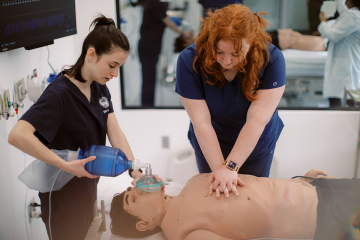
Students simulating giving CPR to a patient in the Nursing Simulation Center

Nursing Simulation Center

Our 11,000 square foot Nursing Simulation Center will help you gain real-world experience in a controlled clinical setting, allowing you the opportunity to get comfortable with your nursing skills before being expected to perform them off-site.

Explore the Nursing Simulation Center

Spotlight on Nursing Students and Alums

Claire Tuquero ’26

Bringing Cancer Education to Underserved Communities

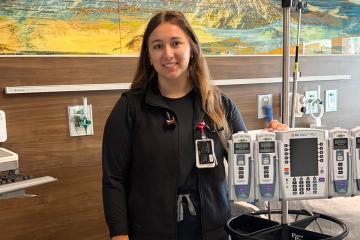
Nursing student Claire Tuquero ’26 reflects on her involvement with the Passionate Leaders Project and the clinical training she was able to achieve at several Boston hospitals.

Lisa Aboagye-Kodjoe ’26

Meaningful Mentorship, Received and Given

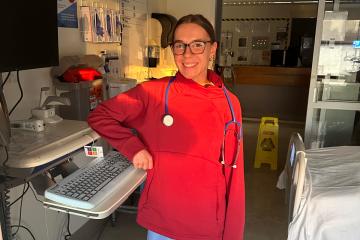
Nursing major Lisa Aboagye-Kodjoe ’26 reflects on her time at Simmons and her involvement with the Dotson Bridge and Mentorship program, the Honors Program, and Girls, Inc.
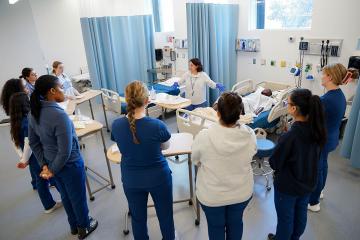

Simmons School of Nursing students and faculty in the Nursing Simulation Center, photograph by Ashley Purvis.

SON Alumna Makes Impact in Pediatric Neurology

Beverly Byron ’75, is currently the co-chair of the Montgomery County (Maryland) Department of Health and Human Services’ Child Fatality Review Team. She is a longtime nurse educator and legal nurse consultant who double majored in nursing and sociology at Simmons.


A collage of the 2026 Bonner Leaders: Ammy A. Cardenes Santana ’29, Gulsah Cayan ’29, Lily-Rose O’Brien ’29, and Mackenzie Oprea ’29

Meet Our 2025–26 Bonner Community Leaders

The Bonner Community Leaders Program is a unique opportunity for students who want to combine a strong commitment to service with personal growth, teamwork, leadership development, and scholarship. This academic year, Simmons announced a new cohort of Bonner Leaders including Ammy A. Cardenes Santana ’29, Gulsah Cayan ’29, Lily-Rose O’Brien ’29, and Mackenzie Oprea ’29.


Simmons nursing students engaging in a hands-on project during Immersion weekend

Nursing Students Enjoy Immersive Learning

Simmons School of Nursing students in our online programs came to campus over the summer for an Immersion experience. For insight into what this entailed, we spoke to Tina Delouchry, Professor of Practice and Director of FNP Clinical Education, and Laura Behm, Associate Professor of Practice and Director of PMHNP Clinical Education.


The 8 SURPASs scholars for 2025

Congratulations to the 2025 SURPASs Scholars

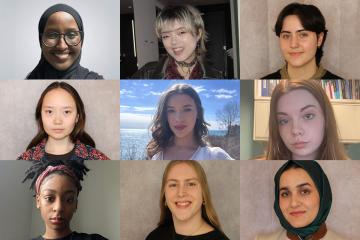
Eight undergraduate scholars from disciplines across Simmons have been selected to join the Summer Undergraduate Research Program at Simmons (SURPASs). SURPASs students receive the necessary funding and mentorship to execute an independent research project of their own design.


The four Samuels siblings

The Samuels Family: A Simmons School of Nursing Tradition

Siblings Nathan Samuels ’05MSN 11DNP; Ashley Samuels Shields ’10; Eryn Samuels Yong ’12; and Brittany Samuels Czerw ’14 all studied nursing at Simmons University. We caught up with them about how this trend began, how they support each other in their careers, and what they most value about their nursing careers.


Associate Professor of Practice LaDonna Christian '16PhD  mentors Dotson Scholar Hayden Lee '24, photograph by Kelly Davidson.

Thriving through Diversity: A Nursing Success Story

The Dotson Bridge and Mentoring Program pairs first-generation and other underrepresented nursing student mentees — called Scholars — with experienced Mentors (typically School of Nursing alumnae/i). Sasha DuBois ’08BSN has served as a mentor since the program began in 2009. LaDonna Christian ’16PhD became director of the program in 2010.