
Mission & History
Mission
Simmons University is a community of higher learning that unites passion with purpose.
Vision
Rooted in a long fight for equality, we envision a future where our historic foundation as a women’s college offers scholars the opportunity to pursue their life’s work. Our expertise in fields that improve the human condition serves as a resource for the nation. The relationships formed through teaching and learning are a cornerstone of our success. Our home in Boston welcomes all genuine forms of intellectual curiosity, imagination, and self-expression.
Values
- We believe in changing the world for the better by inviting the best of the world to change us.
- We believe in strengthening our communities by nurturing inclusion and belonging.
- We believe in leading and modeling leadership through everyday action.
- We believe in improving society by connecting theory to practice.
- We believe in increasing our power to influence by increasing our willingness to serve.
Our History
Decades before women in America gained the right to vote, Boston businessman John Simmons had a revolutionary idea: women should be able to earn independent livelihoods and lead meaningful lives. This spirit of inclusion and empowerment led to the first African-American Simmons graduate in 1914 and made Simmons one of the few private colleges that did not impose admission quotas on Jewish students during the first half of the 1900s.
Since 1899, Simmons has offered a pioneering liberal arts education for undergraduate women integrated with professional work experience. Today, Simmons also offers the benefits of a small university, including renowned coeducational graduate programs, in its six professional schools. We offer bachelor’s, master’s, and doctoral degrees in fields including library and information science; management; media, humanities, and social sciences; nursing; sciences and health professions; and social work.
For more than 125 years, a Simmons education has integrated professional preparation, intellectual exploration, and community orientation because all three are necessary for success. At Simmons, we value many dimensions of identity, including race, class, ethnicity, and sexual identity, and reflect that in our curriculum, affiliated organizations, and community partnerships.
Today, under President Lynn Perry Wooten’s leadership, Simmons consistently ranks among the nation’s top schools in its category in U.S.News & World Report, the Princeton Review, and Forbes. Simmons alumnae/i are influential trailblazers and thought leaders with a long history of challenging the status quo and making a mark in their fields.
Our Founder, John Simmons

John Simmons (1796–1870) left his childhood home in Little Compton, Rhode Island, in 1814 to pursue a career as a tailor in Boston. By 1818, he had established a clothing store, and by 1844, he owned the largest wholesale clothing business in New England. He transformed the menswear industry by introducing ready-made suits in standardized sizes.
Profits from Simmons' clothing enterprise enabled him to invest in prime Boston real estate. Upon his death in 1870, his will provided for his surviving family, including two daughters and two granddaughters, and established provisions to found an educational institution:
"It is my will to found and endow an institution to be called Simmons Female College, for the purpose of teaching medicine, music, drawing, designing, telegraphy, and other branches of art, science, and industry best calculated to enable the scholars to acquire an independent livelihood."
The establishment of a college embodying Simmons' vision was postponed after most of his property was destroyed in the Great Boston Fire of 1872. Reconstruction took many years, and sufficient funding was not secured until 1899. On May 24, 1899, the Massachusetts legislature granted a charter to incorporate Simmons Female College. The newly appointed Corporation members then began implementing the provisions in John Simmons’ will.
Simmons History in the News
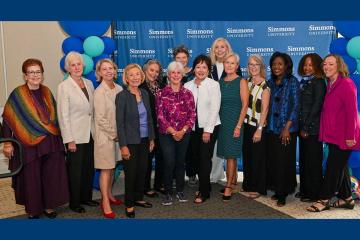
Trailblazers to What’s Next: Anne Jardim at 90
There were cheers, tears, and embraces between classmates when generations of School of Management alumnae gathered at Simmons on September 17 to celebrate the 90th birthday of Dr. Anne Jardim ’13HD.

Anne Jardim ’13HD Saw What Women Needed — and Built It
As Dr. Anne Jardim ’13HD turns 90, alumnae, colleagues, and friends reflect on the pioneering educator who, with the late Margaret Hennig ’62, created a new approach to management education — and taught generations of women to understand the organizations they were entering, trust what they knew, and lead.
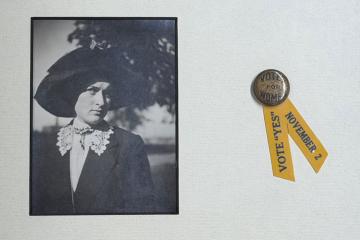
Beyond the Glass: Simmons Women and the Archives
University Archivist Kelsey M. Kolbet '21MS/MA, graduate of the dual degree program in archives management and history at Simmons University’s School of Library and Information Science (SLIS), recently offered a virtual presentation of items from the Simmons Archives. A perfect complement to Women’s History Month, the presentation highlights how women’s history and Simmons’ history are closely intertwined.

50 Years of Computer Science at Simmons: Breaking Glass Ceilings
This year, Simmons celebrates 50 years since the establishment of the Bachelor’s in Computer Science (BS). We spoke to faculty about how computer scientists shaped the computer science program at Simmons, and how a women-centered university can uniquely prepare students to enter a male-dominated field.
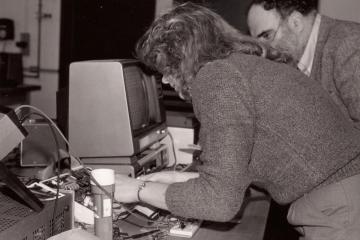
50 Years of Computer Science at Simmons: An Origin Story
This year, Simmons celebrates 50 years since the establishment of the Bachelor’s in Computer Science (BS). We spoke with faculty about the grassroots effort to create the program, and how Simmons was ahead of its time by offering computer science education.

Raise a Toast to 50 Years of Children’s Literature at Simmons
Simmons University Center for the Study of Children's Literature presented the biennial Summer Children's Literature Institute from July 25-27, 2025. This year’s theme, “Are We There Yet?” brought an impressive array of creative writers, illustrators, publishers, and scholars to reflect and promote conversations about literature for young people.
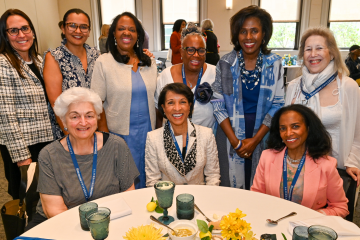
Simmons Celebrates 125 Years
Over 350 members of the Simmons community gathered on campus June 6–8 to celebrate Simmons University’s 125th Anniversary with a unique Reunion for all classes that included special celebrations for the classes of 1965, 1966, 1967, 1970, 1972, 1975, 1980, 1985, 1990, 2000, and 2003.
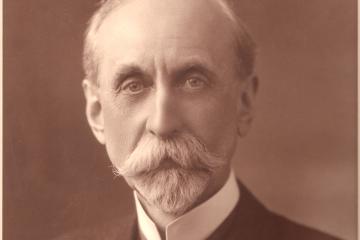
Digitizing the History of the First US School of Social Work
Simmons School of Library and Information Science students in Assistant Professor of Practice Mollie Metevier’s “Digitization Project Planning and Management” course recently presented a project showcase of the digitization of the Jeffrey R. Brackett Papers, the first dean of Simmons School of Social Work (SSW). This project was done in collaboration with the Simmons University Archives.