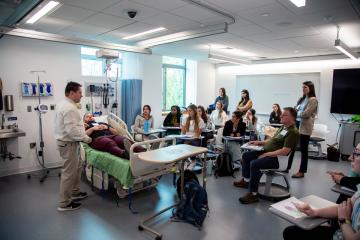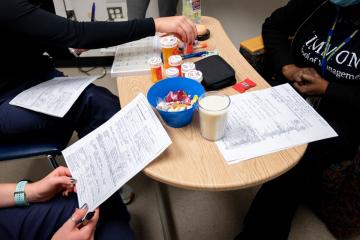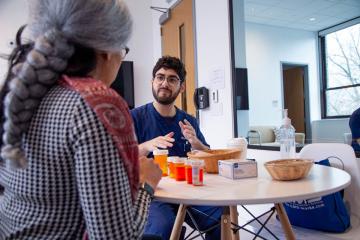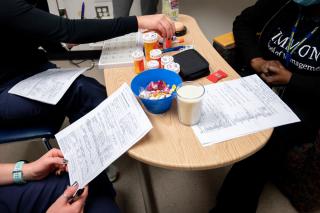
Interprofessional Education (IPE) at Simmons University brings together students from diverse health professions to learn with, from, and about one another through collaborative learning experiences, simulation, and interprofessional educational events. The IPE Digital Badge Program allows students to earn a valuable credential for their resume, demonstrating their commitment to a collaborative approach to health and social care.
“The Digital Badge Program is available for graduate students in any of the health professions at Simmons,” says Jenna Stuebe Powers, associate professor of practice in the Department of Physical Therapy. Students in the School of Sciences and Health Professions, the School of Nursing, and the School of Social Work are encouraged to participate.
“We offer students a menu of learning activities, some of them based at Simmons, some in partnership with other universities,” says Powers.
Most IPE activities are scheduled in the evening, and many are available remotely. These include model team meetings, case collaborations, special interprofessional topic discussions such as trauma-based care and behavior management, simulation experiences, and more. Some activities are part of the “Interdisciplinary Perspective on Health Care” course (IPE 450). Several students in this class opt to participate in the IPE badge program.
Interprofessional Education Badge Offerings
This semester, “Reframing Behavior: A Compassionate Approach to Understanding and Support” was a virtual event hosted by Emerson College, featuring a behavior specialist and a special education teacher.
Other past events included “An Interprofessional Approach to Wellness,” hosted by Quinnipiac University, and “IPE Case Collaborations for Graduate Students,” a collaboration with Emerson College, Quinnipiac University, and Kenyatta University in Kenya. Topics also included trauma-informed care and end-of-life care.
SSW Assistant Professor Noelle Dimitri shared that a record number of social work students enrolled in the badge program this year. Many found the experiential interprofessional learning opportunities provided by Simmons and community collaborators among the most valuable parts of their graduate learning experience, she says.
For example, MSW students and faculty participated in a day-long interprofessional simulation event in collaboration with the Tufts Medical School Physician Assistant Program, focused on end-of-life (EOL) communication with a simulated family meeting.
“This immersive, experiential learning helps our students rehearse EOL skills, prepare for fast-paced hospital and other medical settings, and also gain appreciation for collaborative practice with other health professions’ colleagues. We need each other to be effective in this work,” says Professor Dimitri.
“Once students complete four activities along with an IPE introductory module, they earn their digital badge. It’s excellent for resume building,” says Powers, noting it pushes students outside their comfort zone. “One of those four activities needs to be outside of your mandatory curriculum. You can choose from the menu of activities to engage in.”
A Valuable Healthcare Credential
The Badge Program is available at no additional cost to students, with the goal of receiving a certificate at completion. The badge structure allows for growth, adaptation, and potential external partnerships while supporting the broader movement toward stackable credentials and micro-credentials in higher education.
For Powers, the program also reinforces Simmons’ identity as a leader in health professions education, as well as the university’s commitment to social impact, equity, and collaboration in healthcare.
“We prepare our graduates to be more effective, collaborative clinicians from day one in a system that is becoming increasingly team-based,” she said.
Simmons is also part of a newly developed Northeast Consortium for Interprofessional Education and Innovative Practice, which seeks to create collaborative programs across New England.
“We want to lean on and learn from each other for programming, resources, faculty training, simulation development, and more,” says Powers, who began attending the group’s monthly meetings in December 2025. “It’s exciting, and hopefully we will learn a lot and develop future connections.”
Exploring Ways to Expand IPE Programming
In the future, Powers hopes additional options will be available for online students to access IPE programming. Methods are being tested, including asynchronous modes that can be accessed at any time.
“The student can watch a case study, then engage with peers via a discussion board. Even if it isn’t in real time, it’s an effective way to include students who can’t access other synchronous programming,” she says.
The IPE badge program recently launched an asynchronous activity aimed at distilling the roles and responsibilities of an interprofessional team working with an individual experiencing homelessness or housing insecurity. Students watched a panel discussion between public health practitioners with a range of experience in healthcare and social services, hosted by the Department of Public Health. They later interacted with each other in an online forum.
Leigh Haynes, associate professor of practice in the Department of Public Health, says “this activity gave students the opportunity to explore interprofessional collaboration not only at the level of primary care, but also to envision engagement for community- and population-level prevention to improve health outcomes.”
In addition to benefiting students from different health professions, expanding interprofessional education at Simmons University has also helped connect faculty from different health professions with shared interests and expertise, and highlighted future opportunities for collaboration in educational training and research.