
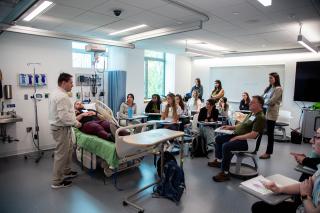
This August, School of Nursing students in the advanced practice nursing programs, including family nurse practitioner (FNP) and psychiatric mental health nurse practitioner (PMHNP) — which include direct entry, Master of Science in nursing, post graduate certificate and doctor of nursing practice degree programs — will convene on the Simmons campus for a three- or four-day Immersion experience to prepare them for clinical rotations.
"A lot has been done to keep these Immersions cutting edge," says Associate Professor of Practice and Director of Advanced Practice, Graduate Nursing Laura Behm. "We're staying current with research and making changes to the program, not just to meet accreditation standards, but to align with what the evidence shows is best for patient outcomes. We're actively integrating that into the curriculum to make sure the program evolves along with patient needs."
The Immersion experience is a valuable opportunity for online and hybrid students to learn skills firsthand, including suturing and I and D (incision and drainage).
"Simmons has dedicated faculty who use these skills regularly in practice, so our students are learning from experts," says Professor of Practice and Director of FNP Clinical Education Tina Delouchry. "Not all programs offer the same level of student touchpoints and support."
Case Studies and Collaborative Discussions
This year's Immersion will include a new interprofessional education element, allowing FNP and PMHNP students to collaborate in small groups, working through complicated case studies together.
Delouchry sees the session as an excellent opportunity for students to learn from each other.
"The case studies we are using are very complex, with a lot of overlap in the presenting symptoms between medical and psychiatric conditions," she says. "PMHNP is a more specialized area of study and practice, while FNP is prepared for a primary care setting. We want them to learn from each other about their approach to provide care for the patient."
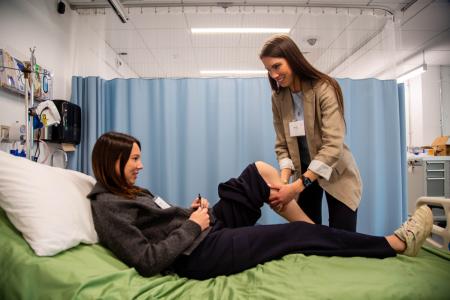
PMHNP students can benefit from the FNP students' broader scope of practice, while FNP students can learn from the psychiatric focus the PMHNP students offer. The complex case studies will require dialogue from all the students.
"As a novice, a nurse may say that a patient comes in with anxiety, but really they are coming in with diabetes, hypertension, and anxiety," says Behm. "We want students to work together and consult in clinical practice, so that they will feel prepared when they go into the real world."
Students will have a limited amount of time to discuss their case study. Twenty minutes before the end of the session, each group will receive a "barrier to care" card to add further complications to the scenario, such as a lack of insurance or transportation.
"The conversation about the case will change, depending on which additional barrier the patient has," says Behm. "It will make the discussion more in-depth and provide different opportunities for learning."
This aligns with the program's intent to teach practices proven to improve patient outcomes.
"Collaborative care improves outcomes for patients," says Delouchry. "We want students to develop confidence to reach out and communicate with a patient's other providers whenever collaboration is needed."
For Behm, the exercise exemplifies a holistic approach to care. "Instead of having patients bounce back and forth between providers, this encourages providers to coordinate and weigh the risks and benefits of potential treatments."
Adding a Social Work Element
School of Social Work Associate Professor of Practice Rebekah Gibbons will also be on hand to offer insights from the social work perspective.
Behm emphasizes the importance of integrating a social work perspective into nursing practice.
"Many providers quickly tell patients to see a social worker, but long waitlists and transportation barriers can make that difficult," she says.
Collaboration with social workers can help bridge the gap by identifying available resources, addressing social determinants of health, and suggesting practical next steps to support the patient's needs.
"We hope to see further collaborations in future — maybe adding physical therapy students and other perspectives — but this is a good starting point," she says.
Preparing for Clinical Rotations
The overall goal of the Immersion experience is to prepare students for their clinical rotations [hands-on training in hospitals and clinics].
"We're constantly reviewing the Immersion, adding activities, and updating workshops," says Delouchry. "And it has an impact. The feedback we get from our preceptors [on-site supervisors of students during clinical rotations] is that our students are very prepared when they reach the clinical portion."
Behm hopes to open students' minds to other perspectives over the course of the Immersion, specifically when collaborating across programs.
"If they are able to recognize at least one clinical decision they made differently because of interdisciplinary input, then they will see the benefit of collaboration," she says.
For more about interprofessional opportunities at Simmons, read about the Carlotta Simulation and the Interprofessional Education (IPE) digital badge program.