
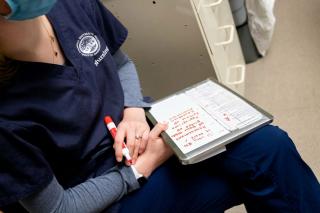
“I was looking for a program that could offer strong clinical preparation, while also offering connection and support,” says Alisa Ssuyu Lin ’25DNP, a graduate of the Direct Entry Doctor of Nursing Practice – Family Nurse Practitioner (DNP-FNP) at Simmons and a current student in the Post-Graduate Certificate Psychiatric Mental Health Nurse Practitioner (PGC- PMHNP).
“Simmons’ location in Boston, near so many different facilities, creates strong professional connections for students,” Lin says. “That stood out to me, along with the high level of support Simmons faculty offer their students.”
While she initially joined the Direct Entry Master of Science in Nursing and Post-Graduate Certificate Family Nurse Practitioner (RN-FNP) in person, Lin has done the program online since the COVID-19 pandemic.
“I’m grateful to have experienced a year of in-person courses before the pandemic hit, but I’ve had a good experience online as well,” she says. “I’ve met students from other states and students at different stages of life when they join the program. It’s beneficial to learn from those perspectives.”
Lin completed the Doctor of Nursing Practice-Family Nurse Practitioner program in August 2025. Given her prior interest in the mental health sphere (she earned a master’s degree in clinical mental health counseling from Lesley University), when she learned about the PGC-PMHNP, she was immediately interested.
“It’s a certification, a post-grad, and it only takes 15 months. I decided, yes, let’s get it done!” she says. “I’ll be dual-certified by December 2026, and able to serve more people with these complex needs.”
Coursework and Clinical Experiences
Lin completed her clinical placements in different private practices for her FNP and DNP, and is currently in a clinical rotation for her PGC-PMHNP program.
“One placement was at Newton-Wellesley Hospital, and I loved that experience. In a hospital, there are different ways to approach practice as part of a team,” she says. “In private practice, it can be challenging, with only one or two peers with you. I need to be more independent and enhance my decision-making abilities. It’s definitely challenging, but I’ve learned a lot from my clinical experiences, and my preceptors were awesome!”
Lin is grateful for coursework and faculty support to prepare her for clinical experiences.
“The coursework helped me develop clinical reasoning and become more competent in making decisions,” she says. “In class, we learn from shared experiences from the faculty and other students, which is super helpful and important. I feel this preparation from class helped me to feel competent and comfortable when I did my clinical placement.”
She notes the challenge of applying her knowledge to clinical experiences. “It takes time to feel the connection between all of the information we’ve learned and the individual patient in front of us,” she says. “Simmons professors emphasized the importance of building relationships and looking at the whole patient, as opposed to focusing on one issue or diagnosis. Independent clinical decisions are all connected to the larger issues in healthcare. I’m definitely challenging myself more and finding opportunities for improvement in my everyday practice to maximize the benefit for my patients. Every time I see a patient, I want to think about something to make their day-to-day quality of life better.”
Committee Chair and Associate Professor Tanya Cohn offered support during the thesis process. Lin also received feedback and support from Professor Patricia Rissmiller on a poster project she presented at the 8th Annual Sigma Region 15 Research Symposium last October at the University of Vermont.
“Professor Rissmiller always encourages students to pursue a research grant for their studies. Fortunately, I received a research grant from the Theta at-Large Chapter of Sigma Theta Tau International to support my work,” she says.
The faculty for her PMHNP course this semester, Associate Professor of Practice and Director of Advanced Practice Graduate Nursing Laura Behm, has her own private practice; a perfect role model for Lin.
“She’s a nurse practitioner who emphasizes self-advocacy, and for nurses to advocate not just for our patients, but for ourselves and our careers,” she says. “My experiences at Simmons and in clinical settings have strengthened my self-advocacy skills, and I feel more confident to take on a leadership role in the field.”
The Impact of the DNP
“The MSN program prepares students to be strong clinicians, and the DNP encouraged me to look at the bigger picture,” says Lin. “For me, the DNP program provides an opportunity to go beyond developing clinical skills. It’s focused on leadership and evidence-based practice.”
To that end, students are required to complete a quality improvement project or a research project for the DNP, requiring system-level thinking.
“Most of the time, as a nurse practitioner, we learn how to take care of patients, prescribe medications, and create treatment plans, but if we can do more system-level thinking, we can enhance the overall healthcare experience for all of the patients in the practice, not just the individual in front of us in that moment,” she says. “It’s important to consider how I can actually improve the healthcare system for the patient and the community. It will take continuous work, not just a one-time change, and the DNP program offers that broader perspective. It has helped me to become a more effective, well-rounded healthcare professional, able to consider situations from multiple perspectives.”
The Nursing Career Path Ahead
Lin plans to build her career around providing comprehensive, holistic care, with a particular focus on serving immigrant and minority communities.
“Simmons has helped me to develop clinical knowledge and the confidence to advocate for myself, especially after the DNP,” she says. “I started to have more conversations with professors who have their own practice or have worked in the field for years. They want us to know how to negotiate a contract and advocate for benefits. Nurses always advocate for patients but often forget to speak up for ourselves. I’ve learned that we need to treat people the way we want to be treated, and that includes treating ourselves with the same respect and care that we give to others. To be a leader in the field, I need to know what I want, what I need, what I deserve, and to stand up and ask for it.”