
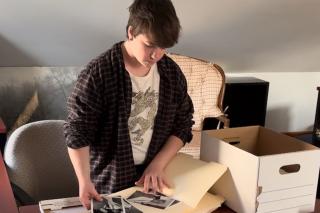
Graduate student Ashten Vassar-Cain ’27MS brings a human rights approach to library and information science. We spoke with him about community archives, centering survivors, and the immersive training at Simmons.
“I am really passionate about information access and community building,” says Simmons School of Library and Information Science (SLIS) graduate student Ashten Vassar-Cain ’27MS. “I enjoy helping people access information and answering their questions.”
Vassar-Cain came to Simmons with a master’s degree in human rights and experience interviewing individuals affected by genocide. He also had volunteered for a community archive in Pennsylvania in 2024 before formally pursuing his studies in library and information science (LIS).
“This experience got me fascinated with the world of archives and libraries,” he recalls. “I started to talk to more people who were working in the profession to see if this was a career path that I would enjoy. I realized that I wanted to pursue this path, with an emphasis on information access and advocacy.”
Expanding upon his interest in community archives, Vassar-Cain chose the cultural heritage informatics concentration at SLIS.
Building a Community Archive
After volunteering at the Pennhurst Memorial and Preservation Alliance for two years, Vassar-Cain now holds a full-time position helping build its community archive.
Pennhurst (Spring City, PA) operated from 1908 to 1987 as a state-run school and hospital for individuals with disabilities. It closed after reports of widespread patient abuse. The archive spans 1975 to 2008 and includes photographs, protest songs, organizing materials, and narratives of former residents.
Together with the Alliance’s Co-Vice President Jess Petrazzuoli-Gallagher ’26, Vassar-Cain documents the legacy of the self-advocacy movement in Pennsylvania.
As he explains, this archive honors “people who had survived state disability institutions like Pennhurst. When they transitioned into the community, they started advocacy organizations to fight for the rights of people with intellectual and developmental disabilities who have been institutionalized and abused.”
Whereas other, more traditional, archival materials related to Pennhurst privilege the voices of medical professionals and lawyers, “we are fortunate to work with the surviving advocates of the movement, and have their accounts and their stories regarding what it was like, and how they created social change through advocacy,” Vassar-Cain says.
“This community archive paints a different story, one that comes from the words of the people who lived through this movement,” he says. “The archives preserve survivors’ resilience and advocacy.”
Vassar-Cain and Petrazzuoli-Gallagher also helped secure two grants for this project, including a $242,000 Council on Library and Information Resources "Digitizing Hidden Collections" grant and a $480,000 Mellon Foundation "Humanities in Place" grant. (The latter is fiscally sponsored by The Community's Foundation of Delaware County.)
Flexibility at Simmons SLIS
Once he knew that he wanted to work within the LIS arena, Vassar-Cain searched for graduate programs that would enable him to continue his work in Pennsylvania while pursuing an advanced degree.
“Simmons stood out to me because of its flexibility,” he says. “I was also drawn to Simmons’ network of alumnae/i, as well as SLIS’s partnerships with sites for internships and placements.” He found the Simmons community “reachable and responsive.”
Moreover, he was intrigued by Simmons’ cultural heritage and informatics concentration.
“I am very interested in community memory, resilience, and storytelling. Since I have done past work in oral history collections, I developed an interest in connecting with people and recording their deeply personal stories,” he explains. “I found that Simmons’ cultural heritage focus really aligned with what I am trying to focus on as an archivist. It was exactly what I was looking for.”
At Simmons, Vassar-Cain also serves as a graduate assistant. He can perform this work remotely and receives compensation through the SLIS Graduate Student Assistantship program. Currently, he is helping Assistant Professor Shengang Wang develop research methodologies in LIS, and assisting with other projects.
“The assistantship involves an area of LIS that I would not have organically stumbled upon. It’s given me a different space to get to know other aspects of the field, which has been great,” he says. “Simmons has given me a lot of opportunities that I was not expecting from an online program.”
Hands-on Training in LIS
Thus far, Vassar-Cain’s favorite Simmons courses have been “Information Organization” (LIS 415) and “Concepts in Cultural Heritage and Informatics” (LIS 432).
Speaking on “Information Organization,” Vassar-Cain says, “this course helped me ground the everyday activities of the profession in theory, and helped me better understand effective organization and communication within the field.”
The course on CHI “drew from real-world case studies, and demonstrated how different organizations have had to contend with their own histories and how the field is evolving to incorporate historically marginalized voices and perspectives,” he explains. “It made me think more deeply about how we remember, and was directly relevant to my interest in CHI.”
One of Vassar-Cain’s most influential Simmons professors has been Associate Professor Adam Kriesberg, with whom he took “Digital Stewardship” (LIS 448) and “Introduction to Archival Theory and Practice” (LIS 438).
“I appreciated how available Professor Kriesberg was to solve problems and troubleshoot, and talk through new ideas and ways to interpret the readings and the assignments,” he says. “His assignments were directly tied to a skill that you would use in a practical environment.”
Even as an online student, SLIS has helped Vassar-Cain access local hands-on learning experiences. For example, he interned at the Colleges of Physicians of Philadelphia Medical Library, where he helps process small collections. He completed the internship as part of the “Introduction to Archival Theory and Practice” (LIS 438) course.
“This placement was significant,” he says. “I was not sure what to expect from an internship placement, but everybody at my site was very welcoming.”
For Vassar-Cain, Simmons SLIS has expanded key skill sets.
“Simmons has provided me with the tools and theory to apply what I learned in the classroom to my work,” he says. “I have also had the opportunity to learn how to conduct LIS research and manage digital assets, which is increasingly important in the field.”
Furthermore, “Simmons is helping me troubleshoot problems in real time, including things I have never before encountered,” he says. “Having a wealth of resources and helpful professors has been so important to my learning process. Simmons has been a very supportive learning environment for me.”
Finding Community Online
While in the midst of the graduate application process, Vassar-Cain had a close friend already at Simmons. “It helped knowing somebody who was going through the program, and I could ask them questions and get a sense of what to expect,” he says.
Nowadays, Vassar-Cain reciprocates peer mentorship by serving as an ambassador for TruLeague. In essence, he makes himself available to prospective Simmons students and chats with them online.
“Navigating the application process can be difficult, so I wanted to help people through this and make them feel supported and connected,” he says.
Though Vassar-Cain attended Simmons fully online, he did not feel isolated and enjoyed considerable faculty support.
“Any concerns I had about going to school online were continually challenged at Simmons,” he says. “Being at a school where everyone is studying information and communication means that questions and discussions are welcome and encouraged.” He also notes that SLIS nurtures student interaction through group projects and virtual or hybrid events.
As an online student, Vassar-Cain has embedded himself in the SLIS community. SLIS’s virtual programming is communicated through a student email list newsletter, which, as he says, “helps me feel more connected.”
He is also involved with the SLIS Student Advisory Board, which combines student and faculty perspectives to share feedback and collaborate with the SLIS administration.
Outside of Simmons, Vassar-Cain attends conferences and other professional events. He is involved with the Society of American Archivists, specifically with their Accessibility and Disability Section.
“Even if I meet people who have not attended Simmons, the University often comes up in conversation when I am meeting new people and networking, which has been wonderful,” he says.
Centering Survivors
As to his future plans, Vassar-Cain intends to work with collections related to social movements and human rights.
He also has a personal motivation to support survivors.
“As someone who has also survived institutional abuse, this is helping me come full circle,” he says. “It is fulfilling to be trusted with the stories of other people who have maybe had similar experiences, to learn from their personal histories, and to honor their memory.”