
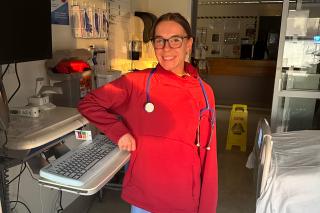
In retrospect, Olivia Panagiotou ’23 wonders if her path to nursing was destined from the start.
“I never knew I wanted to be a nurse, though I grew up around nurses,” she says. In fact, both of Panagiotou’s sisters earned their degrees in nursing from Simmons. (We interviewed Panagiotou in 2023 when she and her sister Kaitie Panagiotou '18 were training for the Boston Marathon.)
“When I saw my sisters going [into the nursing field], I saw what a fulfilling career it was,” she says. “Once I graduated from college, I couldn’t picture myself doing anything else.”
Aside from sibling recommendations, Simmons’ location amid the best hospitals in the country was certainly a draw. Panagiotou did clinical placements at Massachusetts General Hospital, Beth Israel Deaconess Medical Center, Brigham and Women’s Hospital, and Boston Children’s Hospital.
“These are the top hospitals around,” she says, reflecting on her first clinical experiences during her sophomore year. “That’s when I could see myself as a nurse, once I was in the hospital environment.”
Planting the Seeds for Acute Nursing
Now a nurse in the Medical/Surgical Intensive Care Unit (MICU/SICU) at Beth Israel, Panagiotou can see the steps that led her to work with patients in need of acute care. One course that stands out is “Complex Nursing Care Management across the Continuum” (NURS 347), taught by faculty member Kelly Marchant.
“Professor Marchant talked about the ICU experience, then [facilitated] small group discussions about the case studies before sharing with the whole class. It helped to evolve our critical thinking on the material,” says Panagiotou. “Even though I wasn’t in the ICU for clinicals, that class made things start to click for me. The class touched on complex patients with complex medical histories and many factors impacting their clinical presentation. It was starting to make sense to me.”
Panagiotou’s sisters had worked as ICU nurses, and she could see the benefits of gaining experience caring for critically ill patients. “It’s the most beneficial skillset you can gain as a nurse. It opens a lot of opportunities if you have those skills.”
Another step in the journey was Panagiotou’s experience in Simmons’ Nursing Simulation Center during her junior and senior years, where she practiced skills on medical manikins.
“The Sim labs offer the feel of a high-stakes clinical situation in a low-stakes environment,” she says. “At the end of the day, no one was going to be hurt by the decisions you made, and afterward, you can talk about it with the Sim lab instructor.”
The experience provided opportunities to respond to various scenarios in real time. “That got me and my peers comfortable with [answering], What do you do if your patient’s heart rate starts to drop? What is your instinct? I’m very much a hands-on learner, so the Sim labs and clinicals were most beneficial to me.”
Now, in her nursing work at Beth Israel, nurses participate in “skills days,” mock simulations followed by a debrief.
“In the ICU, we’re constantly getting new products or new versions of products [to use]. Or there are skills we don’t use all the time that need a refresh. I’ve never found [simulations] not helpful,” she says.
Getting a Foot in the Door as a Nursing Assistant
Clinical rotations further helped Panagiotou prepare for the realities of a career in nursing.
“Clinicals are your time to take things you discussed during class and see them [present] on a real patient,” she says. “You learn the fundamentals — how to wash a patient, how to turn a patient — that makes the transition to being a nurse that much easier. Given Simmons’ location, you’ll likely have clinical rotations at one of the best hospitals in the area, and see patients at the highest level of acuity.”
During her studies at Simmons, Panagiotou started working at Beth Israel as a nursing assistant on the medical/surgical (med/surg) floor.
“Working as a nursing assistant while at Simmons really gets your foot in the door,” she says. “The nurse managers get to know you, along with the other nurses. If you make a good impression there, you can often find a job after graduating.”
Once she graduated, Panagiotou worked on the same unit as a nurse for the next two years. “Getting those years of experience in med/surg laid a great foundation to build on,” she says. “That’s where I learned how to be a nurse.”
When a position opened in the MICU/SICU unit, she applied. “I shadowed a nurse for a day, then interviewed and was offered the job.”
Now, she works in the only ICU on Beth Israel’s east campus (the smaller of two campuses), located near labor and delivery, oncology, and gastrointestinal (GI) surgery. “We see a lot of patients from oncology, labor and delivery, and surgery. It’s a mix, so you’re not seeing the same population all the time,” she says. “Every day in the ICU is different, because a patient’s acuity is constantly changing. During every shift, I learn new things.”
Panagiotou admits that treating acutely ill patients can be especially challenging. “It was hard at the beginning. There is a learning curve, a whole new world of medicine [in acute care].”
She is also aware of the benefits. “ICU nurses have a lot more autonomy. They’re constantly titrating a patient’s intravenous drips and gauging if they need to be more sedated,” she says. “The residents and interns take into account what ICU nurses say, because we spend so much time at the patient’s bedside.”
For Panagiotou, that close observation is key. “A patient who looks okay one moment can go south really quickly. You need to be alert and notice those subtle changes. Your level of knowledge of the patients is deeper,” she says. “Our patients are very sick, but it’s amazing when they progress and get better. Nurses are very appreciated in this setting.”
Advice for Future Nursing Students
Panagiotou encourages students to gain experience working in hospitals as soon as they can. Of course, it helps if you have willing nurses in your family.
“In high school, I shadowed my aunt for a day. If you have the opportunity to shadow a nurse, it’s a great way to see what their day-to-day life is like,” she says.
Simmons students are fortunate to have many options for clinical rotations.
“If you have the opportunity to practice nursing at these top hospitals, that’s where you should go,” says Panagiotou. “See as much as you can, and the most acute care that you can. That’s where you get the most in-depth level of nursing knowledge, to be the best nurse you can be.”
That said, she appreciated Simmons for more than just its prime location. “Simmons is a smaller school with a great community and a more individualized approach,” she says. “I had great relationships with teachers who cared about my academic success.”