
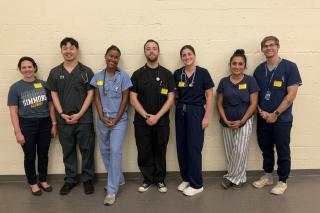
Simmons School of Nursing (SON) students are providing free sports preparticipation examinations for middle and high school student-athletes in the Boston area. We spoke with faculty preceptors Professor of Practice Tina Delouchry and Assistant Professor of Practice Delmy Piano, as well as nursing students and middle/high school faculty, about this special project.
Simmons School of Nursing (SON) graduate students in the family nurse practitioner (FNP) and direct entry Master of Science in nursing (RN) programs brought their skills to local middle and high schools this fall.
SON students Yvette Armstrong ’23MPH, ’27 MSN-FNP; Matt Dasilva ’27 direct entry MSN-FNP; Hafida Ait El Fqih ’27 MSN-FNP; and Matthew Holzapfel ’27 MSN-FNP performed sports preparticipation exams (i.e., physicals) for students at Dearborn STEM Academy in Roxbury over a period of five hours on September 14.
Armstrong, Danielle Doleva ’27 MSN-FNP, Sam Racine ’27 MSN-FNP, Tom Yang ’26 direct entry MSN-FNP, and Clifton “Clif” Ricciardi ’29 direct entry MSN RN-FNP performed physicals for students at Fenway High School over a period of seven hours on September 17.
Thus far, SON students have performed 39 physicals for student-athletes. They are preparing for a similar event at the Boston Green Academy on November 10.
For these events, Professor of Practice and Director of FNP Clinical Education Tina Delouchry volunteered as faculty preceptor to FNP students. Assistant Professor of Practice and Assistant Director of the Bridge and Mentoring Program Delmy Piano volunteered as faculty supervisor to the direct entry (pre-licensure) students.
“All of our MA-based students — whether they are online, on campus, direct entry, or another degree program — are eligible to participate, as long as they are in the FNP clinical portion of their program,” says Delouchry. “Pre-licensure nursing students can assist with the event [though they cannot give physicals], but they must be enrolled in a clinical course.”
Removing Barriers
At the heart of this experiential learning experience is removing barriers to students who wish to play sports.
“Oftentimes, high school students are excluded from playing sports because they are not able to get a sports physical in time for the start of the season for various reasons,” Delouchry explains. “By providing free, accessible physicals, Simmons SON students are removing a barrier for them.”
For SON student Ricciardi, “increasing access to health education and promoting basic health practices are a big part of why I wanted to go into nursing.”
For Piano, it is meaningful to expose high school students to the nursing profession. “I grew up in Boston and went to a Boston public school. You learn about professions like nursing from hearsay, but the youth are not typically interacting with nurses or nursing students,” she says.
Athletic Coordinator at the Dearborn STEM Academy and veteran coach in Boston Public Schools Joao Barros has immense gratitude for Simmons.
“I cannot say enough about the importance of the physical examinations that Simmons provides for our students,” he says. “Having an up-to-date physical is a requirement for students to participate in interscholastic sports, and unfortunately, many students, for a variety of reasons, do not have a current physical. This fall, we were fortunate to have Tina and her team at the Dearborn STEM Academy, where they provided physical examinations for 14 of our students. Thanks to Tina and the Simmons nursing students, these students were able to receive the necessary physicals and participate in athletics.”
Dearborn STEM Academy faculty member Sentidra Joseph echoes this sentiment: “Having Simmons School of Nursing students provide sports physicals to Dearborn students was an incredibly meaningful experience … Thanks to the Simmons School of Nursing students, our students were able to overcome an important barrier and get cleared to participate in sports,” she says.
“Furthermore, the physicals provided an opportunity to identify potential health concerns that some students may not have been aware of and connect them with appropriate follow-up care,” Joseph adds. “We are incredibly grateful to the Simmons School of Nursing students for their time, compassion, and commitment to serving our community and making a meaningful difference in the lives of our young athletes.”
Faculty Support
In her faculty preceptor role, Delouchry begins by collaborating with the high schools, working closely with their staff — particularly school nurses and athletic directors — to coordinate dates.
“I will also do a site visit to decide the best location for the exams and make sure there is sufficient privacy for the students,” she adds. Delouchry also works with the clinical placement team on necessary administrative tasks.
“To prepare nursing students for the events, we let them know up front what to expect. We use the American Academy of Pediatrics sports pre-participation history forms and physical assessment forms,” Delouchry explains. “This way, students can look over that information beforehand, as well as parental consent forms. The school plays a big role in making the event a success, ensuring that all required paperwork is completed so that student-athletes are eligible to participate.”
As faculty preceptor, Delouchry briefs Simmons SON students at the start of the event. She also reviews important aspects of sports physicals and health history with them. “We discuss key aspects of the physical assessment that FNP students should be focused on to ensure that the student athletes are safe to participate in sports.”
However, Delouchry adds, “While FNP students take the lead in conducting the physicals, my role is to oversee and support the students, provide guidance as needed, and answer questions. We collaborate to determine if the student-athlete is cleared to play sports.”
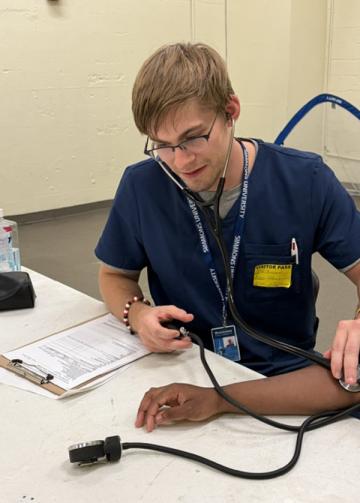
As for Piano’s role at the Fenway High School event, she supported pre-licensure SON students’ contributions. (In the state of Massachusetts, only licensed nurse practitioners can conduct physicals and sign off on physical assessments). Pre-licensure students obtained patients’ vital signs, including checking their blood pressure, heart rate, height, weight, and visual acuity.
“I supported those students who were welcoming the patients in initially before they were handed off to the FNP students for the physical examination,” Piano explains.
Applied Learning
Delouchry and Piano express how these events enable SON students to apply their nursing knowledge in a direct, expansive way.
“Throughout the whole process we encourage critical thinking and clinical decision-making,” says Delouchry. “In some cases, we cannot clear a patient to play sports, and advise them to follow up with their primary care provider.”
Ricciardi “loved the experience” at Fenway High School. “As a former high school athlete, I understand the bigger picture that sports can provide for kids, especially when it comes to developing interpersonal, social, and communication skills,” Ricciardi expressed.
Regardless of where SON students are in their program, this experience has given them an opportunity to apply their knowledge and demonstrate competencies appropriate to their level of education.
As Delouchry says, “Nursing education is about providing competency-based education. Here, FNP students showed their competencies in advanced health assessment, communication, collaboration, critical thinking, and clinical decision-making, which is really important.”
Furthermore, SON students are receiving a group clinical experience, which differs from the typical one-on-one preceptorship in the FNP program. “They can teach and learn from each other, which is really great. And they get the opportunity to collaborate with other students, not only with FNP students, but with pre-licensure students and school staff,” Delouchry notes.
One unusual aspect of this learning experience is the equipment. While most prelicensure nursing students have had clinical experience in hospital settings with electronic blood pressure cuffs and digital records, at the high schools they use manual blood pressure cuffs and paper charts. “Here, the students apply what they learned in their skills lab,” Delouchry says.
Moreover, Piano observed how Simmons students applied foreign language skills. “Our students were surprised by the [cultural] diversity they saw in the schools’ demographics. One of our students used her native language skills to help translate information to a patient. So, I think this is a great opportunity for our students to be exposed to different populations, including the public school system,” Piano says.
She adds, “Simmons SON students will be practitioners one day, so it’s important to get this exposure to treating different kinds of patients.”
Simmons and the Boston public school system wish for this partnership to continue and grow.
“Being able to access this incredible resource is so important to our students and our athletic programs,” Barros says. “I sincerely hope that this partnership and service continues in the future, as it makes a meaningful difference in the lives of our students. Thank you to Tina, everyone at Simmons, and the entire nursing program staff and students for your time, dedication, and commitment to supporting our young people.”
“Helping kids better understand their health and supporting their ability to participate in sports was a great opportunity,” Ricciardi says, “and I’m glad I was able to be a part of it.”