
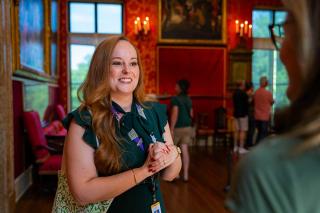
Transfer student and Dix Scholar Brianna Fischer ’26 received Simmons University’s Clio Award, a special recognition for an outstanding student pursuing a Bachelor of Arts degree in history. We spoke with her about her historical research and the stimulating atmosphere at Simmons.
“I was very surprised and honored to receive the award,” says history major, transfer student, and Dix Scholar Brianna Fischer ’26, upon receiving the Clio Award from Simmons’ (former) Department of Humanities. The award is named after the ancient Greek muse of history, and recognizes an outstanding student researcher who is majoring in history.
“It came at a time in my studies when I was having a lot of insecurities about my research and about being an older student. Receiving the Clio Award gave me the confidence to realize that I am in the right place, and that I made the best decision for myself and my education,” Fischer says.
Before she attended Simmons, Fischer worked as a laboratory medical assistant at Beth Israel Deaconess Hospital for 10 years. During the COVID-19 pandemic, she became exhausted. One day, following an especially stressful hospital shift, she visited the Isabella Stewart Gardner Museum. She noticed that a museum internship opportunity was being offered through Bunker Hill Community College.
“I relayed this information back to my partner, and told them that I was thinking about going back to school,” she recounts. “I have always loved history as a subject so I quit my job and eventually got the internship.”
Currently, Fischer serves as a museum educator at the Gardner Museum. In this role, she provides tours to people of all ages, including corporate and professional tours. She also delivers lectures on specific museum topics.
“My main role is to assist people with having their own emotional experiences with the artwork,” she says.
Previously, she worked for the Museum’s development office, where she helped the institution receive external grants. “I fell in love with the Museum, and it inspired me to change the course of my career,” she reflects.
Researching Lesbian Separatism in the South
While at Simmons, Fischer conducted a research project, entitled “From Print to Place: Relocation Networks and the Making of Lesbian Separatism in Florida, 1967–1985.”
As she explains, “My research explores the ways lesbians in Florida used feminist and lesbian publications to build separate communal living spaces during the 1970s.”
Although select scholars have researched lesbian communities elsewhere, Fischer found that those located in the South were understudied.
“When you think of communities like hippie communes during this period, you tend to associate them with the Pacific Northwest, California, or New England. Few people have looked at women in the southern states,” she notes.
During her research, Fischer learned about one such community in Melrose, Florida, called North 40, which was the first women-centered and lesbian-centered communal living space in the country.
“They purchased their land in 1972, which I found very significant,” she notes. “I was born and raised in Florida, so this was especially meaningful to me.”
As part of the research process, Fischer spoke with and conducted oral histories with living members of the Florida group — many of whom are still involved in activism.
She had the opportunity to work with Emily Greene, who had been a part of The Pagoda community in St. Augustine, FL since 1978. (Greene currently lives at Alapine in Alabama). Greene shared her personal archive (including the group’s documents and photographs) with Fischer. Some of these archives were donated to and are now housed within the Invisible Histories Archive in Charlotte, NC.
Other key sources for Fischer are lesbian publications and community resources. The Lesbian Natural Resources Archive provides information on how to start one’s own community. Through this resource, Fischer consulted a book written by Joyce Cheney, entitled Lesbian Lands (1985), which provides testimony from women living in lesbian communities across the country. Other notable publications include The Lesbian Connection, Gaia’s Guide (a lesbian travel guide), and Judith Brown and Beverley Jones’s paper entitled “Toward a Female Liberation” (which eventually became The Florida Paper, the first women’s liberation pamphlet).
“After studying these materials, I noticed that these groups were utilizing these publications not just to get the word out about women’s liberation, but to find each other,” she says.
Beyond her undergraduate work, Fischer hopes to conduct additional in-person interviews with other community members. “It is very pertinent, given our current climate, to acknowledge that communities of queer people and women living communally with each other have always existed,” she says.
Inspiration at Simmons
During her museum internship and associate degree program, Fischer became very aware of Simmons, given the close geographical proximity between the University and the Gardner.
“When I took a tour of Simmons, I learned that it was a women-focused university. The history behind Simmons was also very appealing to me, as well as the closeness to my workplace,” Fischer says. “I chose Simmons, and, thankfully, Simmons chose me.”
Having earned her associate’s degree online, Fischer was glad to be back on campus, especially after the pandemic. During her first semester at Simmons, Fischer took two graduate-level history courses: “9/11 Narratives” (HIST 365), taught by Professor Emeritus Stephen Ortega, and “Seminar in Early American History” (HIST 371), taught by Associate Professor Steve Berry. In both of these classes, she was among peers her own age, even though she was pursuing her bachelor’s degree.
“I felt very welcome in the class, even though I was an undergraduate,” she recalls. “Everyone was appreciative of my knowledge in terms of my previous work experience. Even when taking undergraduate courses alongside younger adults the following semester, I felt that I belonged at Simmons.”
Finding Support at Simmons
In her classes, Fischer found community and mentorship.
“Professor Steve Berry is one of the most phenomenal professors to contextualize how to study history,” says Fischer. “He gives you the tools to really analyze historical events and historical periods. Taking his classes changed the way I look at history and the way I study history. It made me love it even more, and now I am considering graduate school.”
After experiencing a family tragedy involving the passing of her sister, Fischer received “extensive support” from several faculty and staff members, including Associate Director for Online, Adult Learner, and Edge Programs Christine Henningson, Assistant Teaching Professor Cait Parker, with whom she took “Seminar in Modern US History: Counterculture and Revolution: Women in the 1960s–1970s” (HIST 574), and Adjunct Professor Jillian Laceste with whom she took “Gender and Art” (ART 248). “My historical research has now become a way to honor my sister’s memory,” she says.
“Those faculty members really helped me get through this last semester after a family tragedy, in ways that I don’t think they could ever understand. I am very appreciative of them helping me get through a tough time in my life,” she says.
As for her future career plans, Fischer is contemplating a role that revolves around collections management.
“I think collections management encapsulates everything I want to do: being hands-on with the collection, conducting research, and so forth,” she says. Thus, she is contemplating applying for the Master of Science in Library and Information Science: Archives Management + History dual degree program at Simmons’ School of Library and Information Science (SLIS).
Learning from History, Embracing Self-Worth
One of Fischer’s favorite historians is Tim Snyder, the author of On Tyranny: Twenty Lessons from the Twentieth Century (Random House, 2017). “He has a great quote that I have tried to envision and live by: ‘History doesn’t repeat itself; it instructs,’” she says. “What fascinates me about history is that there is always an event from previous eras that mirrors what we are going through, and can instruct us on the way through it.”
As to words of advice to aspiring adult learners who desire a career change, Fischer says, “You are smart enough and worthy enough to do it. Gather one or two people you can rely on and who will support you mentally and emotionally.”
She adds, “Another piece of advice is that you don’t have to go off the deep end. It’s OK to take one class at a time and online classes. Taking that first step is the most important.”