
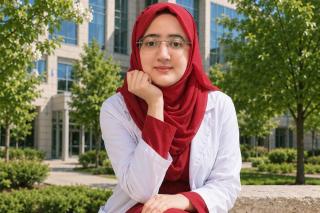
“I’ve always been drawn to food and the way it brings people together,” says Mishal Ali ’26, who completed her BS in Nutrition & Dietetics this spring.
“Growing up in a Pakistani household, food was never just about eating — it was about care, connection, and responsibility for one another,” she says, “Watching my mother care for our family through cooking and hospitality, alongside my father’s support, deeply shaped my understanding of food as a source of nourishment, comfort, and connection.”
She enjoyed cooking and baking from a young age, learning from her mother.
“She not only taught me recipes but also explained how ingredients affect health and well-being, along with the traditional use of herbs and foods,” says Ali. “These early experiences helped me see food as both cultural identity and a form of preventive health, sparking my deeper interest in nutrition science.”
Following Her Passion for Food and Nutrition
Ali moved to the US with her family in 2021. After completing an associate degree in nutrition and diet technology at North Shore Community College (Danvers, MA), Ali transferred to Simmons for her bachelor’s degree in nutrition and dietetics.
“At Simmons, I have explored nutrition through clinical, scientific, and global perspectives,” she says.
She also participated in campus wellness initiatives, including a nutrition education tabling event featuring the “Sugar Detective” game and healthy eating activities.
One of her most impactful academic experiences at Simmons was developing a functional food product in “Advanced Food Science” (NUTR 201).
“This project allowed me to integrate food science with creativity by incorporating bioactive compounds and evaluating their potential health benefits compared to conventional baked products,” says Ali.
Guidance and Experience at Simmons
Ali is grateful to the Department of Nutrition faculty for their guidance and support.
“Professor Teresa Fung was an important mentor who consistently guided me, provided resources, and encouraged my professional development and future goals,” says Ali. “Associate Professor Kathrina Prelack, my clinical preceptor, played a key role in helping me develop patient-client communication skills, build trust, and learn effective counseling approaches.”
Alongside her studies, Ali worked as a nutrition assistant at Mass General Brigham Salem Hospital.
“I assist with menu planning, portion control, and ensuring patients receive meals aligned with prescribed therapeutic diets,” she says. “This experience has shown me how deeply nutrition influences recovery, healing, and quality of life. It has also strengthened my interest in the connection between nutrition and mental health, particularly within adult psychiatry services, where I have observed how dietary patterns and food behaviors can interact with psychological wellbeing, especially among young adults.”
Balancing Diverse Food Culture
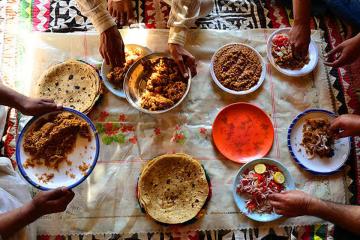
Ali notes that food culture in Pakistan and the US differs significantly.
“In Pakistan, meals are often home-cooked, shared, and centered around family gatherings with traditional dishes prepared fresh daily,” she says. “In the US, food is often more fast-paced and convenience-oriented, with greater reliance on packaged and processed foods. Experiencing both has helped me appreciate the importance of balance between cultural traditions and modern dietary habits.”
Ali enjoys making traditional Pakistani dishes, such as samosas and halwa puri, once per week.
“Samosas were always part of family gatherings and tea time in our home,” she says, noting that she simplifies the recipe by using pre-made wrappers and baking or air-frying instead of deep frying. Halwa Puri, usually served with spicy potato curry, “reminds me of Sunday breakfast mornings with my family. The combination of sweet halwa, crispy puri, and flavorful potatoes creates a warm and festive family tradition.”
While coffee is prevalent in the US, tea time has a special importance in Pakistani culture.
“Sham ki chai [evening tea] is a daily tradition where families come together to relax, connect, and share conversation, representing hospitality and comfort,” says Ali. “I personally enjoy this every day as part of my routine.”
One dish she still makes regularly is daal (lentils) with rice. “It’s simple, nutritious, and easy to prepare, and I often adapt traditional recipes to make them quicker while keeping their authentic flavor.”
Ali looks forward to building a career in clinical nutrition, with a particular interest in outpatient counseling for diabetes management and long-term lifestyle modification.
“I believe that healthy habits begin early and that culturally sensitive, evidence-based nutrition education can create lasting improvements in health outcomes,” says Ali.
“For me, nutrition is more than a profession — it is a lifelong passion rooted in both culture and science,” she says. “From my upbringing in a Pakistani joint family kitchen, through the spiritual and nutritional experiences of Ramadan where food, fasting, reflection, and community come together, to my academic and clinical training in the United States, my journey has been shaped by one belief: food has the power to connect, heal, and transform lives.”