
Students in the doctor of physical therapy (DPT) program at Simmons begin integrated clinical experiences during their first fall semester. These experiences take place in both hospital and private practice settings in Boston and the surrounding areas. Preparation for these clinical experiences begins in the summer semester.
Starting in Summer at Harvard’s Cadaver Lab
Before integrated clinical experiences begin in the fall, all students start the program with an introductory course in “Clinical Medicine” (DPT 631) and “Human Anatomy” (DPT 621), which includes hands-on cadaver dissection at the Harvard Medical School cadaver labs.
“It was really helpful,” Leah Ruddy ’28DPT says of the experience in the cadaver labs. “I can visualize the muscles I saw in dissection when I see patients. It offers a good understanding of anatomy.”
For example, the nervous system, Ruddy says, is like “battery power” for muscles. “The experience of dissection allowed us to explore certain muscles and see what surrounds them, and that’s helpful,” she says.
“I was able to inspect different nerves,” says Brenda Rodriguez ’28DPT, who was grateful for her time in the cadaver lab. “Now, when I see people walking down the street, I can imagine what their muscles look like! It’s made me better able to explain what’s going on in someone’s body, to have that visual aid and apply what I’ve seen to my patients.”
Rebelo also sees the lab training as vital to her PT training. “It helped me understand where everything is in the body,” she says, noting that they could follow “this nerve wraps under here, where does it go? What muscles does it innervate, or stimulate? It helped me understand how nerves supply different parts of the body, and how an impairment of a particular nerve may affect someone.”
If starting the DPT course of study with a semester in Harvard’s cadaver lab may intimidate prospective students, these four are eager to offer reassurance. They cite, in particular, the support of Associate Professor of Practice Rachel Verrill, who accompanies students in the lab as coordinator for the Human Anatomy course.
“Professor Verrill believes in you,” says Rebelo. “The professors at Simmons have so much knowledge and are always there for you. By the time you enter the fall semester, you’re exposed to an entire web of support.”
Rebelo says that Assistant Professor of Practice and Director of DPT Clinical Education Jillian Kulinski is “amazing, eager to support you, and always available for questions. There are also graduate assistants that are available to help in most classes as well.”
Fall Coursework and Labs
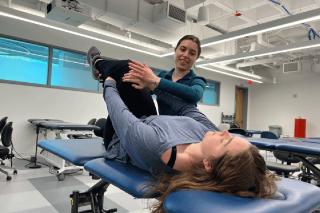
The coursework is structured to support on-site experiences. As an example, “Frameworks of Physical Therapy: Musculoskeletal I” (DPT 672), which students take their first full semester of the program, includes tutorials, lectures, and lab work, in addition to the integrated clinical experiences.
“It’s an introduction to the musculoskeletal system, with two-hour labs twice per week, where you can test out techniques on your fellow classmates,” says Rodriguez. “It covered the basics, while also getting us comfortable with talking to people and building trust. It was good at leading us into the first steps of becoming a PT.”
Ruddy agrees with the importance of this approach. “We learn a lot about interpersonal skills and how to create a connection with a patient,” she says.
Those skills are further developed in their integrated clinical experiences, supported by the knowledge gained in the classroom.
“We learn how to talk to patients and what kind of wording to use, to transform our PT language into something that a patient can understand,” says Zuzanna Misztela ’28DPT.
Rebelo notes that many professors are Simmons alumnae/i, who know well what students are going through.
“They structure their courses towards students’ learning needs, taking feedback each semester to help structure the course further,” she says.
Misztela appreciates the support that faculty offer to students.
“For every lesson, my professors have offered five additional articles we can easily access to help us enhance our knowledge on the topic,” she says. “They also have open office hours, and graduate assistants hold open labs. It’s a rigorous and demanding program, but the support makes it easier to digest.”