
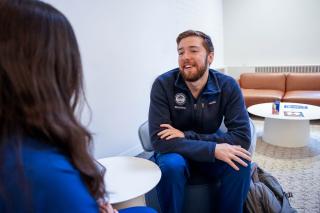
Direct entry nursing student Hunter Lynch ’26FNP works in primary care and aspires to one day become a nursing educator. We spoke with him about hands-on learning at Simmons and the rewards of the nursing profession.
While majoring in biochemistry and minoring in education at the University of Massachusetts, Amherst, direct entry nursing student Hunter Lynch ’26FNP desired to become a professor in the sciences.
“Research is very important, but eventually I found that it wasn’t for me. I wanted a job that was more social and saw immediate change … I thought about medical school, but I really did not want to be a doctor. I realized that with nursing that you get that patient interaction. It’s very social, and you have a direct impact on patients’ lives,” he says.
Moreover, Lynch had a personal motivation for pursuing a career in healthcare. When he was 8 years old, his brother suffered a traumatic brain injury in a snowmobile accident.
“It really changed the whole dynamic of my family growing up,” Lynch says. “But I saw how all the nurses in the hospital and in his rehab cared for him and helped him progress to where he is today. That encouraged me to give back to my community and help other people.”
Currently, Lynch works as a registered nurse (RN) at Brigham and Women’s Hospital.
“The primary care route is definitely where I’m headed. There is a huge crisis with it right now in the healthcare world, and it’s hard to find a primary care provider,” he explains.
Immersive Learning at Simmons
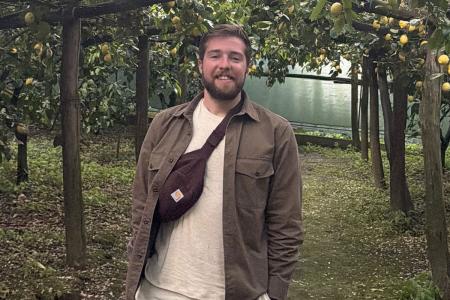
When looking into nursing schools, Lynch wanted a Boston location and in-person learning. On touring Simmons, “the admissions staff was very responsive. They answered all of my questions, and sold the school in a good way. They were really supportive.” Given that his mother is a Simmons School of Social Work (SSW) alumna, Lynch also received a family recommendation.
Another draw for Lynch was the School of Nursing’s (SON) Nursing Simulation Center.
“It’s basically brand new, and I would argue that this facility is probably the best in the state,” he says. “As someone who had no clinical experience before nursing school, the state-of-the-art simulation lab really appealed to me. I wanted to go to a school where I could be exposed to this safely and in a controlled environment where I could get that positive feedback. Simmons’ Sim lab is incomparable.”
Having come from a large state school, Lynch enjoys the smaller, more intimate learning environment that Simmons SON offers.
He also appreciates the accelerated nature of Simmons’ FNP program. “You are not going back completely and starting from scratch. Instead, you are getting your nursing license in a year and a half and then continue with the master’s to become an FNP,” he says.
“Simmons enables us to obtain a higher-level nursing education that will open a lot more doors career-wise,” Lynch notes. “NPs are in really high demand now, and they cover many areas within primary care. You get to spend more time with patients than doctors or physician assistants, and you can also open your own practice.”
Invested Nursing Faculty
One of Lynch’s favorite Simmons courses is “Medical Surgical Nursing 1” (NURS 332), taught by Assistant Professor of Practice Isabelle Milne.
“I like that it is a foundational class and that you are learning the basics of nursing. I liked it so much that I was a teaching assistant for it for three semesters,” he says. “I really like Professor Milne’s teaching style. She has been so helpful and supportive.”
During his pre-licensure phase, Lynch found Professor Sarah Volkman especially influential.
“Professor Volkman is incredible. She is just really willing to help and wants to connect with her students. She keeps in contact with us throughout the program,” he says.
For the graduate (i.e., post-licensure) portion, Lynch enjoyed learning from faculty members Elaine Ferreira and Claire LaBelle, and Associate Professor Kaylee Burke.
Clinical Experiences in the Greater Boston Area
Thanks to Simmons’ location and robust connections, Lynch has benefited from clinical placements in Boston and in the Greater Boston Area.
“The clinical placements were great. All of my pre-licensure placements were at top medical facilities: Massachusetts General Hospital, Brigham and Women’s Hospital, Beth Israel Deaconess Medical Center, Boston Medical Center, and the Veterans Affairs Medical Center in West Roxbury. These experiences give you a sneak peek into how those hospitals operate and expose you to different types of nursing,” he says.
For the nurse practitioner preceptorships, Lynch had placements in Wellesley and Quincy, where he worked with some Simmons alumnae/i.
“They really do a good job of connecting people within the Simmons network. And alumnae/i love to work with Simmons students,” he says.
From Clinicals to the Classroom
One of Lynch’s future plans is to return to school and obtain a certificate in acute care. “I would like to pivot into being an emergency medicine NP and work in an ER,” he says.
Lynch’s ultimate aspiration is to become a faculty member at a college or university.
“Nursing faculty are definitely wanted and needed … there is a huge lack of educators right now,” he observes.
For Lynch, “nursing is unlike any other profession. You are taking care of people at their worst and most vulnerable, and it takes a great level of empathy and compassion for a person to be able to do this,” he says.
“At the end of the day, being able to see someone improve — or even being able to give someone comfort in the last days of their lives — is just so rewarding,” he continues. “It feels good to be able to do that for someone, and to give back to the community in general. Our job is to serve people and to help them … There is no job in the world like nursing.”