
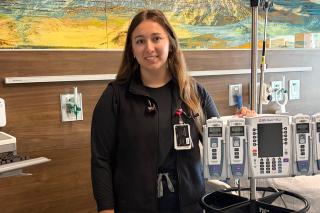
Haley Dover ’22 transferred to the Bachelor of Nursing program at Simmons after realizing in her first semester studying neuroscience at another university that she wanted to work directly with patients.
“I realized, if I keep on this path, I’ll be in school forever and then work in a lab without offering direct patient care,” she says.
After a day shadowing a family friend in her nursing role, Dover realized the high-contact career of nursing was a better fit for her. Starting the program a semester behind, she looked into accelerated programs, which is how she found Simmons School of Nursing (SON).
“I never thought I would end up in a city,” says Dover, who grew up in western Massachusetts. “But at Simmons, you have all the opportunities a city offers but also a safe space on campus.”
Playing Field Hockey as a Simmons Shark
Dover was also thrilled to get back on the field. She played Division III field hockey at her previous institution, and was excited to join the Simmons Sharks.
“Playing field hockey again was wonderful! I had a fantastic coach and teammates,” she says.
Balancing athletics with an accelerated nursing program was challenging, but Dover saw the benefits of a strict schedule.
“Having the structure of an athletic program and the high academic expectations of the nursing program forced me to be organized,” she says. “If I had a chunk of time between practice and a game, I knew that was my time to study. It almost made my life easier. And balancing both of those commitments prepared me for the future, because that’s what real life is like; you have a job and other things you want to do. You have to have a good work ethic; you have to love what you do.”
While some of Dover’s classmates were able to take on additional roles as certified nursing assistants (CNAs) to gain more experience in medical settings, her field hockey schedule, paired with the nursing course schedule, made it impossible to find the time.
“I had no previous experience working in a hospital,” she recalls. “I relied on professors, classmates, and the Simulation lab. Those resources prepared me so I could show up at my clinicals and adapt.”
After the pandemic lockdown and remote learning, Dover opted to take additional classes to complete a psychology minor and enjoy one more semester playing with her teammates.
Simmons Experience: Classes and Clinicals
Dover’s clinical placements were throughout Boston, including Massachusetts General Hospital, Brigham and Women’s Hospital, Newton–Wellesley Hospital, and two separate clinicals at Boston Children’s Hospital.
Though all of her clinical experiences were in inpatient settings, they were “completely different,” she notes. “You might have an idea that you want to be a labor and delivery nurse, or a cardiac nurse, then you go there, and it isn’t what you thought it would be. Clinicals move you around and force you out of the bubble of where you think you’ll spend your career.”
The support of Simmons faculty made all the difference. Dover recalls the “Anatomy and Physiology I” (BIOL 231) class she took with Teaching Professor and Assistant Dean Charlotte Russell, for which she struggled to find the right study method.
“I met with [Professor Russell] during her office hours, and she had me do a test to figure out what would work best. I was a little of three different categories — she said that usually people aren’t split that way, but you are! — and she helped me create a plan tailored to the class, incorporating different study methods,” she says. “Once I had that figured out, all of my classes were much easier because I knew how to understand and retain the information.”
In her final semester, faculty member Marianne Williams offered solid support, and reviewed concepts.
“We wouldn’t just talk about the information; she would ask all of us how it applies to our clinicals,” she says. “We discussed real nursing issues we had experienced while looking at different case studies, including studies about nurses who lost their licenses. We discussed how, as a nurse, you can protect and advocate for yourself, and make sure that you are staying in your scope of practice and caring for your patients the best you can.”
Between graduating and studying for the NCLEX (National Council Licensure Examination), Dover worked at the Windsor School as a field hockey and basketball coach — a job she landed thanks to her connections in the Simmons Athletics Department. “The athletic director had had great experiences hiring Simmons grads,” she says.
From Surgical RN to Travel Nurse
Dover began her career as a registered nurse in a surgical unit at Beth Israel Deaconess Medical Center, where her Simmons education made a difference.
“There were clinical educators at Beth Israel in the Simmons program, and they had hired multiple graduates and had positive experiences,” says Dover. “Graduating from Simmons helps you get your foot in the door.”
Two years in the surgical unit was exactly what Dover needed to get her bearings as a new nurse before her next adventure: travel nursing.
“I’m very happy that I started as an RN on a surgical unit, where I was exposed to everything under the sun,” she says. “I knew I would end up as a travel nurse, but waited until I felt comfortable and prepared.”
Her first travel position was in a pulmonary stepdown unit in Charlotte, North Carolina, followed by a surgical oncology unit in Denver, Colorado. She recently signed a contract that will send her to Southern California.
“I’ve always liked to travel in general, and I want to learn and be exposed to different surgeries, be knowledgeable about medications and treatments,” she says. “The best way is to get that hands-on experience.”
Generally, travel nurse contracts last 13 weeks and are posted a month in advance. “If you see something you like, you have to jump on it, as things go quickly,” says Dover.
Independence and flexibility are key requirements for this work. With a new employer, Dover says, “you get two days of orientation — about the documentation system, how they run things — and then you’re on your own.”
Dover likes the exposure to new ways of doing things. “I get to work with a new patient population and learn something new, and I can bring new things to the floor. I value having that knowledge.”
While travel nurses earn a lower hourly rate, they also receive a stipend that is not taxed, which can make it a lucrative opportunity. “You have to be okay without a huge support system of family and friends right there with you, and a bunch of new co-workers you’re learning to live with,” says Dover. “Then three months later, you start somewhere new. You have to be able to adapt.”
She likens the experience to clinical rotations. “You’re exposed to one floor: how it runs, how they document, and you get comfortable there. Then you go somewhere else and start over again.”
Benefiting from Simmons’ Reputation for Excellence
As for how prepared she felt for venturing beyond Boston for her nursing career, Dover says, “It does come back to your nursing school. Simmons sets very high expectations. Anybody who goes to Simmons wants to excel; that’s the culture. We value academics in the School of Nursing. Would I be the same nurse that I am without Simmons? Probably not.”
And the Simmons reputation travels with her, beyond New England.
“When I say that I went to Simmons, they know Simmons. I can always find connections to Simmons, everywhere I go,” she says.
That standard, along with the standards set by her clinical experiences, empowers her current path.
“The high standard of those Boston hospitals set me up really nicely for travel nursing,” says Dover. “It all goes back to where you start.”