
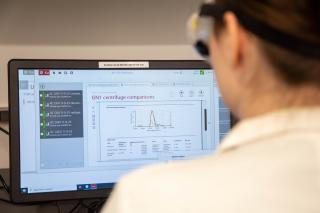
Simmons University’s 3+2 dual-degree engineering program empowers students to earn two degrees in five years: a Bachelor of Science from Simmons and a Bachelor of Science in Engineering from one of our partner institutions. For a glimpse into this unique program, we spoke to three students who have completed their Simmons degree and are looking forward to the second portion of their studies this year: Jingwen Pan ’26 and MJ Vasquez ’26 (Columbia University), and Sydney Whalen ’26 (Washington University).
Jingwen Pan ’26 is ready to explore.
“What excites me most about this stage of the dual-degree program is the flexibility to explore science courses beyond my major, like chemistry, biology, and physics,” says Pan, who completed her BS in mathematics at Simmons and is looking forward to beginning the second portion of her dual degree in engineering at Columbia University this fall. “Even though they aren’t required for my major, I get to take them and learn more about them to see my real interest, and they’ve turned out to be truly meaningful and enjoyable.”
As part of the 3+2 dual-degree engineering program, students spend their first three years at Simmons in majors such as biochemistry, biology, chemistry, computer science, mathematical sciences, or physics. The second two years are spent at a partner university — Columbia University, Washington University in St. Louis, and Wentworth Institute of Technology — focusing on advanced engineering courses in the area of their choice, including biomedical, environmental, computer, or mechanical engineering.
Mentorship at Simmons
The chance to build a strong foundation in science, technology, engineering, and math (STEM) at a small, women-centered institution resonated with MJ Vasquez ’26, a chemistry major who will also attend Columbia to pursue a degree in chemical engineering.
“I think getting introduced to STEM at a women-centered university helped immensely,” says Vasquez, who was also part of the Dynamic Research Education Academy for Mentoring Students in STEM (DREAM-STEM). The DREAM-STEM mentorship program, directed by Professor Arpita Saha, was funded through a collaboration with the National Aeronautics and Space Administration (NASA) to retain women in STEM fields.
As Vasquez says, “...attending their workshops and getting one-on-one mentorship from a faculty member really helped me navigate the field, especially when I was a [first-year student] and new to everything.”
Research at Simmons
She was also able to focus on research projects during her studies at Simmons.
“It was an extremely valuable experience for me,” she says. “I was able to learn how to work independently in the lab, while also contributing and meeting with my lab advisor regularly.”
Vasquez was one of six students selected for the 2026 Senior Scholar Award for her project with faculty mentor, Professor Arpita Saha, “Investigating the biological reactivities of a family of lanthanide metal complexes bearing 2,2-bipyridine in developing novel chemotherapy drugs.”
Of the experience, Vasquez says, “I was able to see a different part of research, and it was through this experience that I know now I want to pursue a PhD after graduating from engineering, something I’m not sure I would’ve come across had I gone straight into engineering. I’m extremely thankful to have been able to experience both sides of science and engineering through this program.
Faculty Support
Despite the rigorous program, mathematics major Sydney Whalen ’26 was able to complete her studies in an even more compressed timeframe.
“I entered the program late and transferred in the second semester of my first year,” says Whalen. “I was extremely grateful that Professor Jason White and Professor Nanette Veilleux were willing to work with me to create a personal course schedule to accommodate my late entrance.”
Whalen worked with Professor Veilleux on an independent study. Pan, Vasquez, and Whalen were named 2025–2026 Clare Boothe Luce Scholars in recognition of their valuable contributions and commitment to academic excellence.
For Pan, the faculty-student relationships at Simmons have also been pivotal. “Every professor I've met has been very supportive,” says Pan, who is particularly grateful for her relationship with Professor Donna Beers. “I worked as her teaching assistant and paper grader for multiple courses across several semesters, and did an independent study with her. She later recommended me to a fascinating internship on the environmental comfort index.”
Whalen, who will study systems engineering at Washington University this fall, says, “Overall, the faculty for the engineering department were incredible. They really want students to pursue this opportunity, and this shows through with their communication with students and accommodations.”
Advice for Prospective Dual Degree Students
Applying to a dual degree program may prove daunting for prospective students, but graduates are quick to offer encouragement.
“My advice is simple: if you truly commit yourself to the program, you can make it,” says Pan. “It takes effort, but the support from Simmons and the Colleges of the Fenway [COF] network makes the journey absolutely worthwhile.”
For Pan, knowing she had the option to take coursework from other institutions in the COF was helpful, especially given her packed schedule.
“Don’t be scared by the rigorous curriculum,” says Vasquez. “Yes, it’s hard and challenging, but it’s not impossible, and the help you receive from faculty members and on-campus resources makes the load feel a lot lighter. If I can do it, so can you!”