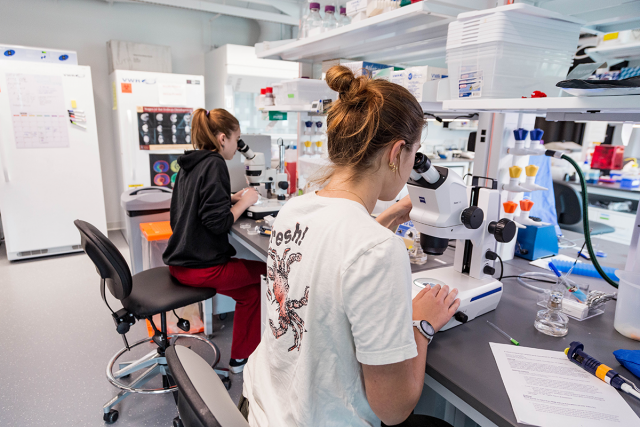
Many undergraduate programs at colleges and universities encourage students to develop research skills early in their higher education journey, giving them confidence and valuable experience.
According to the Council on Undergraduate Research, undergraduate research is: “a mentored investigation or creative inquiry conducted by undergraduates that seeks to make a scholarly or artistic contribution to knowledge.”
Types of undergraduate research may include:
- Institutional programs and fellowships: Organized, often competitive programs run by universities or outside groups to support student researchers
- Curriculum-based research: Research embedded into course requirements, like a capstone project, senior thesis, independent study, or creative activity
- Faculty-led research: Collaborative projects conducted by faculty and students, often under the guidance of a faculty member.
- Off-campus internship opportunities: Research at off-campus laboratories through partnerships with outside institutions
What Are the Benefits of Undergraduate Research?
Developing and maintaining undergraduate research programs benefits students, faculty mentors, and the university. As an undergraduate student, you can build skills and career direction, including:
- Critical thinking and problem-solving skills
- Strong oral and written communication skills
- Hands-on experience with the scientific research process
- Experience using hypothesis-driven methods to solve problems
- Preparation for graduate study and professional careers
You may work on projects developed by faculty mentors or create your own research questions. Either way, you gain valuable real-world experience through the research process.
Moreover, just by participating in course-based undergraduate research experiences, many students report gains in “scientific identity” and emotional ownership of their work. In other words, undergraduate research experiences mean you’ll increasingly see yourself as a capable contributor to knowledge.
At teaching-focused universities, faculty work closely with students to make learning meaningful. Research presentations and publications also help the university gain recognition in the scientific community.