
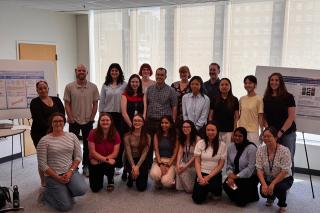
This summer, the STARS (Summer Training in Academic Research at Simmons) 2026 Scholars program paired students and faculty across STEM disciplines to collaborate on research projects. The projects lasted six weeks, culminating in student poster presentations at the end of June. This year, the students were challenged to investigate ways that machine learning could be applied to faculty research.
“The goal was to find intersections and ways that we can use machine learning to make our research more effective and productive,” says Assistant Professor of Biology Seth Johnson, one of the participating faculty members and director of the program.
For Johnson, that involved partnering with three faculty members in the Department of Computer, Data, and Mathematical Sciences (CDMS), who offered guidance to students developing ways to apply the technology to existing research.
“It inspired collaboration between computer science, chemistry, biology, and psychology,” he says. “Sharing ideas among students and faculty, and spreading our expertise as best we could.”
What Fruit Flies Teach Us about the Human Nervous System
Johnson’s specific research lab studies fruit flies to map the development of the nervous system.
“In humans, neurons are connecting from our brains to our muscles, enabling us to move, speak, and breathe,” says Johnson. “The process also relies on genetic and environmental factors. During development, different genes and proteins are necessary for targeting those neurons to reach their specific muscles and to reinforce that connection. Each neuron is programmed to go where it needs to go. If a neuron that is supposed to communicate with your hand goes to your foot, it will cause a problem.”
Neurodegenerative disorders, such as ALS (Amyotrophic lateral sclerosis, also known as Lou Gehrig’s disease), are a breakdown of the connections between neurons and muscles, causing patients to lose the ability to make voluntary muscle movements.
“We need to understand how muscles connect to neurons to better understand ALS and other such conditions,” says Johnson. “We also need to understand the genetic and environmental factors required to position those neurons to interact with the muscles, effectively.”
Johnson’s lab does this work using fruit flies: a simple organism with many of the same genes and developmental pathways as humans.
“We share up to 75% of our genetics with fruit flies and their central nervous system connects muscles to the brain in a similar way,” Johnson says. Flies are also inexpensive to maintain and develop quickly, making them good subjects for research.
Applying Machine Learning
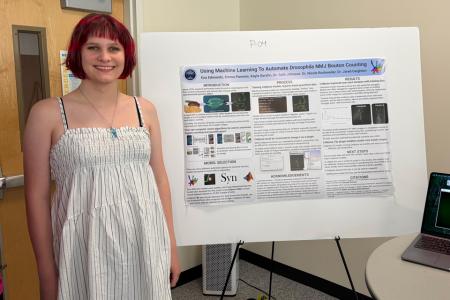
Johnson, who had no previous experience using Artificial Intelligence (AI) or machine learning in his research before, worked with biology and computer science student Ena Edmonds ’28, as well as CDMS faculty members Nicole Rockweiler and Jared Deighton.
While machine learning falls under the AI umbrella, there are important distinctions. AI often refers to large language models (LLMs) that can generate text and images, while machine learning systems are focused tools often used in research settings to perform certain functions.
To support Johnson’s lab research, Edmonds worked with CDMS faculty to create a tool for counting the number of neurons in the peripheral nervous system of the fruit fly and seeing how the sizes of those neurons change under different genetic or environmental conditions.
“The majority of the research we do involves getting these microscopic images of the neuromuscular junction of the fly and quantifying the neurons,” says Edmonds. “We had this process in our lab workflow, but we had to do most of it by hand. There was a tool, but it was unreliable and difficult to use.”
Edmonds turned to her prior experience as a technician at a local pharmacy.
“A lot of pharmacies now have automated systems that verify that you’ve counted the correct number of pills using a machine learning algorithm,” says Edmonds. “When Professor Johnson came to me with this problem, I was thinking of similar algorithms that could be combined to automate the process in the lab.”
To do this, Edmonds used a computer vision model: a pre-existing AI algorithm designed to interpret visual data.
“These are already prevalent in research, so you don’t need to start from scratch,” says Edmonds.
The team opted for Cellpose, a general algorithm used for cellular segmentation.
“It was created by a separate team with a lot more people and resources who made a program good at counting whole cells,” says Edmonds. “We took that version and trained it with our data.”
To train this general model for their specific need, Edmonds and two other students, Emma Parsons ’26 and Kayla Serafin ’28, assembled a training data set. Their work was used as a model to show the algorithm the correct output.
“We only needed to use 97 images to make it specialized for our task,” says Edmonds, who describes the current version as “student accurate, but what would take a student 15 minutes per image, the algorithm can do in seconds with the same or higher level of accuracy.”
Edmonds sees clear applications for machine learning across laboratory research.
“People have this idea that these models need a supercomputer to run them. While you need intensive computing to train the model, once that training was done, we could run it on any laptop,” says Edmonds. “It’s not only powerful but accessible.”
Biology research often relies on repetitive, pattern-seeking tasks. “When we amass enough data, the algorithm can quantify it efficiently. As a student interested in research and computational biology, machine learning is very interesting to me,” she says.
Johnson was impressed by the results of the students’ work. “Before this summer program, we didn’t have a great way to quantify or count that size measurement,” says Johnson. “It’s the first time machine learning has been used to generate something like this, so it’s potentially useful for other researchers as well.”
Benefits of Interdisciplinary Research
Funding for the STARS program over the past two summers was provided by a bequest from Simmons alumna Lois O'Grady ’58 that established a fund that supports science majors engaged in research projects with Simmons faculty members.
Many of these students will continue their research in the fall, through capstone projects or independent studies in the same labs. Johnson and Edmonds are considering publishing the tool to make it more widely available.
Johnson and Edmonds’s project demonstrates just one example of how machine learning impacts faculty-student research. Associate Professor of Biology Eric Luth, Assistant Professor of Psychology Kelsea Gildawie, Assistant Professor of Biology Ling Xin, and CDMS Assistant Professor Lauren Trichtinger also participated in the program.
That interdepartmental collaboration was invaluable for Edmonds.
“An understanding of computer science supports a lot of lab work,” she observes. “I hope that students with interests across departments will talk to their professors about interdisciplinary research. There are so many opportunities in the research labs at Simmons.”