

For Simmons School of Library and Information Science students who are also working parents, earning a graduate degree requires creativity and flexibility. Many move at their own pace or dive into coursework when time allows.
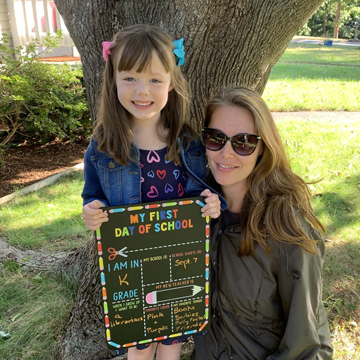
"I'm able to take one graduate class at a time with my schedule," says Master of Library and Information Science online student Carey Zigouras '28MS, who is a parent to a 10-year-old and a full-time access services manager for an academic library. "I'm crawling toward the finish line, but I'm getting there."
Simmons' library science programs — offered on campus, online, and hybrid — help students balance graduate school with work and family. For Zigorouas, the flexibility of the program's asynchronous online classes has been invaluable.
"It's worth its weight in gold when you're a working parent," she says. "My schedule is dictated by my child and my job. I complete a discussion post, read a research article, or crunch away at a paper during lunch break at work, or during my daughter's violin lesson, or after she goes to bed."
Whitney Pillow '26MS enrolled in the master's program when her first child was a baby. "For me, it was the perfect time. I was so tired the first couple of months, but after that there's just a lot of time to sit. I was forced to be still, to not be as social or committed to other hobbies at the time."
Pillow managed to complete her studies in two years while working full time. "Usually, I was doing my work between nine o'clock at night and midnight. It was great to have time to myself in the quiet house to do work that was intellectually stimulating."
Building a Village
"People say it takes a village to raise a child, but I don't know many people who have that," says Zigouras, who spent the first five years of her child's life as the stay-at-home parent, without the support of family living nearby year-round.
"Being a parent can be isolating, especially if you're at home," she says. "I had to create my village. I was at my public library doing every free activity you can possibly do, and discovered a family network group. We would take care of each other's kids during doctor's appointments."
Since Zigouras started the program, that network is all the more crucial.
"If I have an assignment, I have people to ask for help. It makes other people feel helpful and gives me a break. Part of self-care is maintenance," she advises. "Start taking care of yourself right now; don't wait until you're super overwhelmed. The library was a godsend for me, and also offered the chance to build literacy habits with my child."
Once accepted into the program, Zigouras met Professor Lisa Hussey, her faculty advisor, via Zoom.
"We talked about my potential path through the program. I told her that I would like to study abroad in South Korea. Professor Hussey has opened me up to a world of other pathways I hadn't considered," she says. Meeting with her faculty advisor or the staff in SLIS Advising has been useful for planning ahead and figuring out what courses to take when.
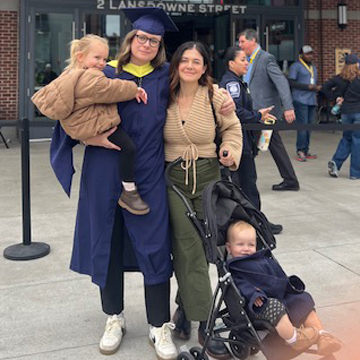
Pillow also connected with Professor Hussey, as well as Associate Professor of Practice and SLIS West Director Eric Poulin and Assistant Director of Operations, School of Sciences and Health Professions Gretchen Peterson, who was "a champion for me," says Pillow. "When I was overtired and in despair about needing to write a 20-page paper, she would cheer me on."
Thanks to Moodle, an online learning platform, the course outline and syllabus are released at the beginning of the semester, along with due dates for all assignments. Both Zigouras and Pillow appreciated the transparency of expectations, and the ease of contacting faculty.
"I didn't have a lot of time, so I needed all of that detail," says Pillow. "I felt like I could connect with them at any time." A year into the program, when her wife gave birth to their second child, Pillow felt comfortable reaching out to her professors to request extra time for assignments.
The Impact of Graduate Studies
Zigouras can see how her work in the program has enriched her position as an academic librarian, and her role as a parent.
"I love taking classes. In my day-to-day work, I rarely have time to reflect or immerse myself in theory and research," she says. "I'm setting goals for myself and putting in the work, and it's important that my daughter sees that. I can't think of a greater gift to give her, and to myself. I want to show her what it means to be intellectually curious, to have an open mind, to develop emotional intelligence, and to take on challenges. It gives me a lot of pride."
For Pillow, the library and information science (LIS) degree offered a pivot toward a more family-friendly work schedule.
"For 12 years, I traveled three out of every four weeks," she says, of her previous position with her current company. When her first child was born, she took a job in Information Technology, which led her to pursue an LIS degree.
"It made sense to shift out of that life and go to a library science job and have my kids while working in an academic space. I'm doing this for myself and for them, to have more time with them in the future," she says. Pillow recalls the hours she spent reading scholarly articles by a small reading light while holding a sleeping baby. "They make me so much more grateful."
Advice for Parents Considering a Degree
"If you think you can start school with children of any age, that you have the emotional and mental capacity for it, you should do it," says Pillow. "When I told people I was going to start the program, my wife was pregnant, and we had a 1-year-old. We got a lot of confused looks, and people advised against it. Intentionally or not, there was a fear being instilled in me. Instead, what I needed was support. Yes, it's going to be hard, but that will make it even more of an accomplishment."
Pillow also notes that SLIS faculty were helpful in advising the "weight" of particular courses.
"Professor Wisser told me not to take "Information Organization" (LIS 415) with two other classes, and she was right about that," says Pillow. "Some semesters you may be able to take one course and others you can take three. Or take a summer off for rest and reprieve. You can make it work for you."
Zigouras has found ways to turn the inherent challenges into opportunities for growth and structure.
"There are times when I have to slow down. I know the sink is full, the laundry is piled up, but I need my daughter to know that no matter how busy I am, I can give her what she needs. It might be just to play a game of UNO before bed," she says. "If I really have to do an assignment, I'll ask her to take out her drawing and work next to me. Sometimes that's enough. We sit and do our work together and drink cocoa, and she gets a sticker as a reward. That's rewarding for both of us."