
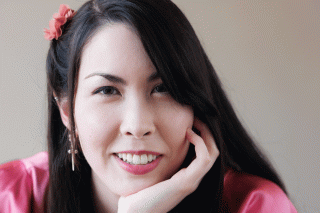
Kylie Lee Baker ’22MS was destined to write horror.
We last interviewed Baker in 2021 after the publication of her debut novel, The Keeper of Night (Inkyard Press/HarperCollins, 2026), a dark historical young adult fantasy. Since then, Baker completed her master of library and information science degree at Simmons University School of Library and Information Science. She published a sequel to her debut, The Empress of Time (Inkyard Press/HarperCollins, 2023), and a second fantasy duology: The Scarlet Alchemist (HarperCollins, 2024) and The Blood Orchid (HarperCollins, 2024).
Last year marked a departure from young adult fantasy with her adult horror debut, Bat Eater and Other Names for Cora Zeng (Mira-Harlequin, 2025), a haunting and socially incisive response to the wave of anti-Asian hate that erupted post-pandemic. Her latest novel, Japanese Gothic (Hanover Square Press, 2026), further solidifies her name in the horror genre.
Entering the Horror Landscape
“I’ve always wanted to write horror. I feel like horror was my first language,” says Baker. “It’s what made me love reading as a teenager, when I cleaned out the library shelves of mass market paperback books.”
While at Simmons, Baker created a LibGuide, “Analyzing Horror Fiction, a guide to critical analysis of both classic and contemporary horror fiction,” as a project for her reference class.
Writing horror, however, felt intimidating.
“It’s hard to scare someone in a book,” she says, having experienced her most effective scares in horror movies. “I didn’t think I would be good at it, so I focused on dark fantasy instead. Then someone read my fantasy and told me, ‘This is terrifying!’ I thought, what would happen if I actually tried to write horror?”
That experiment first led to Bat Eater, the story of a young Asian woman living in New York City who spends her days cleaning crime scenes and notices a string of young, female, Asian murder victims.
“I’m inspired by what horror authors are doing these days,” notes Baker, who studied contemporary horror authors, such as Stephen Graham Jones, Grady Hendrix, Chuck Wendig, and Catriona Ward, to inspire her work.
“They create these vast, complex worlds, with these twisty, unreliable narrators,” she says. “It’s so different from the straightforward horror that I read as a kid.”
(Mis)Conceptions of Modern Horror
In addition to fiction, Baker has been watching horror movies all of her life. “They are deeply embedded in my subconscious,” she says, noting that Bat Eater follows similar beats to the horror movies she’s enjoyed all her life.
For her second adult novel, Japanese Gothic, Baker leaned into some of the experimental, epic, and genre-bending elements of contemporary, “literary” horror — though she does take issue with the label itself.
“Literary horror — it’s more of a marketing label than anything else,” she says, noting that Bat Eater was marketed as a crime thriller in the UK. “In general, horror has been misunderstood by the mainstream media, but people are starting to pay more attention and a bit more respect than they used to. That label, literary horror, may play a part in that.”
What does that label, though inadequate, denote to Baker? “It seems to signify something literary but with ghosts! Though it could also refer to dialing down the gore enough to appeal to an audience who doesn’t normally read horror. When people tell me that they read and enjoyed my book, and they don’t usually read horror, that makes me happy.”
In spite of mainstream misconceptions of horror as an inferior art form, Baker is well aware of the genre’s strengths.
“Horror has always been a way to say very meaningful things about society,” she notes.
That said, as a byproduct of the increased popularity of horror films, there are those eager to cash in on the success without understanding it as an art form. While Obsession (Blumhouse, 2026) is her favorite recent movie, she’s also returned to Asian horror classics, including Dark Water (Kadokawa Pictures, 2002) and Pulse (Daiei Film, 2001).
“A lot of Asian horror like these films is very slow-burn in a way that I think audiences today wouldn't tolerate, but can really help you become immersed in the experience,” says Baker. “I also think these films rely more on creative camera angles and lighting to scare viewers, rather than jump scares.”
Researching History for Fiction
Regardless of what genre she writes, Baker’s background in library and information science supports her current role as a full-time novelist. Her penchant for research and her ability to imbue fantastical worlds with historical accuracy are evident.
“My concentration at Simmons was Archives Management, which got me very used to seeking out primary sources for my research,” notes Baker. “When I was writing The Scarlet Alchemist, I was working at the Burlington Public Library. I needed basic information about the Tang Dynasty [China, 618 to 907 AD] — not just what happened, but if my character were standing on a street, what did it look like?”
She often found useful foundational information in books written for children, noting that the library was the perfect place for a researching author. “Every time I went to work I would check out so many books and put in requests for interlibrary loans from all the college libraries in the area.”
Baker’s research has spanned history and folklore, but when she began to write Bat Eater, she assumed it would be a lighter lift. “I thought, surely, writing a book set in the 1800s in Japan would require more research than writing a book set in New York City in 2020,” she recalls, “but I was shocked at times by how much research I had to do! New Yorkers are very proud of their city.” Regardless of the time period she is researching, Baker’s goal is to “make the setting accurate enough that it won’t be distracting.”
For her most recent novel, Japanese Gothic, her research began with the samurai, especially in the wake of the Satsuma Rebellion of 1877, after which the samurai class was abolished by the imperial government of Japan.
“I thought it was an interesting place to start the story, from the rubble of the lives of the former samurai, and the yearning for what was lost.” Baker’s interest in writing about samurai was further piqued by the FX series Shōgun (2024). Of course, she would need to put her own spin on the story: Sen, one of two main characters in the novel, is a female trained by her samurai father. “Writing about a female samurai made sense for me,” says Baker. “I like writing about badass women with swords.”
Stretching her Fictional Range
In spite of (or, in addition to) this pull toward “badass women,” Baker says that she is “a very unserious person, generally. I like fun, and I want to lean into that part of myself, too.” Which is where one of her lightest books emerged: I'll Find You Where the Timeline Ends (Feiwel & Friends, 2025), which was published after Bat Eater.
“I wanted to try something different, to show that I’m not always doom and gloom,” she says. “I was interested in writing a book that takes place in Korea, having lived there for two years. I had researched ancient China and ancient Japan, and a friend asked if I was going to write about Korea, about things I had actually experienced. I thought, I can’t, I’m not Korean. He reminded me that not everyone living there is Korean, either.”
The result is a magical young adult “romantasy,” (a popular mash-up of fantasy and romance genre fiction), admittedly a sharp turn from her previous books. “I wanted to show what I love about Korea in a scenario that would fit in a K-drama.”
However, Baker isn’t done with horror. “I've gotten really interested in horror that's also humorous, because of how it reflects how absurd society can be.” Movies like The Menu (Searchlight, 2022) or Ready or Not (Fox Searchlight, 2019) fit the bill. “I particularly love it if rich people are the butt of the joke,” she says.
Her next novel, the darkly humorous Hell to Pay (Hanover Square Press) will be released in March of 2027, with another adult horror novel to follow in 2028.
“I don’t always want to write the exact same story or type of story,” says Baker. “I want to grow and write different types of books, but horror will always be there for me.”