
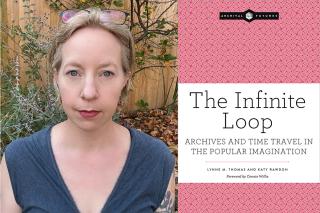
Temple University librarian Katy Rawdon ’97MS recently co-authored a book that brings together science fiction and the central role of archivists. We spoke with her about the book and the essential training she received at Simmons School of Library Science.
“Our book is an analysis of archives as they are portrayed in fictional time travel stories, regardless of format, which include books, movies, television, and other kinds of fictional portrayals,” says Katy Rawdon ’97MS, who serves as librarian and coordinator of technical services within the special collections research center staff at Temple University (Philadelphia). At Simmons, Rawdon obtained a master of science in library and information science with an archives management concentration.
In their book, The Infinite Loop: Archives and Time Travel in the Popular Imagination (ALA Neal-Schuman and the Society of American Archivists, 2026), which was recently featured in ALA News and on the Circulating Ideas podcast, Rawdon and co-author Lynne M. Thomas address different understandings of time and place — particularly through a science fiction lens — and analyze them vis-à-vis archives and archivists.
“Our analysis informs archivists, writers, and users of archives in all their different kinds of work.”
The book belongs to the Archival Futures book series, a joint publication effort between the American Library Association (ALA) and the Society of American Archivists (SAA).
“The purpose of the series is to underscore the importance of archives and record-keeping and how archival work is embedded within justice and philosophical issues,” Rawdon says.
“Both Lynne [a librarian and well-known science fiction editor] and I are very interested in time-travel narratives, and we thought that these shared interests could be a fruitful topic. And I have always been a Doctor Who fan as well,” she adds.
As part of their joint research process, the co-authors read and viewed a massive volume of time-travel stories, both those that included depictions of archives and archivists, and those that did not. Then they narrowed down the sources to those that generated the most fruitful discussions.
When co-writing the book, Rawdon relished the collaborative process.
“I absolutely cannot think of a better co-author than Lynne. It was a real process. We went through a few iterations of the proposal, and then co-wrote and edited the book,” she says.
Representing Archives and Archivists
The book title, The Infinite Loop, contains layers of significance.
“In many ways, time travel is an infinite loop itself, and the way archives work can be seen as an infinite loop: we are accessing, processing, re-processing, and giving back to patrons. It’s really a loop of repetitive work that we do over the course of our careers,” Rawdon explains.
The book also addresses inaccurate portrayals of archives and archivists.
“Archivists love to complain about how they are depicted and portrayed. We are all familiar with those articles that get published about a scholar who has unearthed a source in a particular archive,” Rawdon says. “But, in fact, the reason they found that material is because an archivist processed it, preserved it, and made it available for research. Archivists’ work is not usually deemed important, but we are doing essential work that has real-world consequences.”
In addition to examining representations of archives and archivists, the book explores cultural perceptions of time, the ways in which archival work is tied to perceptions of time and history, and how cultural biases can affect the historical record. The writers attempt to connect these ideas to practices that encourage critical thinking about archivists’ methods and work.
Ultimately, The Infinite Loop demonstrates how history is a social construct.
“We address the fact that history is something that is created,” Rawdon explains. “History is created by the things that we preserve, the things that we have written down, the things that have been captured, and the things that have been deemed important enough to maintain. History is not neutral; it does not exist outside people’s choices and biases.”
The co-authors hope their text will be useful for archivists and librarians, as well as lovers — and writers — of science fiction, and the general public.
Essential Training at Simmons SLIS
Rawdon heard about Simmons School of Library and Information Science (SLIS) through her mother, Janet Rawdon ’82MS, who pursued a master’s degree in library and information science when Katy was a child. (Her mother ended up being a school librarian, and later, an adjunct professor at SLIS).
“My mother literally handed me a Simmons course catalog, which in the 1990s was printed, and she suggested that I should go to library school,” Rawdon recounts.
While obtaining a double major in art history and women’s studies from Smith College, Rawdon developed an interest in archives. She eventually had a conversation with the then-SLIS archives management program director, Professor Megan Sniffin-Marinoff.
“The program sounded fantastic, and I realized that it would set me up in archives, or any other area of librarianship that I wished to pursue,” she says. “I was familiar with the Boston area, so Simmons was just a no-brainer for me.”
While at Simmons, Rawdon enjoyed the archives management courses, especially those taught by Sniffin-Marinoff.
“Archives and archival work were a whole new world to me,” Rawdon says. “While I had done research in the archives in college, learning about the actual work and profession was like drawing back the curtain on a mystery that I definitely wanted to be a part of. I have always loved organizing things, and learning about pieces of the past I’d never known about before. Archival work just felt like where I belonged.”
Furthermore, she appreciated the “Advanced Cataloging.” As Rawdon relates, “Learning cataloging helped me significantly in my job search. Part of my archivist ‘superpower’ is that I know a lot of cataloging and description containers and systems.”
Outside the classroom, Rawdon performed two internships at Harvard University’s Houghton Library and the Newton Historical Society. “Being able to spend time working at those institutions helped me figure out what path I wanted to take in archives, which was really helpful.”
She also worked at the Coolidge Corner branch of the Brookline Public Library throughout her Simmons studies.
Library Career Preparation
In her current role at Temple University, Rawdon works predominantly in technical services, including coordinating archival accessioning, archival processing and description, rare book cataloging, preservation, and stacks management. She also occasionally teaches classroom visits to the archives.
“Simmons did an incredible job in a short amount of time, preparing me for this career,” Rawdon reflects. “I was only at Simmons for a year and a half, and I didn’t really know anything about libraries before then. But even the basic required classes for all students — research methods, cataloging, reference, and then moving into the more specialized classes — were extremely helpful.”
In addition to her day job, Rawdon writes romance novels under the pen name Katy James.
“I do think of that as my second job,” she says. “Writing is something of an escape for me, but being on that side of the publishing industry has been interesting as a librarian, to really understand how books are created from idea to publication.”
Her most recent book is titled The Grump Whisperer.
Learning Broadly
As for words of advice to aspiring archivists and librarians, Rawdon emphasizes the value of a broad understanding of the field.
“Even if you think you want to be a particular kind of librarian, learn more broadly, including opportunities related to public librarianship and cataloging,” she says. “Everything about our jobs is interrelated. You never know what skills employers will want, or what skills will be useful not only in your job search, but also throughout your career.”