
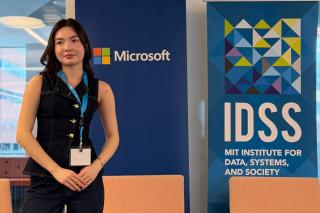
“I enjoy being at Simmons because I enjoy being in an environment that supports women in STEM,” says Nailya Alimova (Alim) ’26.
An international student from Kazakhstan, Alimova hadn’t expected to declare three majors when she came to Simmons. “I intended to be an economics major but then switched to three programs at the Department of Computer, Data, and Mathematical Sciences,” she says. She graduated in May with a triple major in financial mathematics, mathematical sciences, and data science and AI.
“It was a gradual decision to do a triple major. They all contain a mathematics component,” she notes. “Committing to such a workload is not scary when you have so much support from the professors.”
Specifically, Alimova credits Professor of Computer Science and Mathematics and Program Director of Mathematical Sciences Margaret Menzin, Professor of Mathematics Donna Beers, and Professor and Program Director for Economics Niloufer Sohrabji for their support.
Internships and Fellowships
Since beginning her studies at Simmons in 2022, Alimova has engaged in a number of internships and opportunities. The first one took place in her home country.
“After my second year at Simmons, I became an AI specialist at a private bank in Kazakhstan,” says Alimova. “I helped deploy an AI-powered chatbot for customer service.” The bilingual chatbot was recognized as the bank's Best IT Project of 2024.
In 2025, Alimova became a data analytics intern at Resolute Management, Inc. at Berkshire Hathaway, an insurance company in Boston’s financial district. Over the summer, she was an AI/ML (artificial intelligence/machine learning) research fellow at the Massachusetts Institute of Technology (MIT) through the Break Through Tech AI program.
“I had the opportunity that summer to take a class in machine learning at the MIT Schwarzman College of Computing,” says Alimova. “The program was created to give additional AI research opportunities to BIPOC students and women.”
Since then, Alimova has continued to work part-time at Berkshire Hathaway, and to attend monthly meetings at MIT to engage in a hands-on project with OpenAI. “We developed a large language model from scratch,” she says. Though hers was the last cohort to attend the program in person at MIT, the program will continue online.
Learning How AI Works
Alimova’s perspective on AI is unique for its practicality.
“It’s not magic,” she says. “It's just code that finds patterns within massive data volumes at high speeds. My intention [at the MIT fellowship] was to learn how AI works from the inside.”
Alimova refers to the “black box” of AI, a term used to describe a system with internal workings that are hidden from users. While there is inherent risk in using such technology, she is keen to learn as much as she can so that it may be used ethically.
“I wish that more people and more companies knew that AI is not a magic solution to do everything,” says Alimova. “Automation may give you opportunities [to streamline work], but it is still a developing technology. It still has inaccuracies and hallucinations.”
Those hallucinations, she says, are part of the “black box” problem.
“If an AI doesn't have the data to answer a question, it will still generate a response that sounds correct. That is a hallucination,” she explains. “We can’t track where there is a broken or missing piece of information, which can make hallucinations very costly if companies are replacing employees with AI.”
Researching the Economic Impacts of AI
These interests developed into a project for “Econometrics” (ECON 393), taught by Professor Sohrabji, researching the impact of AI on unemployment.
“Initially, I focused on four European countries and the US, but I narrowed it down to the US specifically, because the impact of AI is more profound,” says Alimova. However, finding data that might measure the specific impact has been a challenge. “Starting in 2024, there was little to no data to measure the AI impact. Only one study attempted to address this, using high-tech exports to gauge the technology's effects. I used this metric in my econometrics study.”
Given these difficulties, she shared her concerns with Professor Sohrabji. "I worried my topic wasn't relevant because data and peer-reviewed papers were so scarce. But Professor Sohrabji reminded me that even if the statistics don't show a clear trend, starting the conversation is valuable in itself."
After Alimova shared her work on LinkedIn, she was invited to present her findings at Oracle, an information technology services and consulting firm in Burlington, MA. When she delivered her presentation in August 2025, she stated that there was no definitive trend linking AI development to unemployment. Alimova notes, "If AI is affecting structural unemployment [caused by a large-scale mismatch between worker skills and job requirements], it is hard to trace. However, it will become easier to track with each passing year."
That big tech companies are talking about the implications of these changes in the workforce is a move in the right direction.
“It’s a point of ongoing research to see if the trend is changing. Even if there is no statistical evidence that it is happening, the fear that AI will steal your job is already worth talking about,” says Alimova. “I think we should develop AI with a realistic framework for implementing it. That’s hard to do with something so new that the wider public struggles to fully understand.”
The challenge of researching the topic has resulted in a treasured memory for Alimova. “My favorite Simmons memory was being supported by Professor Sohrabji to pursue [research on] the controversial topic of AI.”
Advice for International Students
For international students considering applying to Simmons University, Alimova has valuable advice.
“Attending Simmons was a great decision for me,” she says. “The most valuable element is the mentoring I’ve received from my professors. I would recommend Simmons if you are looking for a place where you are supported as a woman in STEM.”
Looking back, Alimova is amazed at all that she was able to accomplish during her time at Simmons.
“When I first came to Simmons, I was a shy student with a heavy Russian accent, but the environment was incredibly supportive,” she says. “The small class sizes allowed for personalized attention and support that was really important to me.”