
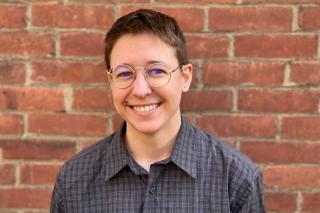
Mik Hamilton '24MS ‘24MA is the archivist at Queer History Boston, a community archive dedicated to collecting, preserving, and sharing the rich LGBTQ+ histories of Boston and New England. Hamilton shares how the dual degree in library and information science: archives management and history at Simmons prepared them for a dream job just before graduation.
Mik Hamilton ’24MS, the archivist for Queer History Boston, has long been drawn to lesser-known histories and untold stories. In the archives of Queer History Boston, underrepresented stories and histories abound.
Hamilton’s first exposure to archival work was through a work-study job as an undergraduate at Cornell University. A formative project involved working with the Honey Lee Cottrell papers, a collection of queer and lesbian photography.
“We were actually able to bring in community members to spend a whole week with us at the archive to fill in context and metadata for the photographs, which was an unusual practice for an institutional archive,” Hamilton remarks. “It was a fun way of activating the collection, of creating a more participatory archival practice. I realized that I loved working with community members to contextualize historical materials in their own words, and that this community-grounded approach was one way to address institutional biases in collection and description.”
Cornell also had one of the earliest university archives of sex and sexuality in the United States, the Human Sexuality Collection. “I was really interested in the story of archival silences, addressing underrepresented stories and histories, and remediating that through archives.”
The Dual Degree at Simmons
That interest in archives and history, as well as familial links to Massachusetts, made the library and information science: archives management (MS) and history (MA) at Simmons School of Library and Information Science (SLIS) an obvious choice.
“There are so many cultural heritage institutions [in the Boston area] to make connections with, and I was impressed by the dual degree program,” says Hamilton, who liked the range of theoretical and practical skills the courses offered. “It made me a well-rounded and prepared archivist and historian.”
That preparation was key when a position as an archivist at Queer History Boston was available just before Hamilton’s graduation.
Queer History Boston
“Our goal is to keep the material local and locally accessible,” Hamilton says of Queer History Boston (QHB), which was founded in 1980 as an all-volunteer history project.
“In its early years, Queer History Boston was collecting oral histories and materials documenting early Boston history, researching existing libraries and archives, and reading against the grain to find queer people in institutional archival collections,” Hamilton says.
QHB began creating its own archives of collected materials, as well as pathways to find materials at other institutions.
“My work is to address the gaps that can be left by institutions, and we try to be community-grounded and volunteer-driven, really accessible and responsive,” Hamilton says. “We do a lot of community collaborations, and we try to uplift stories that haven’t always been told.”
In particular, QHB spotlights queer and trans voices, as well as queer people of color. “We do public outreach and education, offering free reference services and free visits to the archive. We also offer group visits, classroom visits, walking tours, historical lectures, exhibitions, and much more.”
Hired in 2024 as a processing and digitization archivist, and later becoming director of archives, Hamilton is one of three employees at the otherwise volunteer-run organization: Executive Director Joan Ilacqua and Director of Engagement and Advancement Matisse Dupont.
“That leaves me to manage the entire archive, which is a lot!” When Hamilton began a few years after the pandemic, the archives-specific volunteer pool was still thin. “I’ve been revitalizing the volunteer group. We wouldn’t function without volunteers. Simmons students have been helpful. I’ve had three placements from the SLIS archives program, and all of them have been great.”
Working with volunteers and visitors is Hamilton’s favorite part of the job. “It’s nice to have people excited to be there, excited to see what you have and to help out. I like working with researchers, educating and sharing knowledge. Connecting people with the resources they are looking for is very rewarding.”
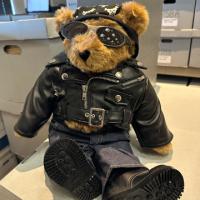
Given the backlog of items that need to be cataloged, Hamilton is still discovering the collection. “I love finding nuggets of history,” they say.
A recent favorite: a teddy bear wearing a leather jacket and leather boots, created as a tribute to Woody Woodward, an activist and member of Moving Violations, a lesbian motorcycle group. Woodward raised funds to support breast cancer and HIV/AIDS research before her death in 2009.
The Simmons Preparation
Jumping immediately into a solo archivist role before graduation was a challenge, but Hamilton felt well-prepared for the task.
They recall “Introduction to Archival Theory and Practice” (LIS 438) with then-Simmons University Archivist and Deputy Director Jason Wood '01MS, '11MS. “He gave me the handbook for how to manage an archive, and then I found myself managing an archive freshly out of graduate school.”
The practical aspects of Simmons courses were particularly useful. In “Moving Images Archives” (LIS 472), “We were presented with a project: you’ve found a box of AV [audiovisual] materials in a closet, what do you do with it? That prepared me for finding many boxes of AV materials in many closets.”
Outreach and Involvement
Hamilton also took advantage of local organizations while at Simmons, attending New England Archivists and Society of American Archivists conferences. They encourage current students to connect with the wider LIS community, and with their classmates.
“You end up with peers as your colleagues once you graduate,” Hamilton says. “It’s a built-in network of peer support once you’re in the workforce.”
For students interested in engaging with community work, Hamilton says, “there are so many wonderful organizations [in the Boston area]. Reach out and talk to the people involved to get an idea of what would be a good fit for you.”
If you find an organization whose work aligns with your interests and values, Hamilton urges, “Don’t be afraid to cold email people and ask for an informational interview. Tell them that you like what they are doing. You can be persistent, too. As a student, if I emailed someone and they didn’t get back to me, I was too afraid to reach out again. Now that I’m on the other side, if someone sends a second or third email as a nudge, I know that they really want to talk to me! Polite persistence isn’t a bad thing. It demonstrates sustained interest.”
Where you can find Queer History Boston this June
Reading Between the Stones: Interpreting Edmonia Lewis through an LGBTQ+ Lens
June 3, 6–8 pm
Museum of African American History
Boston Dyke March
June 5, 6 pm
Parkman Bandstand on Boston Common
Boston Pride Festival
June 6, 11 am
Boston Common
Black Queer Film Screening
June 7, 2–4 pm
Museum of African American History
Mount Auburn Cemetery LGBTQ Pride Walk
June 14, 1–2:30 pm
Mount Auburn Cemetery
Button Making at Juneteenth!: A Block Party celebration
June 19, 10 am–5 pm
Museum of African American History, Myrtle Street to Cambridge Street
Queer History West End Exhibit Opening
June 17, 6 pm
The West End Museum
Queer History West End Pride Party
June 26, 6:30–8:30 pm
Dorchester Brewing Company