
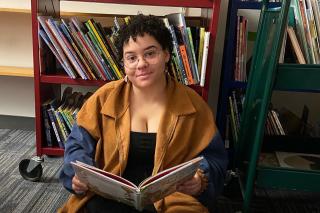
Rosie Lopolito ’29MA/MS shares how a diverse array of experiences led her to the Children’s Literature (MA) and Library and Information Science (MS) dual degree program at Simmons University.
Lopolito had completed her undergraduate studies in English literature and, feeling burned out by academic work, decided to take a gap year before continuing her education.
“During my gap year, I interned at an animal shelter, worked at a library, worked at a haunted house, and served in AmeriCorps,” recalls Lopolito. “I sampled a whole bunch of things!”
Working in youth services at the St. Louis Public Library in Missouri, “felt like home, like I belonged there,” she recalls. “When I talked to my parents about it, they said they knew that I would be surrounded by books, in some capacity.”
Her search for library and information science master’s programs led her to the Children’s Literature (MA) and Library and Information Science (MS) dual degree program.
“I was really scared to apply. I was worried that I wouldn’t feel comfortable in academia anymore. But walking into my first class, “Criticism of Literature for Children” (CHL 401) with Professor Cathryn Mercier, all of my nerves melted. I felt at home,” she says.
What is Metafiction?
This spring, Lopolito took Mercier’s course “Metafiction & Self-Reflexivity” (CHL 436C), which has been a revelation.
“I was into metafiction from a very young age, even if I didn’t know what it was called,” says Lopolito. “My parents used to read The Monster at the End of this Book [written by Jon Stone, illustrated by Michael Smollin, Little Golden Books, 1971]. It’s exciting to see the different ways that metafiction can work.”
The class was visited by author/illustrator David Wiesner, who has received three Caldecott Medals for his wordless picturebooks. “I was just starstruck, he was so cool! Cathie seems to know everybody in the [children’s literature] world,” she says.
However, metafiction can exist in all types of fiction, across all audiences. “My professional definition of metafiction is a text that draws attention to its own construction.”
Lopolito says that a work can have metafictional elements — such as when the narrator of Charlotte Brontë’s Jane Eyre directly addresses the reader — but that doesn’t make it a work of metafiction.
“For me, metafiction is play. A willingness on the part of the reader, the author, and the illustrator, to play,” says Lopolito.
Combining Coding and Metafiction
Lopolito was inspired to apply the skills she was learning in her LIS coursework to a final project for her metafiction class. Specifically: using HTML code to build a website.
“I wanted to take some of that knowledge and apply it to metafiction, because I think the structure of hyperlinks and embedded information can create really cool loops, where you click on a link and think you know where it goes, but it actually leads somewhere else,” she says. “Not best practice [for coding], but it manipulates the audience [like metafiction].”
To that end, Lopolito made a metafiction videogame modeled on the Choose Your Own Adventure book series published by Bantam Books in the 1980s; another good example of metafiction, and hugely popular during Lopolito’s childhood. “They are written in the second person, so you are the protagonist of the book,” she explains. “As the reader, your actions have consequences — it’s up to you to choose to turn to page 22 or 60.”
Lopolito used a software called Twine to create the text-based game, with plenty of advice from Professor Naresh Agarwal, her instructor for “Technology for Information Professionals” (LIS 488), along the way. “It felt really good to be able to combine classes like this.”
Also inspired by tabletop role-playing games, Lopolito’s video game begins in a tavern — one of many classic Dungeons & Dragons tropes that she enjoyed including in the project. “A person in the tavern is trying to submit a final essay for a class in metafiction,” she says. “The plot of the game is that you are trying to fix this person’s laptop.”
Along the way, players encounter Dungeons & Dragons characters and puzzles to solve. “There are two essays embedded in the game,” says Lopolito. “One is the final project of the person in the game. The other is my final essay, which is a commentary on the game itself.”
Lopolito had to learn a lot as she went through the process, but didn’t let it stop her. “I see cool things and try to reverse engineer them,” she says. “I’m driven by curiosity. Plus, I use my librarian research skills until I find answers!”
Book Nook and Makerspace
On campus, Lopolito loves hanging out in the “book nook” in the Children’s Literature office, where students often congregate. “I feel a connection to people on campus, partly because it’s so small. All of my professors know me because they don’t have a class of 300 students to deal with. I like the tight-knit community.”
In addition, Lopolito works on campus in the Makerspace, where she guides visitors through using available craft supplies, including the 3D printer and the embroidery stitch settings on the sewing machine. “I love the makerspace! There are groups of people who come in regularly. We know each other by name and I ask how they are doing and what they are working on, which is really lovely.”
She encourages members of the Simmons community to stop by whenever they can.
“[It’s fun] to work with physical materials in a communal space,” she says. “In a world that wants you to be productive and be the best at whatever you are doing, it’s good to experiment and be an amateur. You don’t have to be good at something to love it! I'm not trying to win at crocheting.”
Lopolito is enjoying her studies and the community at Simmons, and plans to spread that joy in her future career.
“Given everything going on in this country, and the world at large, children’s librarians are really important! I think the dual degree helps put the importance of [librarianship and children’s library services] into perspective. You are becoming an expert in your field,” she says.
Rosie’s recommendations:
- Goldilocks and the Three Bears: A Tale Moderne by Steven Guarnaccia (Harry N. Abrams, 2010)
- Strega Nona by Tomie dePaola (Simon & Schuster Books for Young Readers, 1975)
- Helga's Dowry by Tomie dePaola (Houghton Mifflin Harcourt, 1977)
- Du Iz Tak? by Carson Ellis (Candlewick Press, 2024)
- Again! by Emily Gravett (Simon & Schuster Books for Young Readers, 2013)
- Drawn Onward by Daniel Nayeri and illustrated by Matt Rockefeller (Houghton Mifflin Harcourt, 2024)
- Flotsam by David Wiesner (Houghton Mifflin Harcourt, 2006)
- Monster by Walter Dean Myers (Houghton Mifflin Harcourt, 1999)
- Dungeons & Dragons: Dungeon Club series by Lee Knox Ostertag and Xanthe Bouma (Houghton Mifflin Harcourt, 2022–2025)
- DnDoggos series by Scout Underhill (Macmillan Publishers, 2024 & 2026)